

Sports betting is not legal in California — not online, not retail, not anywhere in the state. Full stop. Nearly 40 million people live here, the pro sports market is absolutely stacked. However, the Golden State can’t figure out how to let adults put $20 on the Lakers. It’s honestly embarrassing.
I’ve been tracking California gambling legislation since 2019, and every year the story is the same: big promises, tribal politics, massive lobbying dollars, and zero progress. The 2022 ballot disaster burned everyone. So, now the state’s cracking down on the workarounds too. If you’re a California resident who wants to bet on sports, this guide breaks down exactly where things stand, why they’re stuck, and what you can actually do about it right now.
Is Sports Betting Legal in California?
No. Sports betting is illegal in California as of June 2026. There are no licensed sportsbooks operating in the state — no mobile apps, no retail windows at casinos, nothing. California law under Penal Code Section 337a prohibits wagering on sporting events, and that hasn’t changed despite years of failed attempts.
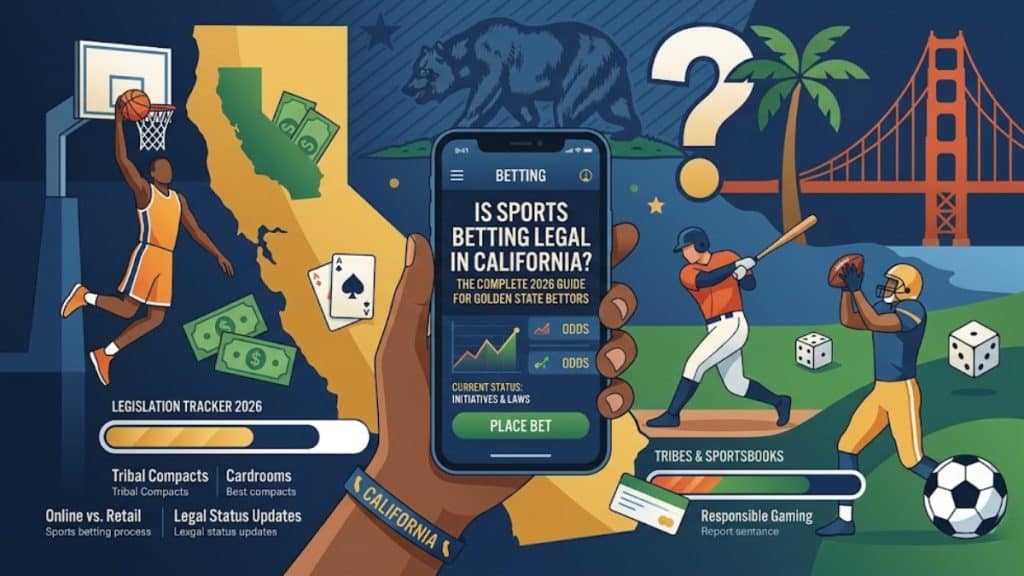
Two ballot measures tried to change this in November 2022. Both got crushed. No new ballot initiative has qualified since, and tribal leaders have publicly said they aren’t pursuing a 2026 measure. The earliest realistic shot at legalization is 2028, and even that’s a maybe.
California is the largest untapped sports betting market in the United States. Forty million people, the Lakers, Dodgers, 49ers, Warriors, Rams, Chargers, Padres, Angels, Kings, Ducks, Galaxy — plus USC, UCLA, Stanford, Cal. The demand is there. The political will isn’t.
What Happened to Prop 26 and Prop 27? Why Did California’s Betting Measures Fail?
The 2022 ballot fight was an absolute trainwreck. Two competing propositions, roughly $460 million in combined campaign spending — the most expensive ballot campaign in American history — and both went down in flames.
- Proposition 26 was the tribal-backed measure. It would have legalized in-person sports betting at tribal casinos and licensed horse racing tracks. Tribes spent heavily supporting it. Voters rejected it by about 68%.
- Proposition 27 was the operator-backed measure. DraftKings, FanDuel, and other commercial sportsbook companies pushed this one. It would have legalized online and mobile sports betting statewide. Voters rejected it by over 83%. Absolute bloodbath.
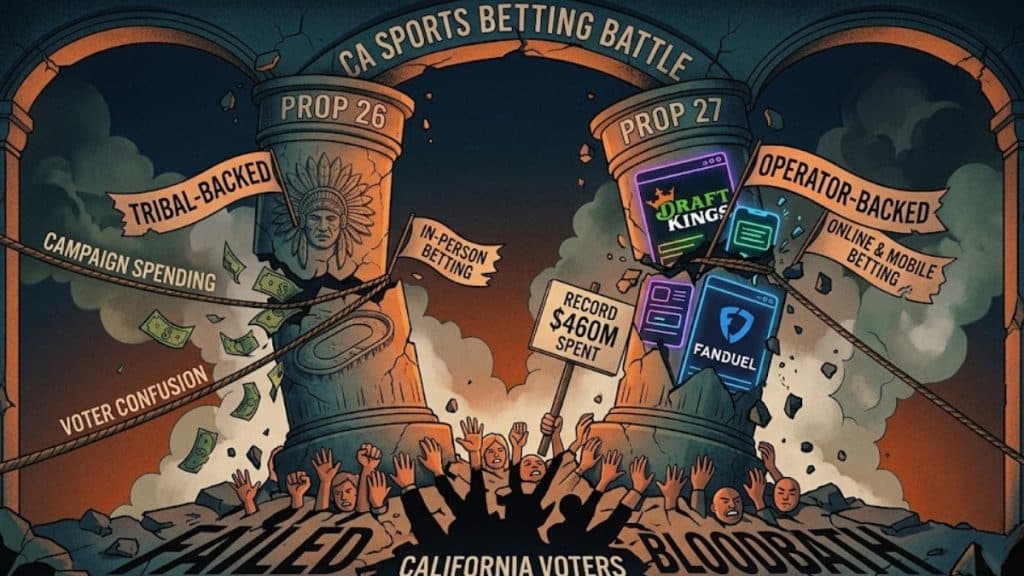
Here’s what actually killed both measures. Californians got bombarded with conflicting ads for months. Tribes ran ads against Prop 27 saying out-of-state corporations were trying to exploit California. Commercial operators ran ads against Prop 26 saying it was too restrictive. Both sides spent so much money trashing the other that voters just said “screw it” and voted no on everything.
We saw the same thing happen in a smaller way in other states — when competing gambling interests can’t get on the same page, nothing passes. But California took that dysfunction and cranked it to a $460 million level. The fallout poisoned the well for years.
Why Can’t California Legalize Sports Betting? The Tribal Politics Nobody Explains
This is the section every other California sports betting guide skips with a sentence or two. We’re not going to do that, because the tribal dynamic is THE reason California can’t get its act together. If you don’t understand this, you don’t understand the problem.
California has 62 federally recognized tribes operating under tribal-state gaming compacts, with 48 of those tribes running active casinos. Another 19 tribes operate under Secretarial Procedures approved by the federal government. That’s nearly 90 tribal casinos across the state, generating an estimated $8 billion in annual revenue. That’s roughly the same as Nevada’s entire gambling industry.
Those tribes have built their economies around exclusivity. Their gaming compacts with the state give them a near-monopoly on casino-style gambling in California. When commercial operators like DraftKings and FanDuel rolled into town in 2022 saying “we want to run online sports betting statewide,” the tribes saw it as a direct threat to their sovereignty and revenue model.
The California Nations Indian Gaming Association (CNIGA) — the largest tribal gaming association in the state — has repeatedly and formally opposed online sports wagering initiatives led by commercial operators. They aren’t budging on this.
But here’s the part that makes it really complicated: the tribes can’t even agree among themselves. Some larger tribes with resort-style casinos — places like Yaamava’ Resort Casino at San Manuel, Pechanga Resort Casino, Morongo Casino — might benefit from offering retail sports betting on their properties. Also, smaller tribes with less infrastructure have different interests entirely. Getting 60+ sovereign nations to agree on a single legislative framework is like herding cats. Heavily armed, politically connected cats with their own legal systems.
For sports betting to pass in California, you’d need a deal that satisfies the tribal coalition, addresses card room operators (who run their own separate lobbying efforts), and sells to voters after the 2022 disaster left everyone bitter. Also, I’ve watched enough Sacramento sausage-making to tell you: that coalition doesn’t exist yet.
When Will California Legalize Sports Betting? A Realistic Timeline
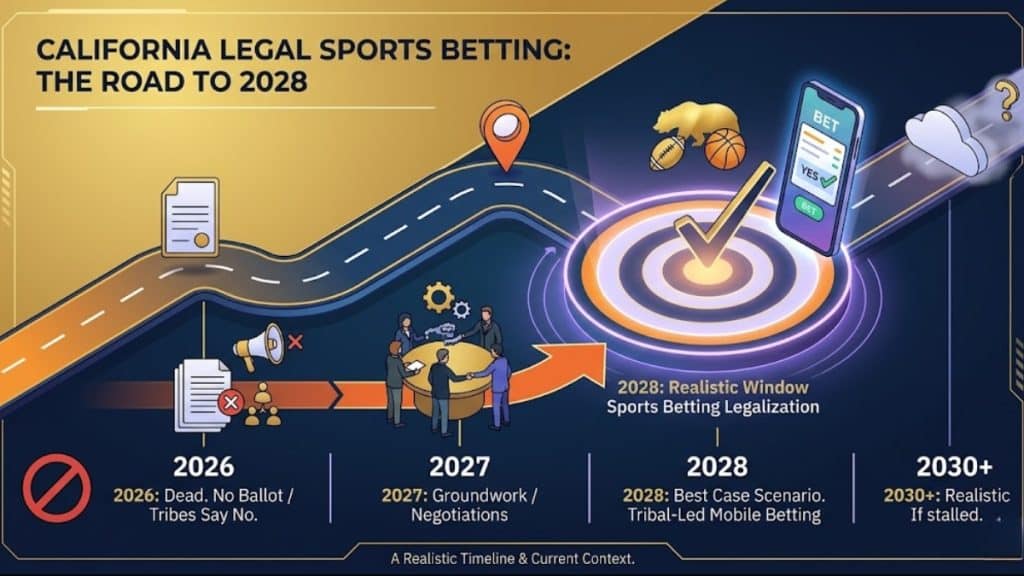
2028 is the next realistic window. Here’s why, broken down year by year.
- 2026: Dead. No qualified ballot initiative. No legislative momentum. Tribal leaders have publicly stated they won’t pursue a measure this cycle. The state is busy cracking down on DFS and sweepstakes gaming instead — more on that below.
- 2027: Possible groundwork year. If tribes and commercial operators start serious negotiations in late 2026 or early 2027, a 2028 ballot measure becomes viable. California’s ballot initiative process requires gathering roughly 550,000 valid voter signatures. That takes time, money, and organizational muscle.
- 2028: The best-case scenario. A tribal-led or tribal-endorsed measure that includes some form of mobile betting — possibly through tribal platforms or a partnership model — could make the ballot in 2028. But only if the tribes and operators work out a revenue-sharing framework that doesn’t trigger another $400 million ad war.
- 2030+: The realistic scenario. If negotiations stall or another competing-measure situation develops, we’re looking at 2030 or later. I’ve covered enough state legalization fights to know that “2028” has a way of becoming “2030” real fast.
One factor that could speed things up: money. California’s state budget faces ongoing pressure, and the revenue sitting on the table is enormous. Also, New York generated $26.3 billion in sports betting handle in 2025 alone, with $2.55 billion in gross gaming revenue and significant tax receipts for the state. California, with roughly double New York’s population and far more professional sports teams, could potentially dwarf those numbers. We’re talking a market that could realistically generate $3-5 billion in annual operator revenue. That’s a lot of tax money Sacramento is leaving on the table while neighboring Nevada and Arizona take California bettors’ money just fine.
BetUS and Everygame are also solid options if you want to spread your action around. Some sharps we know keep accounts at three or four books to line-shop.
What About Daily Fantasy Sports in California? Is DFS Legal?
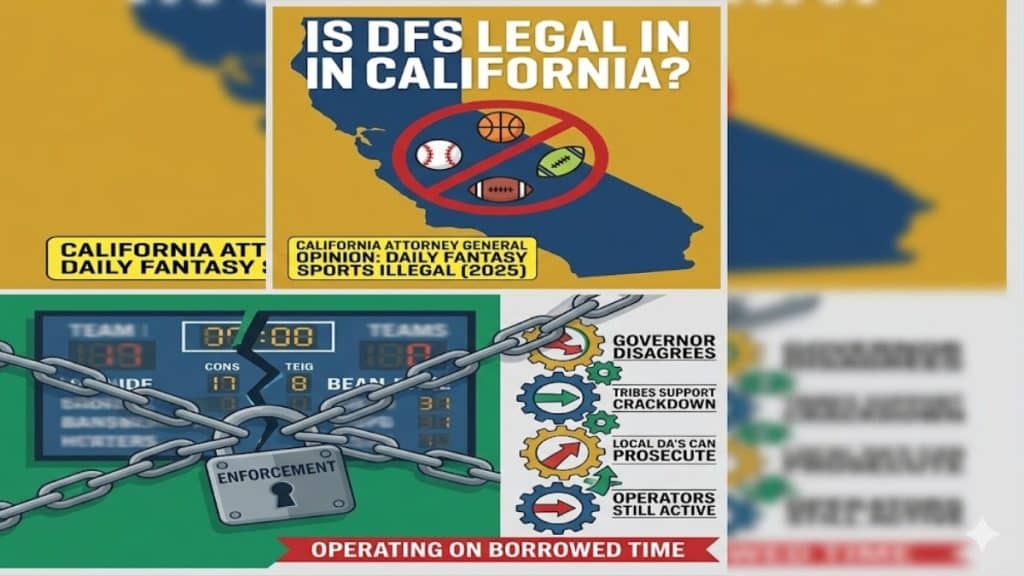
DFS in California is in serious trouble. On July 3, 2025, California Attorney General Rob Bonta dropped a 33-page advisory opinion declaring that paid daily fantasy sports contests — both pick’em and draft-style formats — are illegal under Penal Code Section 337a because entry fees constitute wagering on sporting events.
This was a big deal. Senator Scott Wilk had requested the investigation back in October 2023, and when the opinion finally came down, it hit the industry like a truck.
Now here’s the messy part: some DFS operators are still offering contests in California as of June 2026. Underdog Sports tried to get a temporary injunction to block the opinion’s release — a judge refused. Governor Newsom publicly disagreed with the AG, saying he’d welcome “a constructive path forward in collaboration with all stakeholders.” The Fantasy Sports & Gaming Association called the opinion “out of step” with other states.
But the opinion gives local district attorneys grounds to prosecute. However, that’s the bottom line. DFS in California is now operating on borrowed time, and every operator knows it.
For comparison — we saw Illinois go through something similar. Their AG declared DFS illegal in 2015. The Illinois Supreme Court later overturned that. Texas got a negative AG opinion too, and DFS still operates there just fine because enforcement is fragmented. California’s situation is more like Nevada’s, where the AG opinion actually forced operators out, because California has gambling enforcement agencies (the California Gambling Control Commission and Bureau of Gambling Control) that can actually act on it. Plus the tribal gaming industry publicly supports the crackdown.
What Can California Bettors Actually Do Right Now?
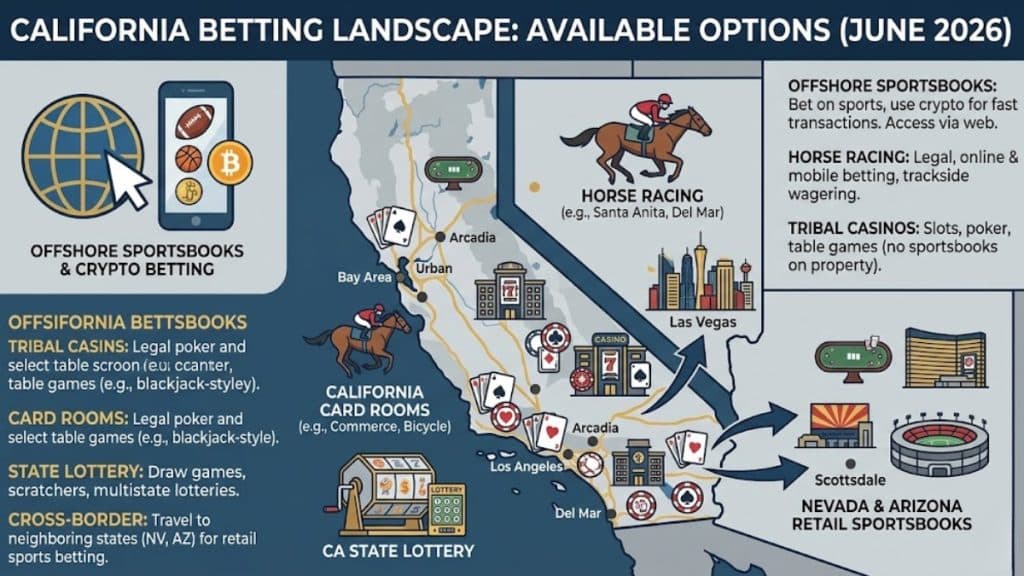
Since regulated sports betting doesn’t exist and DFS is under fire, here’s what’s actually available to California residents in June 2026:
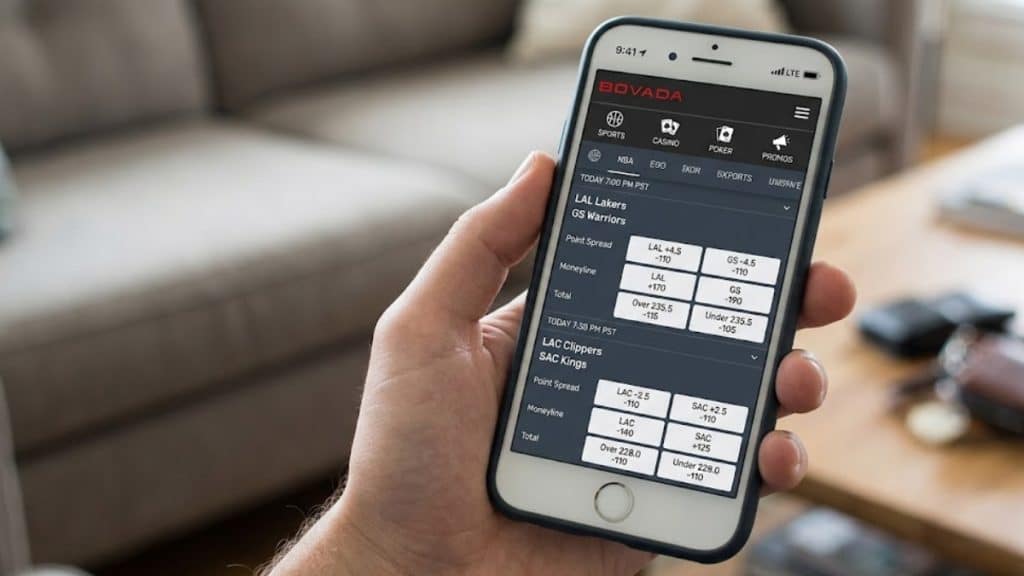
- Offshore Sportsbooks: Bovada, BetOnline, MyBookie, and others continue to serve California customers without interruption. This is where most CA bettors place their action. Also, crypto deposits and withdrawals are the move — fast, private, and no bank headaches. Our crypto betting guide breaks down how to set this up step by step.
- Horse Racing: Legal and fully operational. TVG and TwinSpires let you bet on horse races from your phone. California has some of the best tracks in the country — Santa Anita, Del Mar, Golden Gate Fields. Also, this has been legal forever and isn’t going anywhere.
- Tribal Casinos: Nearly 90 tribal casinos offer table games, slots, poker, and more. No sportsbooks, but if you want to gamble legally on California soil, tribal casinos are the main option. Yaamava’ Resort Casino at San Manuel, Pechanga, Morongo, Thunder Valley, Cache Creek — all solid spots. I spent a weekend at Pechanga last year and the poker room is legit.
- Card Rooms: California has over 80 licensed card rooms offering poker and some house-banked card games. Moreover, the Bicycle Casino in Bell Gardens, the Commerce Casino, Hawaiian Gardens — these are institutions.
- State Lottery: The California State Lottery has been running since 1984. Scratchers, draw games, Mega Millions, Powerball. Nothing sports-related, but it’s there.
- Cross-Border Betting: If you’re in Southern California, the drive to one of Arizona’s retail sportsbooks or a quick flight to Vegas is a real option people use constantly. I know degens in San Diego who drive to Arizona just to place weekend bets.
California Gambling Laws: What You Need to Know
California’s gambling laws are old, complicated, and resistant to change. Here’s the breakdown.
- Sports Betting: Illegal. Penal Code Section 337a prohibits wagering on sporting events. No exceptions, no gray areas on the state-regulated side.
- Online Casino: Illegal. No regulated online casinos operate in California.
- Daily Fantasy Sports: Legal gray area turning dark. The AG’s July 2025 opinion says it’s illegal. Operators still running. Enforcement action could come at any time.
- Sweepstakes Casinos: Being cracked down on. AB 831, passed in 2025-2026, restricts online sweepstakes games and expands liability to entities that support or promote them.
- Tribal Gaming: Legal under tribal-state compacts. Class III gaming (slots, table games, poker) on tribal land.
- Card Rooms: Legal. Licensed by the California Gambling Control Commission. No house-banked games — players bet against each other, with the house taking a rake.
- Horse Racing: Legal. Regulated by the California Horse Racing Board.
- Lottery: Legal. Run by the California State Lottery since 1984.
- Minimum Gambling Age: 18 for lottery, card rooms, horse racing, and bingo. 21 at tribal casinos that serve alcohol (varies by tribe).
Tax on Winnings: California does not have a specific state tax on gambling winnings separate from income tax. Gambling winnings are taxed as ordinary income at the state level (top marginal rate of 13.3% — the highest in the nation). Federal tax applies too, obviously. The IRS wants their cut no matter where you bet.
How Does California Compare to Neighboring States?
California’s neighbors are leaving it in the dust. Here’s where the surrounding states stand:
- Nevada: Legal everything. Sports betting, online poker, casinos — Vegas literally runs on gambling. California bettors drive to Nevada constantly, and that handle is money that could be staying in-state.
- Arizona: Legal online and retail sports betting since September 2021. The Arizona Department of Gaming oversees a thriving market with multiple licensed operators and tribal sportsbook operations. San Diego residents can practically see Arizona from their backyard.
- Oregon: Legal online sports betting through the Oregon Lottery’s Scoreboard app. Limited compared to other states, but it exists.
- Texas: Also stuck. No legal sports betting, similar tribal and political dynamics. We’ve covered why Texas still can’t bet — the parallels to California are wild.
The contrast with New York is even more painful. New York launched mobile sports betting in January 2022 and saw $26.3 billion in handle during 2025 — a 15.8% jump over the prior year — with $2.55 billion in gross revenue. California has roughly double New York’s population. Do the math. Also, the state is hemorrhaging potential revenue and sending its bettors to offshore books, to Nevada, to Arizona. It’s a policy failure of staggering proportions.
California Sports Betting Revenue: What’s the State Losing?
Nobody in the competing guides talks about this, and it’s the most damning argument for legalization.
Based on New York’s 2025 numbers ($26.3 billion handle, $2.55 billion gross revenue for a state of ~19.5 million people), California with 39+ million residents could reasonably project:
- Estimated annual handle: $45-55 billion
- Estimated gross operator revenue: $4-5.5 billion
- Estimated annual state tax revenue: $500 million to $1+ billion (depending on tax rate structure)
Those are conservative estimates. California has more pro teams across more major leagues than any state in the country. College football and basketball are massive here too. The sports betting demand already exists — it’s just being served by Bovada and Vegas instead of Sacramento-licensed operators.
Meanwhile, the black market continues growing as bettors who want to place legal wagers simply can’t. Every year California waits, more bettors get comfortable with offshore options and become harder to convert to a regulated market.
If you’ve decided to use an offshore sportsbook — and again, that’s your call — here’s how the process works:
Step 1: Pick a sportsbook. Bovada is the most popular choice among California bettors we’ve talked to. BetOnline and MyBookie are solid alternatives.
Step 2: Create an account. Basic info — name, email, address. Takes about two minutes.
Step 3: Deposit. Crypto is king here. Bitcoin, Ethereum, Litecoin, and USDT are accepted at most offshore books. You can also use credit cards or bank transfers, but crypto deposits are faster and don’t get flagged by banks. If you’ve never bought Bitcoin before, our cryptocurrency betting guide walks you through it.
Step 4: Claim your bonus. First-deposit bonuses at offshore books are real. Also, Bovada offers up to $750 on crypto deposits. MyBookie goes up to $1,000. Check current MyBookie bonus offers for the latest codes.
Step 5: Place your bet. Lines post early. Live betting is available. Go have fun — but set a damn budget first.
Step 6: Withdraw. Request a payout. Crypto withdrawals at Bovada typically hit within 24 hours. Traditional methods take longer.
Payment Methods for California Bettors
Since you’re using offshore books, your payment options look different from someone in New York or New Jersey:
- Crypto (Bitcoin, Ethereum, Litecoin, USDT): The best option. Period. Fast deposits (minutes), fast withdrawals (same day at most books), no bank interference. Most offshore sportsbooks offer enhanced bonuses for crypto deposits too.
- Credit/Debit Cards: Visa and Mastercard work at most offshore books, but some transactions get declined by your bank. Success rate is probably 70-80% in our experience.
- Person-to-Person Transfers: Some books still offer these. Works but slow.
- Bank Wire: For bigger amounts. Slower and comes with fees.
- Money Orders/Cashier’s Checks: Available for withdrawals at some books. Takes 1-2 weeks.
Bottom line: get a crypto wallet. It makes everything smoother. Coinbase or Cash App are the easiest on-ramps for buying Bitcoin if you’re starting from scratch.
Responsible Gambling Resources for California Residents
Gambling should be fun, not financial ruin. If you’re chasing losses, betting money you can’t afford to lose, or it’s causing problems in your life — that’s not a degen lifestyle, that’s a problem.
- National Council on Problem Gambling Hotline: 1-800-522-4700 (call or text, 24/7)
- California Council on Problem Gambling: (800) 426-2537. They run the state’s 1-800-GAMBLER line and offer free, confidential counseling.
- California Office of Problem Gambling: Part of the Department of Public Health. Offers treatment referrals and resources at problemgambling.ca.gov.
- Self-Exclusion: California’s tribal casinos participate in voluntary self-exclusion programs. Offshore sportsbooks also offer self-exclusion and deposit limits — use them if you need them.
We’ve always said: know your number, set your limits, and don’t bet the rent money. This isn’t financial advice — it’s common sense from people who’ve seen what happens when the fun stops being fun.
Final Thoughts From the Rail
California’s sports betting situation is a mess, and I don’t see it getting cleaned up anytime soon. The tribal interests are entrenched. The commercial operators burned their bridge in 2022 and are still rebuilding it. Sacramento has no appetite for a legislative fight when the ballot process is the expected vehicle for gambling expansion. And now the state is actively cracking down on DFS and sweepstakes — closing doors instead of opening them.
What kills me is the missed opportunity. We’re talking about the biggest state in the country, home to some of the most passionate sports fans on Earth, and the best option for betting on the Dodgers is still an offshore sportsbook that’s technically based in Costa Rica. That’s absurd.
My bet? 2028 is when we see real movement — but only if the tribes and operators can hammer out a deal that doesn’t turn into another $400 million ad war. If they can’t, this whole damn thing drags into the 2030s. California bettors, you’ve been patient. Keep using what works, stay sharp about where your money goes, and follow our state betting coverage for updates when something actually changes.
The Golden State will get there eventually. Just don’t bet on when.
Frequently Asked Questions
No. California has zero legal sports betting options — no apps, no retail sportsbooks, no regulated platforms. Penal Code Section 337a prohibits wagering on sporting events. Both Prop 26 and Prop 27 failed in 2022, and no new initiative has qualified since.
The earliest realistic window is 2028, and even that requires tribal gaming interests and commercial operators to negotiate a framework they both support. Tribal leaders have said they won’t pursue a 2026 ballot measure. If negotiations stall, 2030 or beyond is more likely. I’m not holding my breath.
Not for sports betting. Those companies do not operate regulated sportsbooks in California. DraftKings does offer DFS contests in the state, though the legal ground under DFS shifted dramatically after the AG’s July 2025 opinion. FanDuel’s DFS availability in California is similar — technically still operating but under significant legal cloud.
It’s complicated. California law targets operators, not individual bettors. No California resident has ever been prosecuted for placing a bet through an offshore sportsbook. These sites operate outside U.S. jurisdiction. They’re not “legal” in the way a Nevada sportsbook is legal, but millions of Americans use them and enforcement against individuals is effectively nonexistent.
Tribal politics. California’s 60+ gaming tribes generate approximately $8 billion annually from casino operations and oppose any legalization framework that threatens their exclusivity. Competing interests between tribes, commercial operators, and card rooms have prevented any coalition from forming. So, the $460 million 2022 ballot fight left voters exhausted and hostile to gambling measures. No single stakeholder group has enough power to push legalization through alone.
On July 3, 2025, California AG Rob Bonta issued a formal advisory opinion declaring paid DFS contests (both pick’em and draft-style) illegal under Penal Code Section 337a. The opinion isn’t binding law — it’s an advisory — but it gives district attorneys across the state grounds to prosecute. Some DFS operators continue offering contests. Others are reassessing. The situation mirrors what happened in Nevada in 2015, where a similar AG opinion effectively killed DFS in the state.
Based on comparable state data, California could reasonably generate $45-55 billion in annual betting handle and $500 million to over $1 billion in annual tax revenue. New York, with roughly half California’s population, saw $26.3 billion in handle and $2.55 billion in gross gaming revenue in 2025. California’s sports market (Lakers, Dodgers, 49ers, Warriors, Rams, plus massive college sports) would likely drive even higher engagement per capita.
📂 Explore more: California