Three Card Poker, Ultimate Texas Hold’em and Casino Hold’em side by side: how each works, what the dealer needs to qualify, the house edge per ante and per dollar bet, and what 100 hands really cost at a $10 ante.

Casino poker games are table games where you play your hand against the dealer, not other players, and the house keeps a fixed math edge on every bet. Of the big three, Ultimate Texas Hold’em costs the least per dollar you bet, with Casino Hold’em close behind. Three Card Poker is the easiest to learn but the priciest, at 3.37% of your ante, per Wizard of Odds.
Key Takeaways
- Three Card Poker has one decision per hand. Raise with queen-6-4 or better and the house edge is 3.37% of your ante, per Wizard of Odds.
- Ultimate Texas Hold’em carries a 2.19% edge on the ante, but only 0.53% of all the money you actually bet, because strong hands get a 4x raise.
- Casino Hold’em needs the dealer to hold a pair of 4s to qualify. Its edge is 2.16% of the ante on the most common pay table.
- Side bets cost more. Pair Plus runs up to 7.28%, Trips up to 6.18%, and the AA bonus 6.26% to 6.40% at land casinos.
- Our pick for a first-timer: start with Three Card Poker, then move up to Ultimate Texas Hold’em once you learn its raise chart.
How Are Casino Poker Games Different From Regular Poker?
You’re playing the house, not the table. In regular poker, players bet against each other and the card room takes a rake, which is a small cut of each pot. Good players can win over time because they beat weaker opponents.
Casino poker flips that. The casino banks every bet, so there’s no bluffing and no reading other players. Your choices only shrink the house edge. House edge is the casino’s built-in cut, shown as a percentage of your bet over the long run. Our guide to how RTP and house edge work walks through that math.
Skill can’t beat that math. For a game where it can, see our breakdown of whether online poker is beatable.
How Do Three Card Poker, Ultimate Texas Hold’em and Casino Hold’em Compare?
“Qualify” means the dealer’s hand must reach a minimum strength before your full bet is in play.
| What You Need to Know | Three Card Poker | Ultimate Texas Hold’em | Casino Hold’em |
|---|---|---|---|
| Cards you play | 3 cards, no community cards | 2 cards + 5 shared cards | 2 cards + 5 shared cards |
| Bets to start | Ante (Pair Plus optional) | Ante + equal Blind (Trips optional) | Ante (AA bonus optional) |
| Decisions per hand | 1: play or fold | Up to 3: bet 4x/3x, 2x, or 1x/fold | 1: call 2x or fold |
| Dealer qualifies with | Queen high or better | A pair or better | A pair of 4s or better |
| House edge, best play (per ante) | 3.37% | 2.19% | 2.16% |
| House edge per dollar actually bet | 2.01% | 0.53% | About 0.82% (DWZ calc) |
| Main side bet edge | Pair Plus: 2.32% to 7.28% | Trips: 1.90% to 6.18% | AA bonus: 6.26% to 6.40% (land) |
| Best for | First-timers who want one simple rule | Players willing to learn a chart | Fans of Texas Hold’em with fewer choices |
Sources: Wizard of Odds game pages and House Edge page, checked October 7, 2026. Casino Hold’em per-dollar figure is DWZ’s calculation from Wizard of Odds’ 82% call rate. Edges assume the most common pay tables listed there.
Watch the per-dollar row. Bigger raises on strong hands spread the edge over more money, which is why Ultimate Texas Hold’em looks so cheap there.
How Does Three Card Poker Work?
One rule covers almost everything: raise with queen-6-4 or better, fold the rest.
Place an Ante and get three cards. Then fold and lose the Ante, or add a Play bet equal to it. Pennsylvania’s rules require the table layout to say “Dealer Plays with Queen High or Better” (58 Pa. Code § 649a.2).
- Dealer doesn’t qualify: your Ante pays 1 to 1 and the Play bet pushes, meaning you get it back.
- Dealer qualifies: the higher hand wins. A win pays 1 to 1 on both bets.
- Ante bonus: a straight pays 1 to 1, three of a kind 4 to 1, and a straight flush 5 to 1 on most tables, even if you lose the hand.
Shortcuts cost you. Raising on any queen (copying the dealer) bumps the edge to 3.45%, per Wizard of Odds. Always raising pushes it to 7.65%.
How Does Ultimate Texas Hold’em Work?
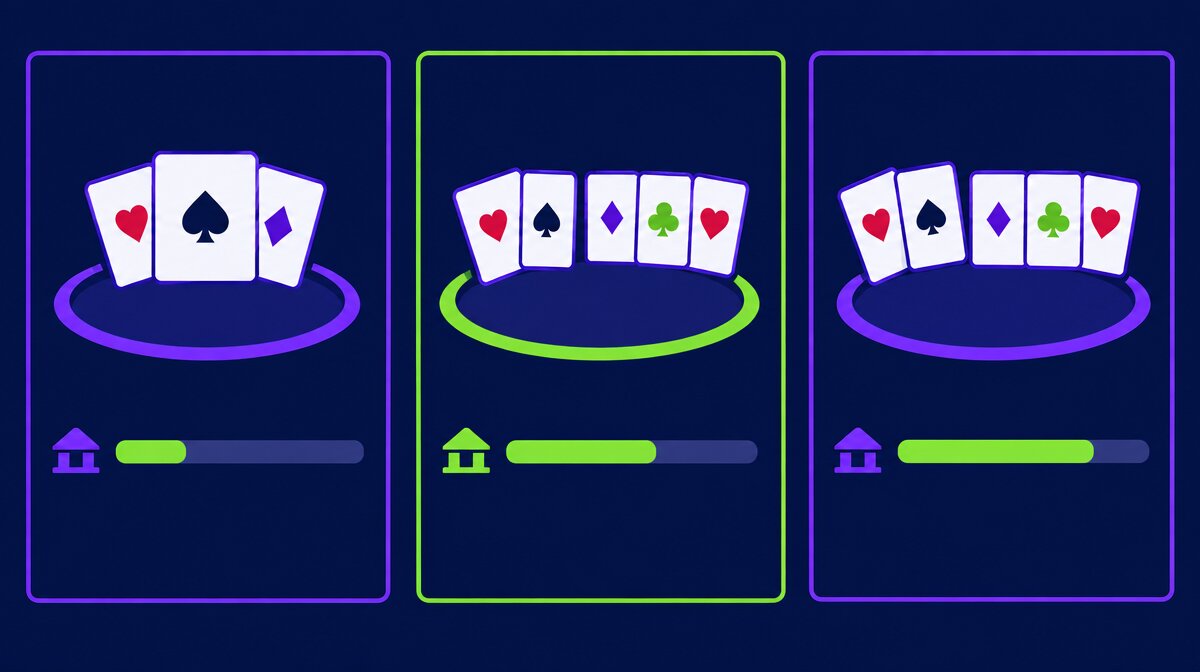
Ultimate Texas Hold’em rewards betting big early. You post equal Ante and Blind bets, get two cards, and five shared cards come out in stages.
Your one raise gets smaller the longer you wait. Pennsylvania’s rules (58 Pa. Code § 653a.11) set the sizes:
- Before the flop: check, or bet 3x or 4x your Ante.
- After the flop (first three shared cards): check, or bet 2x.
- After the last two cards: bet 1x or fold. Folding loses your Ante and Blind.
The dealer needs a pair to qualify. If not, your Ante pushes, but your Play and Blind bets still count. The Blind pays only when you win with a straight or better: 1 to 1 for a straight, 3 to 2 for a flush, and up to 500 to 1 for a royal flush. Win with less, and the Blind pushes.
For the 4x call, Yaamava’ Resort & Casino’s strategy guide offers a simple version: any pair of 3s or better, any ace, or any king with a 5 or higher. Wizard of Odds says its own simplified strategy plays at a 2.43% edge, close to the 2.19% best case.
How Does Casino Hold’em Work?
Casino Hold’em boils down to one choice: call or fold.
After your Ante, you get two cards and the first three shared cards land face up. Fold and lose the Ante, or call with 2x your Ante. Two more shared cards follow.
The dealer needs a pair of 4s or better. When the dealer misses, your Ante pays by its pay table and the call pushes. If the dealer qualifies and you win, the call pays 1 to 1. Ante pay table 3 is the most frequently used, per Wizard of Odds:
- Straight or less: 1 to 1
- Flush: 2 to 1
- Full house: 3 to 1
- Four of a kind: 10 to 1
- Straight flush: 20 to 1
- Royal flush: 100 to 1
No neat chart exists here. Wizard of Odds says best play calls 82% of the time, folding mostly low cards that miss the flop.
What Do 100 Hands Actually Cost at a $10 Ante?
Percentages hide real money. Here’s what 100 hands cost with a $10 Ante and best play.
| Game | Average Bet Per Hand | Expected Loss, 100 Hands | Add $5 Side Bet Each Hand |
|---|---|---|---|
| Three Card Poker | $16.77 | $33.70 | +$11.60 to +$36.40 (Pair Plus) |
| Ultimate Texas Hold’em | $41.52 | $21.85 | +$9.50 to +$30.90 (Trips) |
| Casino Hold’em | $26.40 | $21.60 | +$31.30 to +$32.00 (AA bonus, land) |
DWZ calculation, October 7, 2026, from Wizard of Odds house edge and average-bet data.
Editor’s Note: These are long-run averages built from published math, not play sessions. Over 100 hands, you could finish far above or below them.
Our take: Ultimate Texas Hold’em and Casino Hold’em cost about the same per hand, but Ultimate Texas Hold’em needs the deepest pockets. A $10 Ante can grow to $60 on one hand ($10 Ante, $10 Blind, $40 raise). Three Card Poker tops out at $20 before side bets.

Are the Side Bets Worth It?
Mostly no. A side bet pays on your own hand, whatever the dealer holds, and the big payouts come from rare hands.
Pay tables matter most. Three Card Poker’s Pair Plus costs 2.32% when a flush pays 4 to 1. Drop that flush to 3 to 1 and the edge jumps to 7.28%, per Wizard of Odds. Betting Ante and Pair Plus equally on that weaker table costs 5.32% of the total.
Trips runs 1.90% to 6.18% on common tables. Casino Hold’em’s AA bonus costs 6.26% to 6.40% at land casinos.
Will New Poker Hybrids Like PokerJack Replace These Games?
Don’t count on it. Steve Ruddock’s Straight to the Point newsletter (October 7, 2026) noted that new table games rarely last. He wrote that the odds are against PokerJack, a poker-blackjack mix introduced at G2E, sticking around.
Citing his 2022 count of Nevada gaming stations, he noted Let It Ride was the newest game with a serious presence, at 42 stations. Ruddock also wrote that a dealer should be able to explain a game’s rules in under a minute.
Our analysis: the three games here pass that test, and Three Card Poker passes it fastest.
Which Casino Poker Game Should a Beginner Pick?
Here’s our ranked recommendation, based on the math above. It’s DWZ analysis, not a test result.
- Three Card Poker. One rule (queen-6-4) gets you within a hair of best play. You’ll pay more per hand, but you’ll make fewer mistakes.
- Casino Hold’em. A cheaper edge than Three Card Poker, with just one call-or-fold choice. Calling most hands is close to right.
- Ultimate Texas Hold’em. The lowest cost per dollar bet, but three decision points and the biggest bets. Learn the 4x chart first.
Already comfortable with poker hands? Our video poker strategy basics cover another game where good choices cut the house edge.
Where Can You Play Casino Poker Games Online?
Online, you’ll find two versions. RNG tables use a random number generator, software that shuffles and deals. Live dealer tables stream a real dealer by video, as our live dealer casino guide explains.
Disclosure: the links below are affiliate links. DWZ may earn a commission at no cost to you.
- BetOnline Casino has a casino and a Live Casino section.
- MyBookie Casino publishes its own 3 Card Poker guide.
Lineups change, so check each game’s pay table on its help screen first. Watch for look-alikes, too. Realtime Gaming’s Caribbean Hold’em pays only 1 to 1 on the Ante when the dealer doesn’t qualify, per Wizard of Odds.
References
- Wizard of Odds. “Three Card Poker.” Checked October 7, 2026.
- Wizard of Odds. “Ultimate Texas Hold ‘Em.” Checked October 7, 2026.
- Wizard of Odds. “Casino Hold ’em.” Checked October 7, 2026.
- Wizard of Odds. “House Edge of Casino Games Compared” (includes Element of Risk table). Checked October 7, 2026.
- Pennsylvania Code, 58 Pa. Code Chapter 649a, Three Card Poker.
- Pennsylvania Code, 58 Pa. Code Chapter 653a, Ultimate Texas Hold ‘Em Poker.
- Yaamava’ Resort & Casino. “How To Play Ultimate Texas Holdem.” Checked October 7, 2026.
- Steve Ruddock, Straight to the Point. “Don’t Fix What Isn’t Broken.” October 7, 2026.
- MyBookie. “3 Card Poker at MyBookie: Online Casino Real Money.” Checked October 7, 2026.