
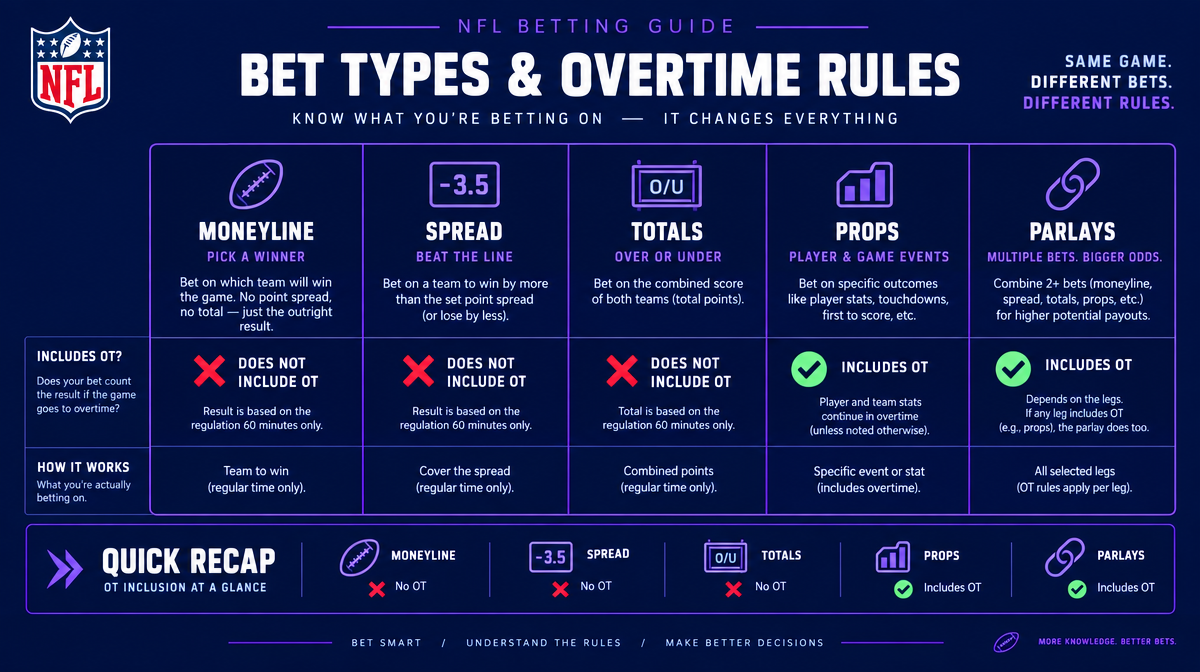
Quick answer: In most cases, full-game NFL moneyline, spread, total and player-prop bets include overtime. First-half and quarter bets stop before overtime; second-half settlement rules vary by sportsbook. Check the house rules before betting.
If an NFL game goes to overtime, almost every full-game bet counts the overtime points — your moneyline, spread, total, and most player props all include OT unless the bet says otherwise. It’s important to understand nfl overtime rules because they can affect the outcome of your wagers.
The big exceptions are first-half and quarter bets. Those were settled long before overtime started. Everything else rides until the final whistle.
Key Takeaways
- Full-game bets include overtime. Moneyline, spread and totals generally include OT at sportsbooks, including Bovada.
- Period bets end earlier. First-half and fourth-quarter bets do not include overtime; second-half rules can differ.
- Regular-season OT lasts 10 minutes. If the score is still tied, the regular-season game ends in a tie.
- Both teams get a possession. Since 2025, the regular-season rule gives both teams a chance to have the ball, even after an opening-drive touchdown.
- Playoff games must produce a winner. They continue through additional overtime periods until one team wins.
League overtime procedures were checked against NFL Football Operations and ESPN’s rules summary. Bet-settlement examples were checked against Bovada’s published Football Betting Rules on September 29, 2026.
Affiliate Disclosure: Daily Wager Zone may earn a commission if you sign up through our links at no extra cost to you. This does not influence our analysis or recommendations.
What are the current NFL overtime rules for the 2026 season?
Overtime happens when the score is tied after four quarters. That is 60 minutes of play, called regulation.
Here is how regular-season OT works, per NFL Football Operations:
- A coin toss decides who gets the ball first. The visiting team calls it.
- Teams play one 10-minute period.
- Both teams get a chance to have the ball. This is called a possession — one team’s turn on offense.
- After both teams have had the ball, whoever is ahead wins. If it is still tied, the next score of any kind wins.
- If nobody is ahead when the 10 minutes run out, the game ends in a tie.
One odd exception: if the kicking team scores a safety on the first drive, the game ends. A safety is when the defense tackles the offense in its own end zone.
What changed in overtime recently?
The old rule was different. If the first team scored a touchdown, the game was over and the other team never touched the ball.
After the Chiefs beat the Bills 42-36 in a 2022 playoff game without Buffalo getting the ball in OT, the NFL gave both teams a possession in playoff overtime. In 2025, owners extended that rule to the regular season, according to ESPN and the NFL’s rule-change summary. That is the rule in place for 2026.
How are playoff overtime rules different for bettors?
Playoff games must have a winner, so there are no ties. If the game is still tied after an overtime period, the teams play another one. They keep going as long as it takes, and both teams still get a guaranteed possession.
For bettors, this matters in one way: every playoff moneyline bet will have a winner. In the regular season, a tie is possible, and that can change how your bet is graded.
What happens to a moneyline bet if the game goes to overtime?
A moneyline bet is a bet on who wins the game. No points are involved. Read our guide to how moneyline, spread, and totals bets work for a refresher.
Overtime counts for the moneyline. If your team wins in OT, you win.
The tricky part is a regular-season tie. At most sportsbooks, a standard two-way moneyline on a tied game is graded as a push. A push means the bet is canceled and you get your money back. Some books also offer a three-way moneyline, where “tie” is its own option. On that bet, a tie is a loss for both team picks. Always check your book’s house rules before you bet.
Does overtime count for point spread bets?
Yes. A point spread is a head start or handicap. The favorite has to win by more than a set number of points; the underdog can lose by less and still cover.
Overtime points count toward the final margin. A team that was losing against the spread after regulation can still cover in OT.
Our analysis: Under the old rules, many OT games ended on a field goal, which meant a three-point win. Now that both teams get the ball, OT games can end with a bigger or smaller margin. For a favorite at -3 or an underdog at +3, overtime is less predictable than it used to be.
Do overtime points count toward the over/under total?
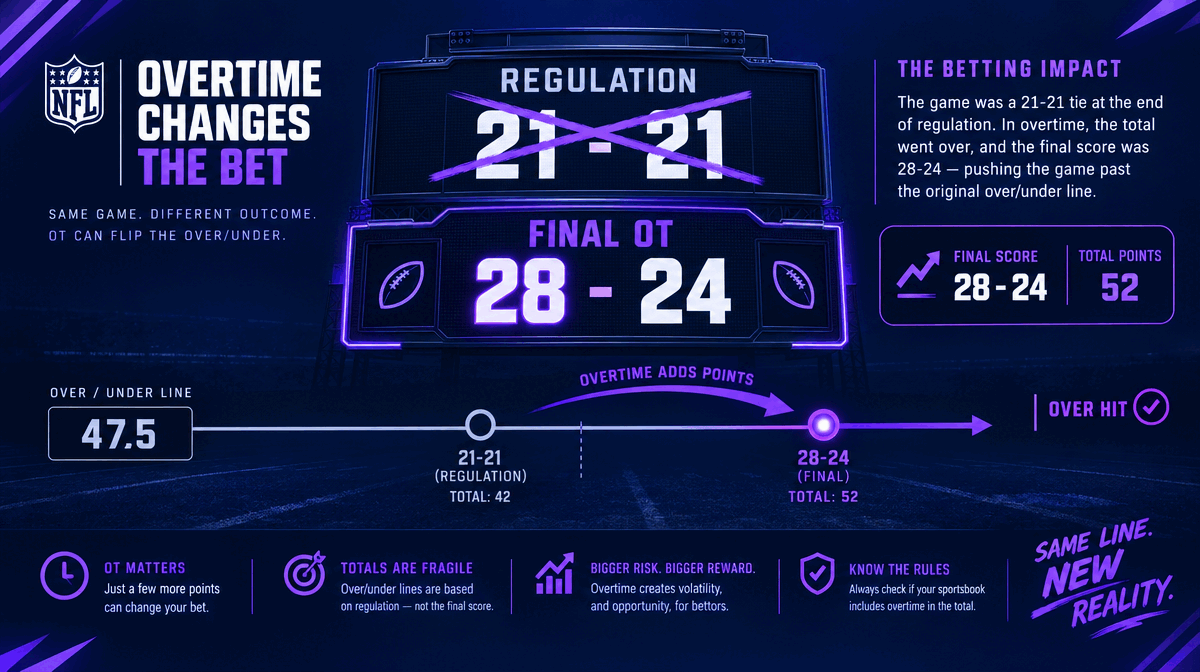
Yes. The total, also called the over/under, is a bet on how many points both teams score combined. Every point scored in OT gets added in.
If the game is tied 20-20 after regulation, the score is 40 points. If either team scores a touchdown in OT, the total reaches at least 46 and the over wins. Even two field goals would push the total to 46.
Our editorial take: Totals bettors feel overtime more than anyone else. OT only adds points; it never takes them away. That means overtime is almost always good news for the over and bad news for the under. If you bet unders, you carry a small hidden risk that the game goes long.
Do player props include overtime stats?
At most books, yes. A player prop is a bet on one player’s stats, such as passing yards or rushing touchdowns. See our guide to NFL player prop bets for more.
If a running back scores in OT, that counts for an anytime touchdown bet. If a quarterback throws for 40 yards in OT, those yards count toward his over or under.
One rule to know: at Bovada, the player must be on the game-day active roster for the bet to count. If the player is active but never plays, the bet still stands.
Do first-half, second-half, and quarter bets include overtime?
This is the most common beginner mistake. Not all half bets work the same way.
| Bet type | Includes overtime? |
|---|---|
| Full game (moneyline, spread, total) | Yes |
| First half | No |
| First, second, or third quarter | No |
| Fourth quarter | No |
| Second half | Yes, at most books |
First-half bets are settled at halftime. Overtime cannot touch them. Fourth-quarter bets stop at the end of regulation. Bovada’s rules state this directly.
Second-half bets are the surprise. Many beginners assume they end with the fourth quarter. Bovada’s Football Betting Rules say full-game and second-half bets both include overtime. Other books may differ, so read the rules before you bet.
What happens to a parlay if one game goes to overtime?
A parlay combines two or more picks, called legs. Every leg has to win for the parlay to pay. Each leg is graded the same way it would be as a single bet, so an OT game counts overtime points for its spread, total or moneyline leg.
If a moneyline leg ends in a regular-season tie and is graded as a push, most books drop that leg. The parlay stays alive with fewer legs, and the payout shrinks to match.
How does live betting work during overtime?
Live betting means betting while the game is being played. Odds update after every play. Many books keep live markets open into overtime, with new lines for the OT winner, next score or final total.
Sportsbooks often pause live betting briefly after big moments, such as the coin toss or a score, and then reopen with new prices. Prices move fast, so know exactly what the bet covers before confirming it.
Can you bet on whether a game will go to overtime?
Yes. Many sportsbooks offer a “Will the game go to overtime?” prop. You pick yes or no before kickoff.
Most NFL games do not go to OT. That is why “yes” usually pays a large plus-money price, while “no” is a heavy favorite. Plus money means you win more than you risk.
Our analysis: This prop is mostly a lottery ticket. Close spreads and low totals may make OT a little more likely, since tight, low-scoring games are easier to tie, but no pregame number can predict a late field goal. Treat it as a small, fun side bet at most — not a core part of a betting plan. For bigger-picture approaches, see our best NFL betting strategies.
Editor’s Note on Methodology
League rules were checked against NFL Football Operations and ESPN, and bet-settlement rules against Bovada’s Football Betting Rules, on September 29, 2026. Sportsbooks set their own house rules, and those rules can change. If a detail matters to your bet, read your book’s rules page before placing it.
References
- NFL Football Operations — “2025 Rules Changes: Overtime Procedures.” Official rules page (accessed September 29, 2026).
- ESPN — “What are NFL overtime rules for regular and postseason play?” (updated September 4, 2025).
- Bovada Help Center — “Football Betting Rules.”
Gambling involves risk. Only wager what you can afford to lose. You must be 21+ (or the legal age where you live) to participate in sports betting. If you or someone you know has a gambling problem, call 1-800-522-4700 (National Council on Problem Gambling) or dial 211.