
Wind is the only NFL weather factor that reliably moves a total. See what the data says about rain, cold and snow — and the mph thresholds that matter.

Quick answer: Wind is the only weather that reliably changes an NFL betting result, and it works by killing deep passes and long field goals at the same time. Rain shaves about 12% off passing production. Cold does far less than people think. Snow only matters when it is heavy. If you check one line in the forecast before you bet, make it sustained wind speed at kickoff — not the temperature.
Key Takeaways
- Weather is live in about 60% of games. Twenty of the NFL’s 32 stadiums are open to the elements, per Covers.com.
- Wind is the big one. At 20-plus mph, passing falls off 1.5 to 2 times harder than it does at 15 to 20 mph, according to Covers.com data published August 31, 2026.
- Rain is flat, not graded. Passing production drops about 12% no matter how hard it comes down. Light snow costs only 2%. Heavy snow costs 25%.
- Cold is overrated. Passing dips about 5% between 25 and 55 degrees, and about 8% below 25 degrees.
- Domes are already priced. Games under a roof average almost four more points than outdoor games, and that is baked into the number you see.
Written by Jake Mercer, sports betting analyst. Last updated September 21, 2026. Every figure below comes from a named public source with a date attached — weather-split passing and kicking data from Covers.com, wind thresholds from BettorEdge, and totals movement research from OddsIndex. Free forecasts referenced here come from the National Weather Service. This is editorial analysis of published data, not a record of bets placed.
Affiliate Disclosure: Daily Wager Zone may earn a commission if you sign up through our links at no extra cost to you. This does not influence our analysis or recommendations.
Which NFL Games Does Weather Actually Touch?
Fewer than you would guess, and more than enough to matter.
Covers.com counts 20 of the league’s 32 stadiums as exposed to the elements. The other 12 play under a fixed or retractable roof. So on a normal Sunday, the forecast is a live factor in a bit over half the slate and completely irrelevant in the rest.
That gap shows up in the pricing. Dome games average almost four more points than outdoor games. Sportsbooks know this. The roof is already in the number before you open the app.
A quick word on the total, since this is where weather lives. The total, also called the over/under, is the combined points the book expects both teams to score. You bet whether the real score finishes above or below it. If you want the full walkthrough of that market, here is our plain-English guide to how NFL totals and point spreads work.
Why Is Wind the Weather That Matters Most?
Because it attacks two scoring paths at once.
A deep pass sits in the air for about three seconds. That is three seconds for the wind to push it off target. And a 48-yard field goal — the safety net that turns a dead drive into three points — becomes a coin flip.
Take away the long completion and the long kick in the same game and you have removed a big chunk of how NFL teams score.
The average wind speed for an NFL game is around 7 mph, per Covers.com. Use that as your baseline. Anything near it is just a normal football game.
Here is where the numbers get interesting.
| Sustained wind at kickoff | What it does to the game | How to read it |
|---|---|---|
| Under 10 mph | Nothing you can bet on | Noise. Ignore it. |
| 10–15 mph | Passing production starts slipping | Watch it, don’t act on it |
| 15–20 mph | Accuracy drops, field goals convert ~80% vs ~83% normal | Real effect |
| 20+ mph | Passing falls 1.5–2x harder than the tier below | Sharp effect |
Those thresholds line up with BettorEdge’s August 26, 2026 breakdown: 10 is noise, 15 is real, 20 is sharp.
The field goal data is the part most bettors read wrong. Kickers convert about 83% in winds under 15 mph and about 80% from 15 to 20 mph. Barely a dent, right?
Wrong. In 20-plus mph wind, the average attempt is roughly seven yards shorter, because coaches stop sending the kicker out from distance. Shorter kicks should convert at nearly 89%. They actually convert at 77%. That 12-point gap is the real damage, and it never shows up in the raw percentage.

How Much Does Rain Change an NFL Game?
Less than the broadcast makes it look, but the effect is real and it is consistent.
Any rain at all cuts passing production by about 12%, per Covers.com. Light drizzle, steady rain, a downpour — the drop is roughly the same. That is the useful finding, because most bettors try to grade rain on intensity and the data says intensity barely matters.
Kicking survives rain better than you would expect. Field goals actually convert around 85% in the rain, though that is only because coaches are calling shorter attempts. Adjusted for distance, kickers are about 2% below where they should be.
So rain nudges a game toward the run and trims the passing yards. It does not gut the scoreboard.
Does Cold Weather Really Lower Scoring?
Not much. This is the biggest gap between what bettors feel and what the data shows.
Passing production dips about 5% in the 25-to-55 degree range. Below 25 degrees it dips about 8%. Those are small numbers for a condition that gets talked about like it decides games.
Here is why the myth survives. The coldest games are very often the windiest games too. When a January game in Buffalo finishes 13-10, people credit the temperature. The wind did the work.
Both teams also play in the same air, and these are conditioned professional athletes. A calm 25-degree game generally plays close to its normal total. A 45-degree game with 25 mph wind does not.
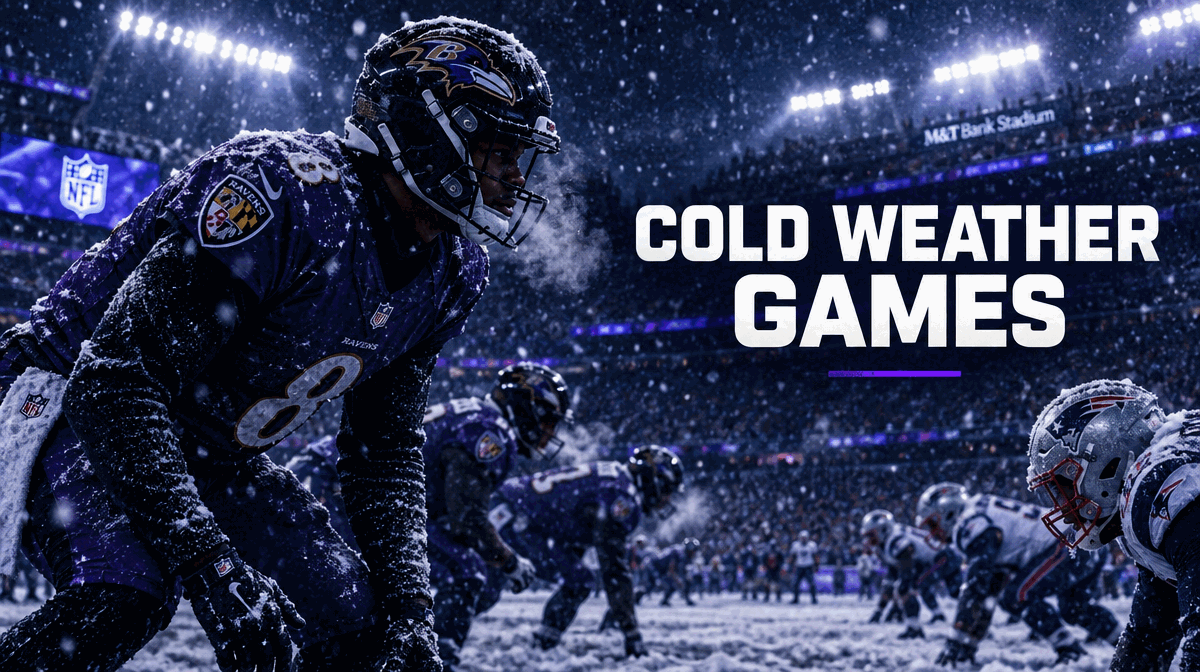
Is Snow an Automatic Under?
No, and treating it like one is an expensive habit.
Split snow into two buckets. Light snow costs passing production about 2% — basically nothing. Heavy snow costs 25%, which is the single largest weather effect in the dataset.
Kicking is where snow bites hardest. Field goals convert at just 76% in snow, against an expected 88% given how short those attempts are.
But heavy snow cuts both ways. Defensive backs cannot plant and turn either. Tackling gets sloppy. Plenty of snow games have turned into 200-yard rushing afternoons for both teams rather than defensive slogs.
The trap with snow is that it is beautiful on television. Everyone sees it, everyone thinks under, and the number has already moved by the time the casual money arrives.
When Should You Actually Place a Weather Bet?
Early, or not at all.
Weather is public information. Totals start adjusting to a forecast the moment it appears, usually midweek. OddsIndex, in a guide last updated February 2026, notes that weather can swing an NFL total by 5 to 10 points — a 47.5 sliding to 42.5 in a matter of hours.
If your entire angle is “it’s going to be windy,” you are betting the same idea as everyone else who read the same forecast, and you are late.
Three habits that actually help:
- Read the kickoff forecast, not the daily summary. A 1 p.m. ET game in Buffalo has nothing to do with that evening’s numbers. Weather.gov is free and gives you hourly sustained wind.
- Read sustained wind before gusts. Sustained wind changes play calling for four quarters. Gusts mostly add variance.
- Write down your own number first. Decide how many points you would move the total, then compare that to how far the market already moved. If the market moved further than you would have, the value is on the other side.
That last habit is the whole game, honestly. It is the same discipline behind how sharp bettors handicap an NFL game in any spot, weather or not.
One more thing worth watching: retractable roofs. The open-or-closed call often gets made close to kickoff, and books in different places do not always update at the same speed. Bovada, BetOnline, and MyBookie can post the same windy game a point or two apart on the total. Having more than one account open is how you catch that half point, and half points matter more than they look — see why 3 and 7 are the key numbers in NFL betting.
A standard total is priced at -110, meaning you risk $110 to win $100. Say a forecast pushes a total from 45 down to 42.5 through the week. Grabbing the under at 45 on Wednesday instead of 42.5 on Sunday is not a small improvement — it is 2.5 points of cushion on a bet where one field goal decides it. On a $110 wager that is the difference between cashing and tearing up the ticket a few times a season.
And weather stacks with the other stuff already in the line. A cold outdoor stadium is often also a strong home venue, which is a separate adjustment covered in our look at what home-field advantage is really worth.
References
- Covers.com — How Weather Actually Impacts NFL Games — stadium counts, wind/rain/snow/temperature splits for passing and kicking, updated August 31, 2026
- BettorEdge — Wind, Cold and Rain: How Weather Moves NFL Totals — 10/15/20 mph wind thresholds and midweek line movement, August 26, 2026
- OddsIndex — How Weather Affects Over/Under Betting: NFL and MLB Totals Guide — 5 to 10 point total swings from weather, updated February 2026
- Sharp Football Analysis — Weather Impact on NFL Betting Outcomes — weather categories affecting totals and player props
- National Weather Service — free hourly sustained wind and precipitation forecasts by stadium location