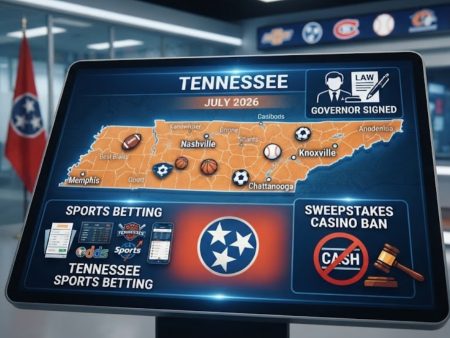

Tennessee just went scorched earth on everything that isn’t a state-licensed sportsbook. Governor Bill Lee signed two bills on May 22 — banning sweepstakes casinos and making prediction market manipulation a felony — and Attorney General Jonathan Skrmetti is now dragging Kalshi to the Sixth Circuit Court of Appeals. With the new Tennessee Sports Betting Bill June 2026 updates, three enforcement actions in one month. If you’re operating outside Tennessee’s regulated sports betting framework, the state wants you gone.
SB 2136 kills online sweepstakes casinos that use virtual-currency systems. SB 1992 creates a Class E felony for rigging prediction market outcomes. And the Kalshi appeal could determine whether states or the federal government controls prediction markets. Tennessee is testing every legal weapon it has.
What Does Tennessee’s Sweepstakes Casino Ban Actually Do?
SB 2136 makes Tennessee the seventh state to outlaw sweepstakes casino operations, joining California, Connecticut, New Jersey, New York, Montana, and Louisiana. Governor Lee signed it on the very last day of his 10-day decision window — waited until May 22 when the deadline hit.
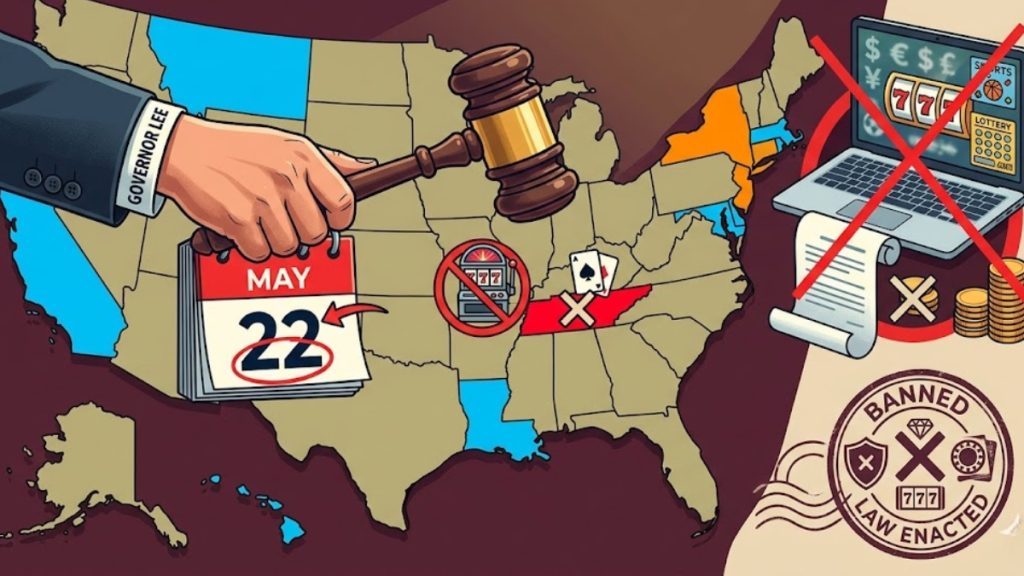
The ban covers:
- Virtual-currency casino games — slots, table games, bingo, video poker using any dual-currency or multi-currency system
- Lottery-style sweepstakes games operating online
- Unlicensed sports wagering through sweepstakes platforms
- Any game where you exchange virtual currency for cash or prizes
AG Skrmetti had already issued cease-and-desist letters earlier this year that forced major sweepstakes operators out of Tennessee. The bill just makes it law instead of an AG enforcement action.
Real talk: sweepstakes casinos were operating in a gray zone everywhere. They’d give you “gold coins” for purchases and “sweepstakes coins” for free, and somehow the sweepstakes coins were redeemable for cash. Everybody knew it was gambling dressed up in a trench coat. Tennessee just stopped pretending.
The four states that moved against sweepstakes in quick succession this spring — Iowa, Louisiana, Oklahoma, and Tennessee — bring the total to about 15 states where sweepstakes platforms are explicitly banned. The dominoes are falling fast. If you’re still using a sweepstakes casino in a state that hasn’t banned them yet, pay attention. Your state might be next.
How Does the New Prediction Market Manipulation Law Work?
SB 1992 is nastier than it sounds. It creates a Class E felony — that’s up to six years in prison in Tennessee — for anyone who intentionally manipulates the outcome of an event while holding a prediction market contract tied to that event.
Translation: if you’re an athlete, coach, referee, or anyone with influence over a sporting event, and you buy a prediction market contract on that event and then fix the outcome, Tennessee will come after you with criminal charges. Not a fine. Not a slap. A felony.
This law came directly out of Tennessee’s Kalshi fight. The state tried to push Kalshi out through civil enforcement earlier this year. Skrmetti’s office issued cease-and-desist orders arguing that Kalshi’s sports event contracts were just sports betting by another name. Kalshi sued, won a federal preliminary injunction on February 19, and kept operating.
So Tennessee said fine — if we can’t shut down the platform through civil action, we’ll make manipulation of these contracts a crime. It’s a flanking maneuver. They can’t ban Kalshi directly (the federal courts blocked that), so they’re creating criminal liability around the edges.
The bill specifically targets “individual conduct rather than platform operations.” Smart. It dodges the federal preemption argument that Kalshi has been winning in court.
What’s Happening With the Tennessee vs. Kalshi Appeals Court Battle?
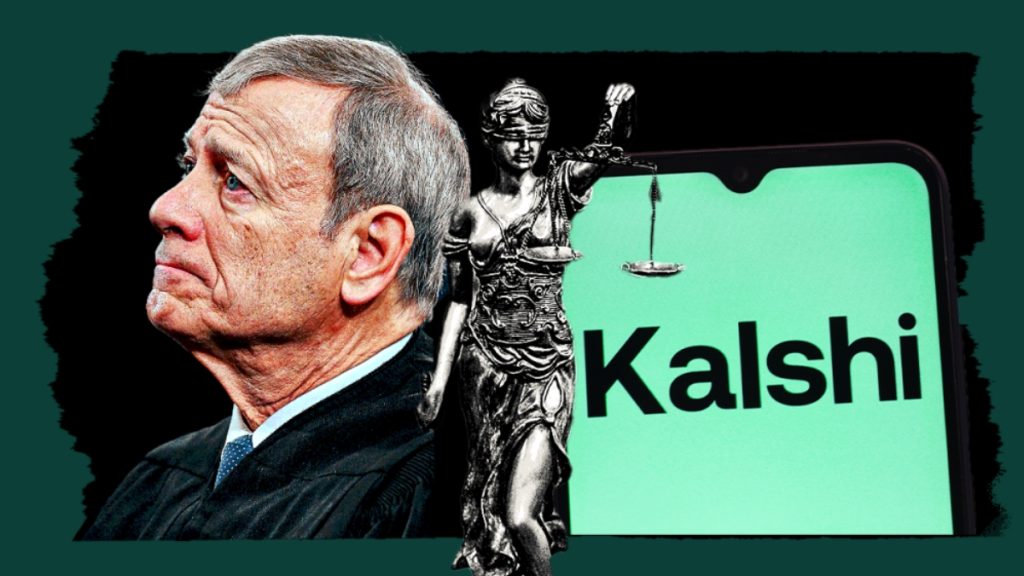
AG Skrmetti filed an appeal with the U.S. Court of Appeals for the Sixth Circuit, asking the court to reverse the February ruling that stopped Tennessee from enforcing its sports betting laws against Kalshi.
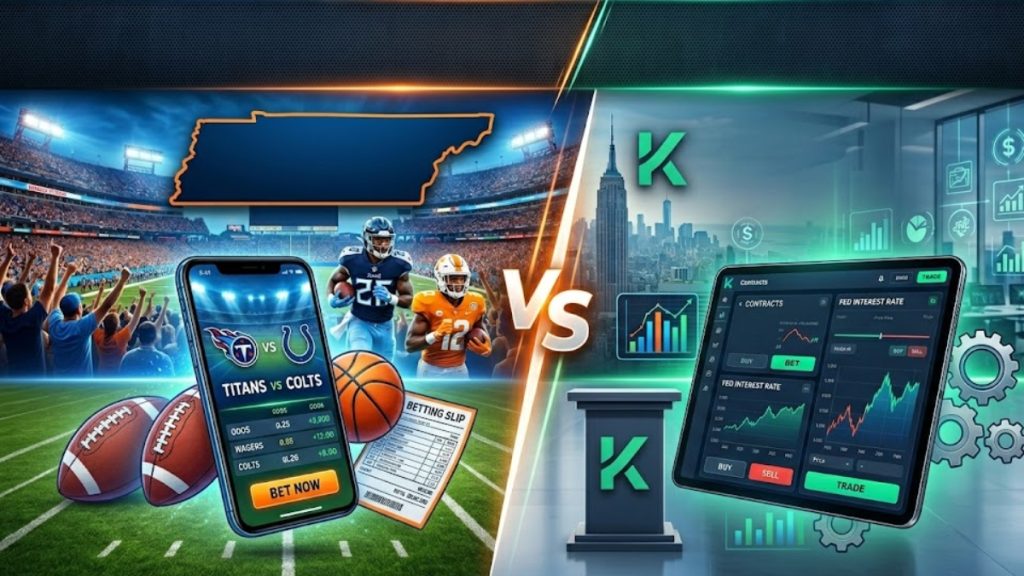
Tennessee’s argument is straightforward: Kalshi’s sports event contracts — who wins games, player performance, point spreads — are sports betting. Period. They should follow the same state laws that apply to FanDuel, DraftKings, and BetMGM in Tennessee.
Kalshi disagrees. The company argues its products are federally regulated financial instruments called “swaps,” supervised by the Commodity Futures Trading Commission (CFTC). If they’re swaps, state gambling regulators have no jurisdiction. That’s the core fight.
“Kalshi can call their bets ‘swaps’ all they want,” Skrmetti said, “but everyone who so much as glances at the platform understands that this is sports gambling.”
He’s not wrong. I looked at Kalshi’s sports offerings back in March. You’re literally betting on whether the Titans cover the spread. That’s a sports bet wearing a Wall Street costume. The “swap” framing is creative, but come on.
Courts around the country are split. Tennessee and New Jersey got early rulings favoring Kalshi. Nevada, Ohio, and Maryland courts have been more skeptical. A bipartisan federal bill — the “Prediction Markets Are Gambling Act,” introduced March 23, 2026 — would ban sports and casino-style event contracts on these platforms entirely. That bill is still in committee.
The Sixth Circuit ruling could take months, but it’ll be one of the most consequential decisions in the entire prediction market fight. Tennessee is betting that appellate judges will side with state gambling regulation over federal financial product classification.
Is Sports Betting Legal in Tennessee Right Now?
Yes. Tennessee legalized online sports betting in 2019 and launched in November 2020. It’s been one of the busier mobile-only markets in the country. No retail sportsbooks — Tennessee is online-only.
Currently legal:
- Mobile sports betting through licensed operators
- Standard game lines, totals, futures
- Prop bets and parlays
- Live in-game wagering
What just became illegal:
- Sweepstakes casino operations (SB 2136)
- Prediction market manipulation (SB 1992 — felony)
- Kalshi’s status remains in federal court limbo
Tennessee’s market runs on a minimum hold requirement — operators must retain at least 10% of handle as gross revenue. The state takes a 20% tax on that adjusted gross revenue. Both figures have been criticized as too high by operators, but the market keeps humming.
How Does Tennessee’s Crackdown Compare to Other States?
Tennessee is among the most aggressive states in the country right now when it comes to shutting down non-regulated gambling products.
Tennessee is the only state attacking on all three fronts simultaneously: sweepstakes ban, prediction market criminal liability, AND active federal court battles. That’s about as aggressive as it gets.
The Volunteer State has always been a weird market. Online-only with no retail. High minimum hold. Now it’s positioning itself as the national test case for whether states can regulate prediction markets the same way they regulate sportsbooks.
What Should Tennessee Bettors Watch For Next?
Here’s your timeline:
- SB 2136 and SB 1992 enforcement — both laws are now active; AG Skrmetti’s office will enforce
- Sixth Circuit ruling on Kalshi — could come by late 2026 or early 2027
- Federal “Prediction Markets Are Gambling Act” — the bipartisan bill (S.4160) is in Senate committee; if it passes, it would override the Kalshi federal preemption argument entirely
- Sweepstakes operator fallout — watch for lawsuits from sweepstakes companies challenging SB 2136
For Tennessee bettors who were using sweepstakes casinos or Kalshi for sports-adjacent gambling, those doors just closed. Licensed sportsbooks are your regulated option. For everything else — props, casino games, prediction-style wagers without state oversight — offshore books like Bovada, BetUS, MyBookie, BetOnline, BetNow, Everygame, and TheOnlineCasino accept Tennessee residents and don’t answer to AG Skrmetti.
We covered the sweepstakes ban passing the Tennessee legislature last month. Now it’s law. Follow our state betting coverage and prediction market news for what happens when the Sixth Circuit rules.
Frequently Asked Questions
1. Can I still bet on sports legally in Tennessee?
Absolutely. Licensed mobile sportsbooks are fully legal and operational. Nothing has changed for standard sports betting. The new laws target sweepstakes casinos and prediction market manipulation — not your regular sportsbook app.
2. Is it a crime to use Kalshi in Tennessee?
Using Kalshi itself is not a crime under SB 1992. The felony applies specifically to people who manipulate event outcomes while holding prediction market contracts. But Kalshi’s ability to offer sports contracts in Tennessee is being fought in the Sixth Circuit — the platform may eventually be forced out regardless.
3. What counts as a sweepstakes casino under the ban?
Any online platform that uses virtual, dual, or multi-currency systems to offer casino-style games (slots, table games, bingo, video poker) where the virtual currency can be exchanged for cash or prizes. Traditional loyalty programs and genuine sweepstakes promotions without cash redemption are not affected.
📂 Explore more: Tennessee