The full blackjack basic strategy chart for hard totals, soft totals and pairs, plus what each common mistake costs in dollars per $100 bet.

A blackjack strategy chart tells you the best move for every hand you can be dealt, based on your cards and the dealer’s one face-up card, and following it cuts the casino’s edge to about 0.4% to 0.5%. This page gives you the full chart for the most common online rules (4 to 8 decks, dealer stands on soft 17), explains how to read it, and adds something most charts skip: what each wrong move actually costs you.
The Quick Version
- One chart covers almost every online table. The chart below fits games with 4 to 8 decks, a dealer who stands on soft 17, a 3:2 blackjack payout and double after split allowed. Check those rules on the game screen first.
- Basic strategy cuts the edge to roughly 0.43%. That is the Atlantic City figure from Wizard of Odds. At $10 a hand over 100 hands, the expected cost is about $4.30.
- Bad habits cost 9 to 23 times more. “Never bust” costs about 3.91%, “mimic the dealer” about 5.48%, and “assume the dealer has a ten” about 10.03%.
- Missed doubles and splits are the expensive mistakes. In our calculation, not splitting aces against a 6 costs about $51 per $100 bet. Standing on 12 against a 2 costs about $3.80.
- Our take: memorize the doubles and splits first, then the stand-or-hit rows. That order fixes the costliest errors fastest.
What Is a Blackjack Strategy Chart and Which Rules Does It Assume?
A blackjack strategy chart (also called basic strategy) is a lookup table. You find your hand on the left side, find the dealer’s face-up card across the top, and read the best move where they meet. The moves come from running the math on every possible hand millions of times. They are not opinions or hunches.
Every chart assumes certain rules. The chart on this page uses the standard online setup from the Wizard of Odds 4-8 deck chart: 4 to 8 decks, the dealer stands on soft 17, you can double after splitting, blackjack pays 3:2, and the dealer checks for blackjack before you play. We compared it with the Blackjack Apprenticeship chart for the same rules, and the two agree on every hard total, soft total and pair.
Soft 17 means a dealer hand that counts an ace as 11, such as ace and 6. “Stands on soft 17” is the version that is better for you. If your game uses different rules, jump to the section on rule changes below. If you are brand new, start with our beginner guide to playing blackjack online, then come back here.
What Is the Basic Strategy Chart for Hard Totals?
A hard total is a hand with no ace, or an ace that must count as 1. Find your total on the left and the dealer’s card across the top. Key for every table on this page: H = hit, S = stand, D = double (hit if doubling is not allowed), Ds = double (stand if doubling is not allowed), P = split, Ph = split if doubling after a split is allowed, otherwise hit, R = surrender if allowed, otherwise hit.
| Your hard total | Dealer 2 | Dealer 3 | Dealer 4 | Dealer 5 | Dealer 6 | Dealer 7 | Dealer 8 | Dealer 9 | Dealer 10 | Dealer A |
|---|---|---|---|---|---|---|---|---|---|---|
| 8 or less | H | H | H | H | H | H | H | H | H | H |
| 9 | H | D | D | D | D | H | H | H | H | H |
| 10 | D | D | D | D | D | D | D | D | H | H |
| 11 | D | D | D | D | D | D | D | D | D | H |
| 12 | H | H | S | S | S | H | H | H | H | H |
| 13 or 14 | S | S | S | S | S | H | H | H | H | H |
| 15 | S | S | S | S | S | H | H | H | R | H |
| 16 | S | S | S | S | S | H | H | R | R | R |
| 17 or more | S | S | S | S | S | S | S | S | S | S |
Two things stand out. First, you stand on 12 through 16 only when the dealer shows a 6 or lower, because those are the cards most likely to make the dealer bust. Second, 11 is a double against everything except an ace. Surrender (R) lets you give up half your bet and is not offered at every table. When it is offered, it saves money on 16 against a 9, 10 or ace and on 15 against a 10.
What Is the Basic Strategy Chart for Soft Totals?
A soft total includes an ace that counts as 11 without busting. Because the ace can drop to 1, you cannot bust with one more card, so you can be bolder.
| Your soft hand | Dealer 2 | Dealer 3 | Dealer 4 | Dealer 5 | Dealer 6 | Dealer 7 | Dealer 8 | Dealer 9 | Dealer 10 | Dealer A |
|---|---|---|---|---|---|---|---|---|---|---|
| A,2 (soft 13) | H | H | H | D | D | H | H | H | H | H |
| A,3 (soft 14) | H | H | H | D | D | H | H | H | H | H |
| A,4 (soft 15) | H | H | D | D | D | H | H | H | H | H |
| A,5 (soft 16) | H | H | D | D | D | H | H | H | H | H |
| A,6 (soft 17) | H | D | D | D | D | H | H | H | H | H |
| A,7 (soft 18) | S | Ds | Ds | Ds | Ds | S | S | H | H | H |
| A,8 or A,9 (soft 19 or 20) | S | S | S | S | S | S | S | S | S | S |
The row that surprises beginners is soft 18 (ace and 7). Many players stand on it every time because 18 sounds strong. The chart says to hit it against a 9, 10 or ace, because those dealer cards often finish with 19 or better.
What Is the Basic Strategy Chart for Pairs?
| Your pair | Dealer 2 | Dealer 3 | Dealer 4 | Dealer 5 | Dealer 6 | Dealer 7 | Dealer 8 | Dealer 9 | Dealer 10 | Dealer A |
|---|---|---|---|---|---|---|---|---|---|---|
| 2,2 or 3,3 | Ph | Ph | P | P | P | P | H | H | H | H |
| 4,4 | H | H | H | Ph | Ph | H | H | H | H | H |
| 5,5 (play as hard 10) | D | D | D | D | D | D | D | D | H | H |
| 6,6 | Ph | P | P | P | P | H | H | H | H | H |
| 7,7 | P | P | P | P | P | P | H | H | H | H |
| 8,8 | P | P | P | P | P | P | P | P | P | P |
| 9,9 | P | P | P | P | P | S | P | P | S | S |
| 10,10 | S | S | S | S | S | S | S | S | S | S |
| A,A | P | P | P | P | P | P | P | P | P | P |
Two rules cover the most money. Always split aces and 8s. Never split 10s or 5s. Two aces are a weak 12 together but two strong starts apart. Two 8s make 16, the worst hard hand in the game, but 8 is a decent starting card. Splitting turns one bad hand into two playable ones. Two 10s are already 20, so you stand. Two 5s make a 10, which you double.
How Do the Rules Change the Chart?
The chart above is built for one set of rules. Small rule changes can move the edge by a lot, so check your game’s rules screen before you bet.
- Dealer hits soft 17. The Wizard of Odds 4-8 deck chart notes you should double 11 against an ace in that game. Hitting soft 17 also raises the house edge slightly, so pick a table where the dealer stands when you can.
- Blackjack pays 6:5 instead of 3:2. A $10 blackjack pays $12 instead of $15. The Wizard of Odds rule table prices this at about 1.39 percentage points of extra house edge. Skip those tables. No chart fixes that.
- No doubling after a split. Every Ph in the pair chart becomes a hit.
- Surrender offered. Use the R plays in the hard-totals chart.
- Single or double deck. A few plays change, and the Wizard of Odds publishes separate charts for those games. Most online software tables deal many decks, so the chart above fits.
What Does Each Strategy Mistake Actually Cost?
Most strategy pages tell you the right play and stop there. We wanted to know how much the wrong play costs. So we calculated the expected result of the right play and the wrong play for the same hand, then took the difference. Think of it as the price tag on each mistake.
The method: we modeled an endless deck, with the dealer standing on soft 17, double after split allowed, splits allowed once and no surrender. We assumed the dealer has already checked for blackjack. Then we worked out the average result of each choice for each hand. Real multi-deck games differ by a few cents, so treat these as close estimates, not exact figures.
| Mistake | What the chart says | Cost per $100 bet on that hand |
|---|---|---|
| Hit A,A against a 6 | Split the aces | about $51 |
| Split 5s against a 6 | Double the 10 | about $45 |
| Hit 11 against a 6 | Double | about $33 |
| Stand on soft 17 against a 9 | Hit | about $27 |
| Stand on soft 17 against a 6 | Double | about $24 |
| Hit soft 18 against a 7 | Stand | about $23 |
| Split 10s against a 6 | Stand on 20 | about $13 |
| Stand on 16 against a 7 | Hit | about $6.10 |
| Stand on 12 against a 2 | Hit | about $3.80 |
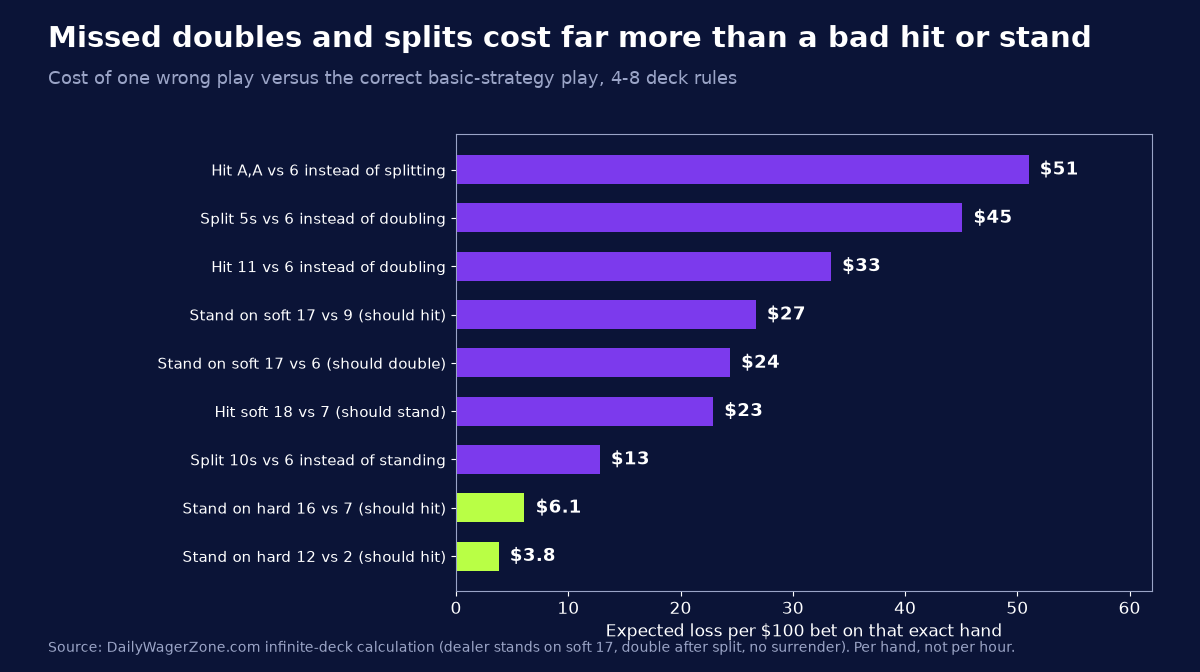
Look at the pattern. The three most expensive mistakes are all missed doubles and splits, the moments when you should put more money on the table or turn one hand into two. The “scary” plays, such as hitting 12 against a 2 or 16 against a 7, cost only a few dollars per $100. A caution: this table is per hand. Hands like 12 through 16 come up far more often than A,A against a 6, so the cheap mistakes still add up. We did not weight by frequency.
Our take: when you study the chart, learn the money rows first: always split aces and 8s, double 10 and 11, and double soft hands against a 5 or 6. Those few rules fix the costliest errors. Then memorize the stand-or-hit rows for 12 through 16.
How Much Do Popular Bad Strategies Cost?
The Wizard of Odds blackjack page tests three common habits. Each one sounds reasonable at the table, and each one is very expensive. All three use Atlantic City rules, where basic strategy carries a 0.43% house edge. The expected loss column is our arithmetic on $1,000 wagered ($10 a hand for 100 hands), where the loss is $1,000 times the edge.
| Strategy | What the player does | House edge (Wizard of Odds) | Expected loss on $1,000 wagered |
|---|---|---|---|
| Basic strategy | Follow the chart | 0.43% | $4.30 |
| Never bust | Never hit a hard 12 or higher | 3.91% | $39.10 |
| Mimic the dealer | Hit to 16, stand on 17, never double or split | 5.48% | $54.80 |
| Assume a ten in the hole | Play as if the dealer’s hidden card is a 10 | 10.03% | $100.30 |
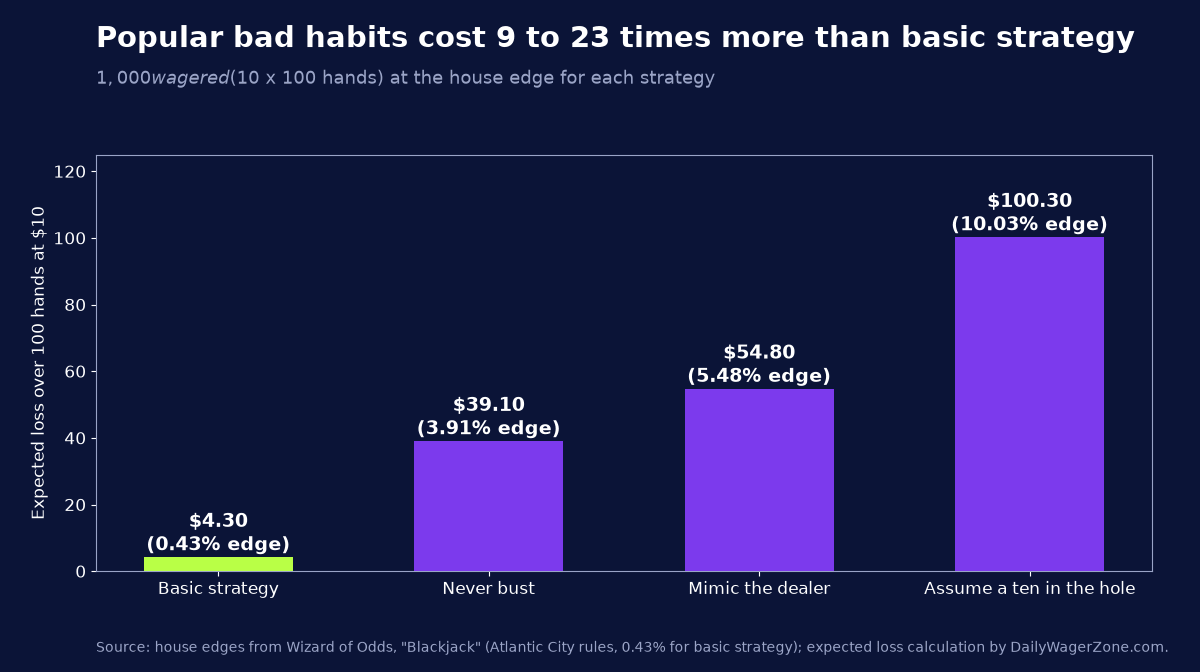
We cross-checked the first two with our own calculator. It gave about 3.96% for never bust and 5.72% for mimic the dealer, within about 0.2 percentage points of the published numbers. The gap is expected, because our model uses an endless deck and allows only one split. These strategies are costly because the dealer plays last. A player who never busts keeps hands that lose to almost any dealer result. A player who mimics the dealer gives up every double and split.
Should You Take Insurance in Blackjack?
No. Insurance is a side bet offered when the dealer shows an ace. It pays 2 to 1 if the dealer has blackjack. Here is the math with an endless deck, where 4 of every 13 cards are worth 10. The dealer has blackjack 4 times out of 13 and does not 9 times out of 13. On a $1 insurance bet you win $2 four times out of 13 and lose $1 nine times out of 13. The average result is (4 x $2 – 9 x $1) / 13 = -$1/13 = about -7.7 cents per dollar. That is a house edge near 7.7%, far above the 0.4% on the main bet. Both charts above say to decline insurance and “even money” every time.
How Do You Use the Chart at an Online Table?
- Check the rules screen. Look for dealer stands on soft 17, blackjack pays 3:2, double after split, and the number of decks. If blackjack pays 6:5, leave.
- Keep the chart open in another tab. Software blackjack has no clock, so look up every hand until the chart feels automatic.
- Use live dealer tables with care. They run on a timer, so learn the chart on software tables first.
- Set a loss limit first. Strategy lowers the edge, but it does not remove it. Our casino bankroll management guide shows how much to bring and how long it lasts.
- Read bonus terms before you play. Many casinos count blackjack at a reduced rate or exclude it when you clear a bonus. The wagering rules in each casino’s terms decide this.
You can find blackjack at offshore casinos that accept U.S. players. We compare rooms in our best online blackjack sites guide. When we checked on Oct. 15, 2026, BetOnline Casino, MyBookie and BetUS each listed blackjack on their own casino pages. We did not test deposits, withdrawals or payouts at any of them, and we do not quote bonus amounts because offers change. Check the current terms on each site.
Affiliate disclosure: DWZ may earn a commission if you sign up through these links, at no cost to you. This does not change the chart or the figures above.
Important: offshore casinos are not licensed by U.S. state gaming regulators, so state consumer protections do not apply the way they do at a state-licensed casino. Whether you can play depends on where you live, so check your state’s rules first. Only play with money you can afford to lose. Gambling should be entertainment, not income. If it stops being fun, free confidential help is available 24/7 from the National Problem Gambling Helpline at 1-800-MY-RESET (1-800-697-3738). The National Council on Problem Gambling says the older number, 1-800-522-4700, also remains active.
Where Should You Go Next?
| If you want to… | Read this |
|---|---|
| See how blackjack compares with other games | Casino games guide: RTP, house edge and volatility |
| Learn the rules from scratch | How to play blackjack online |
| Set a budget | How much to bring, by game |
| Find a blackjack site | Blackjack rooms compared |
References
- Wizard of Odds. “The Wizard of Odds: Blackjack basic strategy, 4 to 8 decks.” Page last updated Aug. 3, 2026. Checked October 16, 2026.
- Wizard of Odds. “Blackjack” (Bad Strategies: never bust, mimic the dealer, assume a ten in the hole). Checked October 16, 2026.
- Wizard of Odds. “Blackjack Rule Variations.” Checked October 16, 2026.
- Blackjack Apprenticeship. “S17 Basic Strategy” (PDF). Checked October 16, 2026.
- National Council on Problem Gambling. “NCPG Adopts 1-800-MY-RESET as New National Problem Gambling Helpline Number.” Jan. 29, 2026. Checked October 16, 2026.