Casino Games Hub: RTP, House Edge, Volatility and Strategy
RTP, house edge and volatility explained with worked math, a house-edge table for blackjack, craps, baccarat, roulette, video poker and slots, and a cost-per-hour calculator table.
Home » Casino Games Hub: RTP, House Edge, Volatility and Strategy
This casino games guide comes down to one idea: every casino game has a built-in house edge, and your expected loss is the amount you bet times that edge. Three terms explain almost everything about casino math: RTP, house edge and volatility. This page defines each one, shows the arithmetic, compares the most popular games using published house edges, and then adds a calculation you will not find on most casino pages: what each game costs you per hour.
By Maya Torres. Last updated: October 15, 2026.
The Quick Version
RTP and house edge are two sides of one number. RTP (return to player) plus house edge always equals 100%. A 96% RTP slot has a 4% house edge.
Expected loss = amount bet x house edge. Bet $1,000 in total at a 1% edge and you expect to lose about $10. That is an average over many bets, not a promise for one night.
The bet matters more than the game. Craps Pass Line costs 1.41%. Craps Any Seven costs 16.67%. Baccarat Banker costs 1.06%. Baccarat Tie costs 14.36%.
Pace multiplies the edge. At a $10 average bet, a 2% slot played 600 times an hour costs $120 an hour. Blackjack at 0.28% played 60 times an hour costs $1.68.
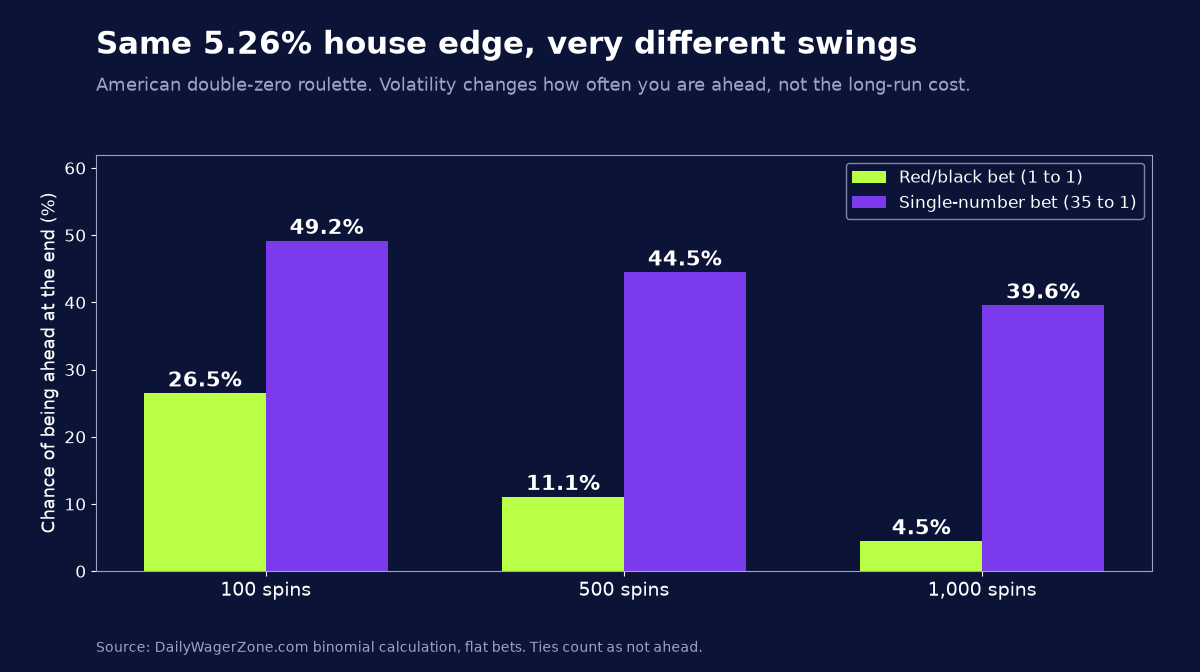
Volatility changes the swings, not the long-run cost. On double-zero roulette, a red bet and a single-number bet both cost 5.26%, but after 1,000 spins you are ahead 4.5% of the time on red and 39.6% of the time on a single number.
Our take: pick the game and the bet first, then set a loss limit from the hourly-cost table below. Choosing a low-edge game and a slow pace is the only “strategy” that works in every casino game.
Trust & Authority
Item
Details
Sources
Wizard of Odds, “What is the House Edge?” (updated Aug. 3, 2026) and “Blackjack Rule Variations”; UK Gambling Commission, “How to calculate return to player (RTP)”; National Council on Problem Gambling, 1-800-MY-RESET announcement (Jan. 29, 2026). All checked Oct. 15, 2026.
Original analysis
An expected-loss-per-hour table (bets per hour x average bet x house edge) and a red-versus-single-number roulette calculation showing how volatility changes your chance of being ahead. All arithmetic is shown. Betting pace is an assumption you can change, not measured data.
Author
Maya Torres, casino and gambling guides, Daily Wager Zone
Disclosure
This guide links to BetOnline, MyBookie, BetUS and BetNow through affiliate links. DWZ may earn a commission at no cost to you. We did not test any casino for this guide. Offshore casinos are not licensed by U.S. state regulators.
What Are RTP, House Edge and Volatility?
RTP is the share of all money wagered that a game pays back to players over a very long run. House edge is the share the casino keeps. They are mirror images: RTP + house edge = 100%. Volatility (also called variance) describes how big and how often the wins and losses swing around that average. RTP and house edge tell you the average cost. Volatility tells you how bumpy the ride is.
Here is the math with a slot that has a 96% RTP. Wager $100 in total across many spins and the game is built to return $96. The house keeps $4. So the house edge is 100% – 96% = 4%, and the expected loss is $100 x 0.04 = $4. You will almost never end a session at exactly -$4. You might win $60 or lose $90. The $4 is the long-run average.
The UK Gambling Commission treats RTP the same way and shows how to check it: a game designed for 91.68% RTP that took £1,200,000 in bets and paid £1,085,000 in wins had an actual RTP of 1,085,000 / 1,200,000 = 90.42%. The Commission adds that volatility sets how far actual results may drift from the design figure, and that the drift shrinks as the number of plays grows. That is the whole idea of this page in one sentence: averages are reliable over huge numbers of bets and unreliable over one session.
What Is the House Edge on Each Popular Casino Game?
Here are the figures from Wizard of Odds, which lists house edges assuming optimal or near-optimal player strategy and was last updated Aug. 3, 2026. We pulled the most common bets for the six game families this hub covers.
Game
Bet or rules
House edge
RTP (100% minus edge)
Blackjack
Liberal Vegas rules, basic strategy
0.28%
99.72%
Blackjack
Same game with a 6-to-5 blackjack payout (rough estimate, see note)
about 1.67%
about 98.33%
Craps
Pass Line / Come
1.41%
98.59%
Craps
Don’t Pass / Don’t Come
1.36%
98.64%
Craps
Odds behind a Pass Line bet (any point)
0.00%
100.00%
Craps
Field (pays 2 to 1 on 12)
5.56%
94.44%
Craps
Any Seven
16.67%
83.33%
Baccarat
Banker
1.06%
98.94%
Baccarat
Player
1.24%
98.76%
Baccarat
Tie
14.36%
85.64%
Roulette
Single zero (European)
2.70%
97.30%
Roulette
Double zero (American), most bets
5.26%
94.74%
Video poker
Jacks or Better, full-pay paytable (9/6)
0.46%
99.54%
Slots
Range across machines
2% to 15%
85% to 98%
Notes on the table. The blackjack 6-to-5 line is our rough sum: the same source lists a 6-to-5 blackjack payout as costing the player about 1.39 percentage points on its Wizard of Odds rule table, and 0.28% + 1.39% = 1.67%. Treat it as an estimate, because the rule table is measured from a different starting game. The craps odds bet carries no edge on its own, but you can only place it after a Pass Line bet, so it lowers your average cost per dollar without removing the Pass Line edge. The roulette double-zero figure is 1/19 = 5.26%, and the same source notes one exception: the five-number bet (0-00-1-2-3) carries 7.89%. The slots range is based on available returns from a major manufacturer, so a specific game can sit outside it.
Look at how much the bet matters. In craps, the same table spans from 0% (odds) to 16.67% (Any Seven). In baccarat, Banker costs 1.06% and Tie costs 14.36%. A beginner who picks the right bet in the right game can play for a fraction of the cost of a beginner who picks the wrong one. Our guides to craps for beginners and baccarat rules explain which bets are which.
How Much Does Each Game Cost Per Hour?
This is the number casino pages leave out. The house edge is a percentage of money bet, so what you lose depends on how much you bet, and you bet more in a fast game. Use this formula:
Expected loss per hour = bets per hour x average bet x house edge
Example: 200 bets an hour at $10 each is $2,000 wagered. At a 1.06% edge (Baccarat Banker), the expected loss is $2,000 x 0.0106 = $21.20 an hour. The table below runs the same formula for a $10 average bet at three speeds. We do not claim any game runs at a certain speed. Online games and live dealer tables move at different rates, so pick the column closest to how you play, or time yourself for ten minutes and scale it up.
Game and bet
House edge
Expected loss per $1,000 wagered
Per hour at 60 bets
Per hour at 200 bets
Per hour at 600 bets
Blackjack, liberal rules
0.28%
$2.80
$1.68
$5.60
$16.80
Video poker, 9/6 Jacks or Better
0.46%
$4.60
$2.76
$9.20
$27.60
Baccarat, Banker
1.06%
$10.60
$6.36
$21.20
$63.60
Craps, Pass Line
1.41%
$14.10
$8.46
$28.20
$84.60
Slots, low end of range
2.00%
$20.00
$12.00
$40.00
$120.00
Roulette, single zero
2.70%
$27.00
$16.20
$54.00
$162.00
Roulette, double zero
5.26%
$52.60
$31.56
$105.20
$315.60
Slots, high end of range
15.00%
$150.00
$90.00
$300.00
$900.00
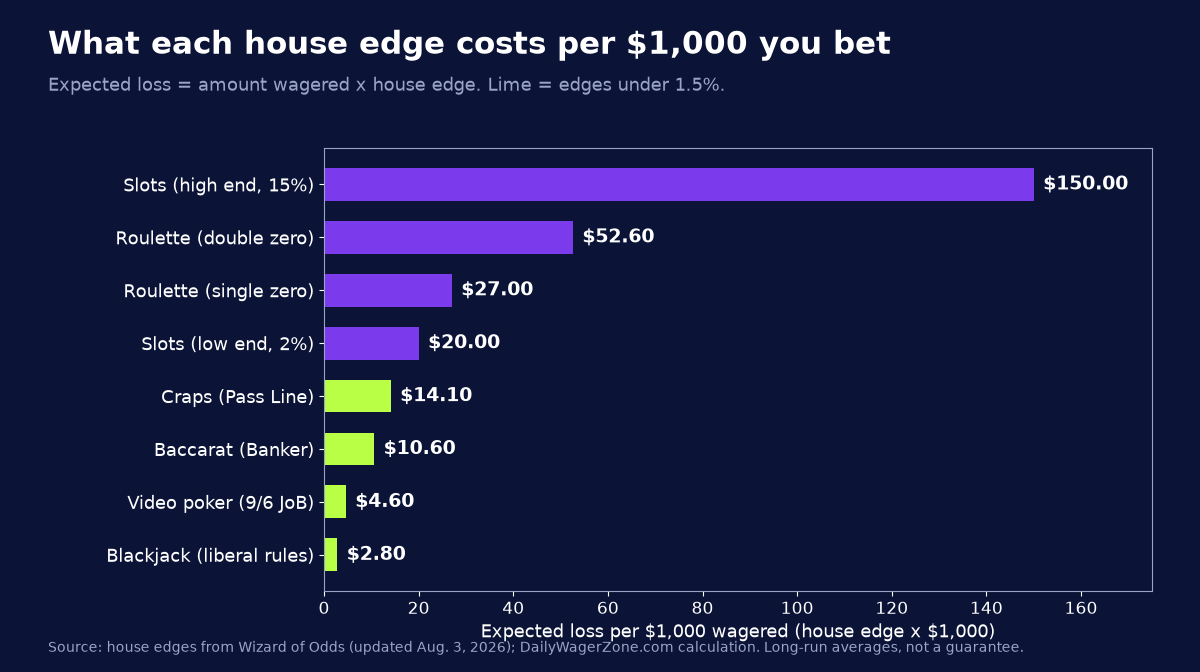
Expected loss per $1,000 wagered. House edges from Wizard of Odds; calculation by DailyWagerZone.com.
Two things jump out. First, speed matters as much as the game. Slots at the 2% end of the range, played 600 times an hour, cost $120 an hour. Blackjack at 60 hands an hour costs $1.68, about 71 times less. Second, a game with a bigger edge is not always the costlier hour. Video poker at 0.46% and 600 hands an hour costs $27.60, which is less than double-zero roulette at 60 spins an hour ($31.56). Those are pure arithmetic from the stated assumptions, not measured results.
Our take: before you sit down, multiply your expected hourly cost by the hours you plan to play and treat the result as the price of the entertainment. If $120 an hour is more than you would pay for a night out, slow down or choose a lower-edge game. Our guide to casino bankroll management shows how much to bring for each game.
What Does Volatility Change, and What Does It Not?
Volatility does not change the long-run cost. It changes how often you are ahead on the way there. American roulette shows this cleanly because two very different bets cost exactly the same. Bet $1 on red: you win $1 with probability 18/38 and lose $1 with probability 20/38. The average result is (18/38 x 1) + (20/38 x -1) = -2/38 = -$0.0526, a 5.26% edge. Bet $1 on a single number: you win $35 with probability 1/38 and lose $1 with probability 37/38. The average is (1/38 x 35) + (37/38 x -1) = -2/38 = -$0.0526. Same edge.
The swings are not the same. The standard deviation, which is the typical size of one bet’s swing around the average, is about $1.00 for the red bet and $5.76 for the single-number bet. We worked that out from the formula: standard deviation = the square root of (average of squared results minus the squared average). With a $10 bet and 100 spins, both bets lose $52.63 on average. The red bettor’s total typically lands within about $100 of that average. The single-number bettor’s total typically lands within about $576 of it.
Spins at $10 flat
Average loss (both bets)
Chance ahead: red/black
Chance ahead: single number
100
$52.63
26.5%
49.2%
500
$263.16
11.1%
44.5%
1,000
$526.32
4.5%
39.6%
Same 5.26% house edge, different volatility. DailyWagerZone.com calculation with flat bets.
Read that table carefully. The single-number bettor is ahead far more often, because one 35-to-1 hit can erase many losses. But when that player is not ahead, the hole is deeper. And both pay the same price per dollar. After 1,000 spins you are ahead about 4.5% of the time on red and about 39.6% of the time on a single number, yet the expected loss is $526.32 either way. The “chance ahead” figures are our binomial calculations with flat $10 bets, counting ties as not ahead.
This is why high-volatility slots can feel generous and then drain a bankroll fast, while low-volatility games feel steady and still lose to the edge over time. If a game says it has a 96% RTP, that tells you the average. It does not tell you whether you will see small frequent wins or rare big ones. Check both numbers, and use this simulation guide to see volatility in action.
Which Strategy Actually Changes the House Edge?
It depends on the game. In some games your decisions move the edge. In others they only decide which bet you make, and in slots you only choose the game and your pace.
Blackjack: decisions matter a lot. Basic strategy is what gets the edge down to the 0.28% shown above, and the rules matter too. A 6-to-5 payout instead of 3-to-2 adds about 1.39 percentage points. Start with our blackjack beginner guide and compare rooms in the best online blackjack sites roundup.
Video poker: the paytable matters most. A full-pay 9/6 Jacks or Better game returns 99.54% with optimal play. Weaker paytables return less, and you need correct holds to reach the stated figure. See our video poker strategy guide.
Craps and baccarat: pick the right bet. There is no way to out-play the dice or the cards. The skill is avoiding the high-edge bets in the table above. Stay with Pass Line plus odds in craps and Banker in baccarat.
Roulette: no system beats the edge. Every spin is independent, and the edge is built into the zeros. The only real choice is single zero over double zero, which cuts the cost roughly in half (2.70% vs 5.26%). Our roulette strategy for beginners explains why betting systems do not change the math.
Slots: choose the game, not a trick. Look up the RTP, match the volatility to your budget and keep spins slow. We rank rooms in best online slots for real money.
Poker works differently from every game above. You play against other players, not the casino, and the room earns a fee called rake. That is a separate math problem, and we cover it in our online poker rooms guide.
How Do Casino Bonuses Change the Math?
A bonus is not free money until you clear its wagering requirement, and clearing it means betting, which costs the house edge. Here is a hypothetical, not a real offer: a $100 bonus with a 30x wagering requirement on the bonus amount means $3,000 in required bets. On slots with a 4% edge, the expected loss while clearing it is $3,000 x 0.04 = $120. That is more than the $100 bonus. The same $3,000 played on blackjack at 0.28% costs $8.40 in expectation, but many casinos count blackjack at a reduced rate or exclude it, which is why the terms matter. Always read the game weighting and maximum bet rules. Our casino bonus terms guide walks through each one.
Where Can You Play These Games Online?
Offshore casinos accept many U.S. players, including players in states without a local legal option. We link to four brands, listed in the order we use on our casino board. Each one listed the game types below on its own casino pages when we checked on Oct. 15, 2026. We did not test deposits, withdrawals or payouts at any of them.
RNG craps, live dealer roulette and baccarat (shown on its home page)
Current offers and wagering rules on BetNow’s site
Important: offshore casinos are not licensed by U.S. state gaming regulators, so state consumer protections do not apply the way they do at a state-licensed casino. Whether you can legally play depends on where you live, so check your state’s rules first. Read each casino’s payout terms, limits and bonus rules before you deposit, and only deposit money you can afford to lose. We do not quote bonus amounts here because offers change. Check the current terms on the casino’s site.
Affiliate disclosure: DWZ may earn a commission if you sign up through these links, at no cost to you. This does not change our analysis or the house-edge figures above.
What Should You Check Before You Play Any Casino Game?
What is the exact bet? Find its house edge in the table above. Skip anything over about 5% unless you are paying for pure entertainment.
What are the rules? Blackjack payout, roulette zeros, video poker paytable and slot RTP can each change the edge by a point or more.
What is your pace? Multiply your bets per hour by your average bet by the edge. That is your hourly price.
Can you handle the swings? Higher volatility means longer losing runs and a bigger bankroll needed, even at the same edge.
What is your loss limit? Decide it before you start, in dollars, and stop when you hit it. Never chase losses.
Gambling should be entertainment, not income. If it stops being fun, free confidential help is available 24/7 from the National Problem Gambling Helpline at 1-800-MY-RESET (1-800-697-3738). The National Council on Problem Gambling says the older number, 1-800-522-4700, also remains active.
Maya Torres writes casino, iGaming and gambling guides at Daily Wager Zone. Her work covers how casino games and offshore casinos work for U.S. players, with a focus on plain-English math and sourcing.
Written by
Maya Torres
Maya Torres is a sports betting legislation analyst and regulatory writer covering the state-by-state legalization of sports betting across the United States. With a background in policy research and legal media, Maya tracks active legislation, ballot initiatives, and regulatory changes in every US state — giving bettors and industry observers the most current picture of where legal wagering stands nationwide.
Her work at DailyWagerZone focuses on comprehensive state pillar pages, bill tracking, and breaking news around sports betting law. Maya approaches regulatory content with the same depth and sourcing standards applied to legal journalism — citing official bill text, legislative calendars, and statements from gaming commissions rather than recycling secondhand reporting.
Before joining DailyWagerZone, Maya covered gambling law and public policy for independent legal and sports media outlets. She has tracked sports betting legislation since the Supreme Court's 2018 PASPA ruling opened the door to state-by-state legalization and has documented every major legislative development since.
Maya is based in Austin, Texas — a state still fighting for legalization — which gives her a personal stake in the coverage she produces. She can be found on Bluesky at @mayatorres-betting.bsky.social and Reddit at u/MayaTorres_DWZ.