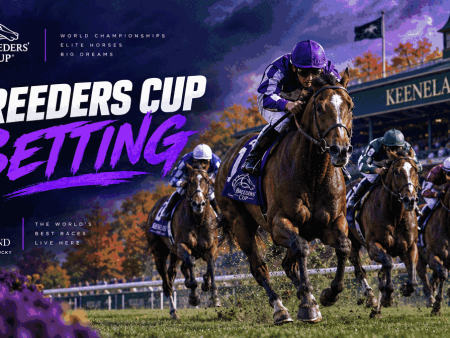

Quick answer: The Breeders’ Cup 2026 runs Friday, October 30 and Saturday, October 31, 2026 at Keeneland Race Course in Lexington, Kentucky. It is a two-day, 14-race world championship for horse racing. Friday is Future Stars Friday, which is built around the races for young horses. Saturday is Championship Saturday, and it ends with the $7 million Breeders’ Cup Classic. You can bet the whole card online with the sportsbooks and racebooks we list below.
The Breeders’ Cup is the biggest betting weekend in horse racing. The Kentucky Derby is one race and one age group. The Breeders’ Cup is 14 races, two days, and the best horses in the world in almost every division. That means more bets, bigger pools, and more ways to find value.
This guide is the starting point if you are new to it. We cover the 2026 dates, the Keeneland venue, the full race card, the bet types, where to bet online, and simple tips that keep beginners out of trouble. No jargon without a plain-English definition. Keep this page bookmarked, because our contender profiles, odds updates, and race previews all build off it.
Key Takeaways
- Dates: October 30-31, 2026, a Friday and Saturday.
- Venue: Keeneland Race Course in Lexington, Kentucky, a track that has hosted the event before.
- Races: 14 championship races over two days, split between dirt and turf.
- Format: Friday is Future Stars Friday for two-year-olds. Saturday holds the Classic, Turf, Sprint, Distaff, Mile and more.
- Betting: Start with win, place and show bets. Add exactas and pick fours only once you are comfortable.
- Big money: The Breeders’ Cup Betting Challenge costs $10,000 to enter and gives players a $7,500 live bankroll.
This guide is built from the official Breeders’ Cup event schedule and published Betting Challenge rules, Keeneland Race Course track information, and standard pari-mutuel wagering rules used by licensed racebooks. Race dates, purses and post times can change, so we note what is confirmed and what is still subject to change. Odds and contender information will be updated in separate articles as the 2026 season plays out.
Affiliate Disclosure: Daily Wager Zone may earn a commission if you sign up through our links at no extra cost to you. This does not influence our analysis or recommendations.
What Is the Breeders’ Cup?
The Breeders’ Cup is the year-end world championship of thoroughbred racing. It was first run in 1984. Every year it moves to a different host track, and the best horses from the United States, Europe, Japan and beyond ship in to settle who is best.
Here is the part that matters for bettors. Racing is split into divisions. A division is a group based on age, sex, distance and surface. Sprinters run short. Turf horses run on grass. Fillies and mares are female horses. The Breeders’ Cup crowns a champion in each of those divisions on the same weekend.
So you are not betting one big race. You are betting a card full of small, deep, high-quality fields. Most races have 8 to 14 runners. Many of them have never met before. That mix is why payouts can get large, even when a favorite wins.
Why It Is Different From the Kentucky Derby
The Derby is for three-year-olds only, and it always runs at Churchill Downs. Many Derby runners are unproven. The Breeders’ Cup is open to older horses too, and most of the field has already proven something. There is more form to study and fewer total unknowns.
That cuts both ways. Better form means sharper odds. It also means you can handicap with real evidence instead of guessing. Handicapping just means studying the runners to figure out who should win and at what price.
Breeders’ Cup 2026 Dates and Venue
The 2026 Breeders’ Cup is set for Friday, October 30 and Saturday, October 31, 2026. The host is Keeneland Race Course in Lexington, Kentucky. Halloween falls on Championship Saturday, which is a fun bonus if you are planning a watch party.
Post times are not final this far out. Expect Friday to run in the afternoon and early evening, and expect Saturday to be a long card that ends with the Classic in prime time on the East Coast. We will post the confirmed post-time schedule once the Breeders’ Cup releases it.
Why Keeneland Matters for Bettors
Keeneland is not a neutral stage. It is a smaller track with its own shape and its own quirks, and those quirks show up in results. Here is what to keep in mind:
- Tight main track. The dirt oval is a mile and a sixteenth around. Turns come fast, so tactical speed helps.
- Short run to the first turn in some races. An outside post can cost a horse ground early.
- Strong turf course. Keeneland’s grass racing is well respected, and European shippers have done well there.
- Late-fall weather. End of October in Kentucky can mean rain. Wet ground changes turf races the most.
- Proven host. Keeneland has staged the Breeders’ Cup before, most recently in 2022, so there is recent race data to study.
The Full 2026 Race Card: 14 Championship Races
The Breeders’ Cup card has 14 championship races split across the two days. Friday is for two-year-olds. Saturday is for the older divisions and the headline events. The exact order of races is set closer to the event.
Friday: Future Stars Friday
Friday is branded Future Stars Friday. Every championship race that day is for two-year-olds, meaning horses in their first season of racing. These races often decide the early Kentucky Derby and Kentucky Oaks picture for the next spring.
| Friday Race | Surface | For |
|---|---|---|
| Juvenile Turf Sprint | Turf | Two-year-olds |
| Juvenile Fillies Turf | Turf | Two-year-old fillies |
| Juvenile Fillies | Dirt | Two-year-old fillies |
| Juvenile Turf | Turf | Two-year-olds |
| Juvenile Sprint | Dirt | Two-year-olds |
| Juvenile | Dirt | Two-year-olds |
Friday is the harder day to handicap. Young horses have run only a few times, so the form is thin. Prices are often bigger for the same reason. If you like longshots, this is your day, but keep the stakes small.
Saturday: Championship Saturday
Saturday is the main event. The card works through the sprint, mile and distance divisions on both surfaces, then finishes with the Breeders’ Cup Classic. The Classic is the richest race of the weekend and usually decides Horse of the Year.
| Saturday Race | Surface | Rough Distance |
|---|---|---|
| Filly & Mare Sprint | Dirt | 7 furlongs |
| Turf Sprint | Turf | About 5 to 6 furlongs |
| Dirt Mile | Dirt | 1 mile |
| Filly & Mare Turf | Turf | About 1 3/16 miles |
| Sprint | Dirt | 6 furlongs |
| Mile | Turf | 1 mile |
| Distaff | Dirt | 1 1/8 miles |
| Turf | Turf | About 1 1/2 miles |
| Classic | Dirt | 1 1/4 miles |
A furlong is one-eighth of a mile. So six furlongs is three-quarters of a mile, which is a short, fast sprint. A mile and a quarter, the Classic distance, asks for both speed and stamina. Exact distances at Keeneland may be adjusted slightly for the track configuration, and we will confirm them closer to race week.
How to Bet the Breeders’ Cup
Horse betting works differently from football or basketball betting. Most horse bets are pari-mutuel. That means you bet against the other bettors, not against the house. All the money goes into a pool, the track takes a cut, and the rest is split among the winners. Final odds are only known once betting closes.
Some online books also offer fixed odds on big races. Fixed odds lock in your price when you bet. If you take 8-1 and the horse drifts to 5-1, you still get paid at 8-1. Read the bet slip so you know which type you are getting.
Simple Bets: Win, Place and Show
Start here. These three bets are cheap, easy and hard to mess up.
- Win. Your horse must finish first. Best value if you have a strong opinion.
- Place. Your horse must finish first or second. Smaller payout, better hit rate.
- Show. Your horse must finish first, second or third. Smallest payout of the three.
- Across the board. One bet that covers win, place and show. A $2 across-the-board bet costs $6.
Exotic Bets Inside One Race
Exotic bets ask you to get the order of finish right. They pay a lot more and hit a lot less.
- Exacta. Pick the first two finishers in exact order.
- Quinella. Pick the first two in any order, where offered.
- Trifecta. Pick the first three in exact order.
- Superfecta. Pick the first four in exact order. Big scores live here, and so do big losing streaks.
You can also box a bet. Boxing means your horses can finish in any order, but you pay for every combination. A three-horse exacta box is six combinations, so a $1 box costs $6.
Say you like two horses in the Breeders’ Cup Sprint: #4 at 3-1 and #9 at 12-1. A straight $1 exacta of 4 over 9 costs $1 and only wins if #4 is first and #9 is second. A $1 exacta box of 4 and 9 costs $2 and wins if either one finishes first with the other second. If 4-9 pays $68 for $1, the straight bet returns $68 on a $1 risk. The box returns the same $68 for a $2 risk, but it also covers the 9-4 result. You are paying extra to be less precise.
Multi-Race Bets: Doubles and Pick Fours
Multi-race bets ask you to pick winners in a row. Breeders’ Cup weekend is the best time of year for these, because the pools get huge.
- Daily double. Winners of two straight races.
- Pick 3. Winners of three straight races.
- Pick 4. Winners of four straight races. The most popular multi-race bet on big cards.
- Pick 5 and Pick 6. Five or six straight winners. Life-changing payouts, tiny hit rates.
Cost grows fast. A pick four with three horses in each leg is 81 combinations. At 50 cents a combination that is $40.50. Always check the ticket cost before you submit it.
Where to Bet the Breeders’ Cup Online
You do not need to be in Kentucky to bet. Online books take action on the Breeders’ Cup from most of the country, and the four below are the ones we point readers to. Check the rules where you live before you sign up, and compare the welcome offers, because terms change.
- BetOnline. Deep racing menu and a long track list. A solid all-round pick if you want racing and other sports in one account.
- Bovada. Simple layout and easy navigation, which helps if this is your first time betting a race card.
- BetUS. Posts futures and division odds early, so it is useful for shopping prices before race week.
- MyBookie. Straightforward racebook with quick signup and regular promos on marquee events.
One practical note. Fund the account and complete any verification steps a few days early. Breeders’ Cup weekend is a peak traffic window, and you do not want to be fixing a deposit problem 10 minutes before the Classic.
The Breeders’ Cup Betting Challenge
The Breeders’ Cup Betting Challenge, or BCBC, is the event’s flagship handicapping contest. Entry is $10,000. Of that, $7,500 becomes your live bankroll, which means real money you wager on the championship races. The player with the largest bankroll at the end wins the top prize.
That is a serious buy-in, and it is not a beginner play. Most people get in through qualifying tournaments run by racebooks and contest sites, where a small entry can win a seat. If you are new, treat the BCBC as something to watch, not something to enter.
Breeders’ Cup Betting Tips for Beginners
Fourteen races in two days is a lot of chances to make a bad bet. These habits keep the weekend fun and keep your bankroll alive.
Set a Weekend Budget, Not a Race Budget
Decide what the whole weekend costs you before Friday starts. Then divide it. If you have $200 for two days, that is roughly $14 a race. You will not feel pressure to chase after a bad beat in race three.
Skip the Races You Do Not Understand
You are not required to bet all 14. Pass on the races where you have no read. Two or three well-researched bets beat 14 guesses every time.
Respect Surface and Distance
A horse that wins on dirt may be useless on turf. A sprinter stretching out to a mile and a quarter often stops late. Check whether the horse has already won at this surface and this distance. If it has not, ask yourself why today is different.
Look at Pace, Not Just Names
Pace is how fast the leaders go early. If four horses all want the lead, they tire each other out and a closer wins. If only one horse has early speed, it can run away uncontested. Scan the field and count how many runners need the lead.
Shop for Value, Not Just Winners
A 3-5 favorite can be the right horse and still a bad bet. Ask what price makes the bet worth it. If you think a horse has a one-in-four chance, you need better than 3-1 for the bet to make sense over time.
Key Storylines to Watch in 2026
Fields are not set yet, and any contender list this far out is guesswork. What you can track now are the themes that decide Breeders’ Cup weekends. Follow these through the summer and fall and you will be ahead of the crowd in October.
- The Classic picture. Watch the summer and fall dirt route races. Winners there tend to show up as short prices in the Classic.
- European turf raiders. Horses shipping in from Europe and Japan have a strong recent record in the turf races. Keeneland’s grass course suits them.
- Three-year-olds versus older horses. The 2026 Derby and Preakness generation meets seasoned older runners for the first time here. That clash creates mispriced horses.
- The Keeneland bias. Track configuration and late-fall ground matter. Early results on the day will tell you which running style is working.
- Future Stars form. Friday’s juvenile winners become next spring’s Derby and Oaks favorites, which makes Friday worth watching even if you do not bet it.
We will publish contender breakdowns, odds updates and race-by-race previews as the picture clears. Those pieces will link back to this guide, so you can always come back here for the basics.
Frequently Asked Questions
When is the 2026 Breeders’ Cup?
Friday, October 30 and Saturday, October 31, 2026. Friday is Future Stars Friday and Saturday is Championship Saturday. Post times are announced closer to the event.
Where is the Breeders’ Cup 2026?
Keeneland Race Course in Lexington, Kentucky. Keeneland has hosted the Breeders’ Cup before, most recently in 2022.
How many races are in the Breeders’ Cup?
There are 14 championship races across the two days. Friday holds the races for two-year-olds. Saturday holds the older divisions, including the Classic, Turf, Sprint, Distaff, Mile and Dirt Mile.
Can you bet on the Breeders’ Cup online?
Yes. Online sportsbooks and racebooks take Breeders’ Cup action, including win, place, show, exactas, trifectas and multi-race bets. Check the rules where you live, and fund your account before race week so nothing holds you up.
What is the Breeders’ Cup Betting Challenge?
It is the event’s flagship handicapping contest. Entry costs $10,000, and $7,500 of that becomes a live bankroll you bet on the championship races. Many players get in through smaller qualifying tournaments instead of paying full price.
Which Breeders’ Cup race is the biggest?
The Breeders’ Cup Classic. It is run at a mile and a quarter on dirt, carries the largest purse of the weekend, and usually settles Horse of the Year.
Gambling involves risk. Only wager what you can afford to lose. You must meet the minimum age requirement where you live to bet on horse racing or other sports. If you or someone you know has a gambling problem, call 1-800-522-4700 (National Council on Problem Gambling) or dial 211.