
Slot volatility is how bumpy a slot’s payouts are. Two slots can both return 96% over the long run, yet one pays small wins often and the other pays big wins rarely. We simulated 200,000 sessions of each. A high volatility slot wiped out a $100 bankroll in 83% of 300-spin sessions. A low volatility slot did it in under 1% of them.
Key Takeaways
- Volatility (also called variance) describes how widely a slot’s payouts swing. RTP describes how much it returns on average over a huge number of spins.
- Same RTP, same average cost. In our simulation both models lost about $12 on average over 300 $1 spins. The typical session looked nothing alike.
- The typical session is what hurts. The median result was -$16.50 on the low volatility model and -$169 on the high one.
- Bankroll size matters more than the label. At $200 (200 bets), the high volatility model still went broke in 34% of sessions.
- Our pick for a small budget: choose low or medium volatility, and size your bet so your bankroll is at least 200 to 300 bets.
What Does Volatility Mean in Slots?
Volatility tells you how much a slot’s results jump around. A low volatility slot pays smaller wins more often. A high volatility slot pays bigger wins less often, with long stretches of nothing in between. Many sites call the same thing variance.
There is a math definition behind the word. European Gaming notes that the UK Gambling Commission’s technical guidance says standard deviation is commonly used to represent slot volatility. Standard deviation is just a measure of how far results spread out from the average. Variance is that number squared.
You can’t change a slot’s volatility. Cache Creek Casino Resort says it is built into the machine, and Hard Rock Bet says the game maker sets both volatility and RTP. All you can do is pick a game that fits your budget.
How Is Volatility Different From RTP?
RTP is the share of all money bet that a slot pays back over a huge number of spins. A 96% RTP means the house keeps 4%. Volatility says nothing about that 4%. It tells you how the 96% gets handed out. Our guide to how RTP and house edge work covers the first half of the story.
Hit frequency is a third number, and people mix it up with volatility. It is the share of spins that pay anything at all. Hard Rock Bet gives an example: a 25% hit frequency means roughly one spin in four pays. A slot can have a high hit frequency and still be volatile if its few big wins carry most of the return.
What Did Our Simulation Show?
Our take: rules of thumb are easy to repeat, so we wanted numbers. We built two made-up slot models in Python. Both have a 96% RTP. Neither is a real game, and the pay tables are our own.
- Low volatility model: 49.5% of spins pay something. Prizes run from 0.5x to 50x your bet. The top prize hits about once in 1,000 spins.
- High volatility model: 11.3% of spins pay something. Prizes run from 1x to 1,000x. The top prize hits about once in 2,000 spins.
- The test: 300 spins at $1 each, which is $300 wagered. We ran 200,000 sessions per model and counted what happened.
A “pay” here includes wins smaller than your bet, so a 0.5x payout still counts as a hit. That is why the low volatility hit rate looks high.
| Result after 300 $1 spins | Low volatility model | High volatility model |
|---|---|---|
| RTP | 96% | 96% |
| Average loss across all sessions | $12.03 | $12.59 |
| Typical (median) result | -$16.50 | -$169 |
| Best 10% of sessions finish at least | +$45 | +$794 |
| Sessions that finished ahead | 35% | 16% |
| Longest run of spins with no payout (median) | 7 spins | 32 spins |
| Went broke on a $100 bankroll | 0.8% | 83% |
| Went broke on a $200 bankroll | 0% | 34% |
Source: DWZ simulation, 200,000 sessions per model, run October 9, 2026. Median results assume you could keep spinning even after the balance hit zero. The no-payout streak is from a 20,000-session sample. Illustrative models, not real games.
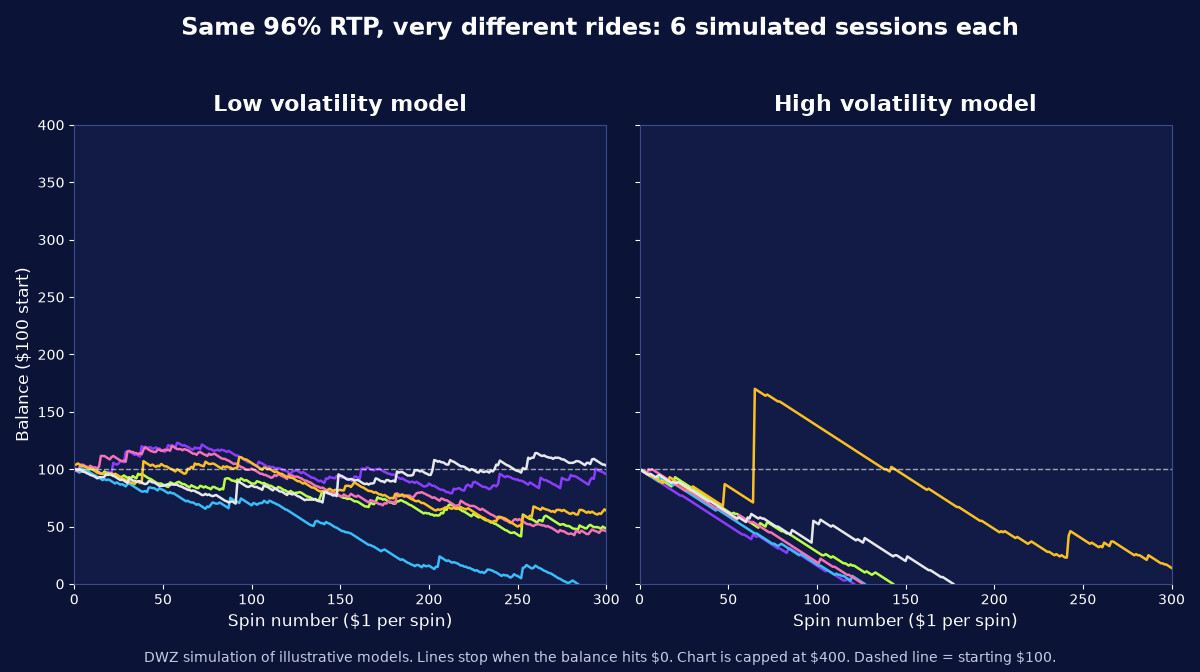
Here is the part that surprised us. The average loss was almost identical, about $12 either way. That is what a 96% RTP promises. But the average hides the real experience. On the high volatility model, the typical session lost $169 if the bankroll could take it. Meanwhile the best 10% finished at least $794 ahead. Averages blend those two groups together.
That is the whole idea of volatility in one table. The cost per spin is the same. The ride is not.
Is High or Low Volatility Better?
Neither is better. It depends on your bankroll and what you want from a session. Low volatility gives you longer play and smaller swings. High volatility gives you a shot at a huge win, and it burns through money faster while you wait.
Hard Rock Bet suggests having at least 200 to 300 times your bet available for high volatility play. Our numbers say to treat that as a minimum. On our high volatility model, a $200 bankroll at $1 a spin (200 bets) still went broke in 34% of 300-spin sessions. The low volatility model almost never did.
Even low volatility is not safe. In our model, about 65% of low volatility sessions did not finish ahead. The house edge is still there. Low volatility just makes the losses smaller and slower. European Gaming makes the same point: low volatility does not mean low risk.
How Can You Check a Slot’s Volatility Before You Play?
Most sites do not put a big volatility label on the game tile. Here is where to look, in order.
- The game’s info or help panel. Look for RTP and any volatility rating there.
- The game maker’s own page. Developers often publish a rating of low, medium or high. Some use a 1 to 5 or 1 to 10 scale, so check what scale is being used.
- The paytable. Big gaps between small and large prizes point to higher volatility.
- Demo mode. It shows how often a game pays. But 100 demo spins is a small sample, as European Gaming warns. In our model, one in ten high volatility sessions went about 47 spins or more without a payout, so a short test can easily fool you.
Don’t judge by max win alone. European Gaming checked supplier pages and found Burning Chilli 243 listed as low volatility with a 500x max win. Giga Jar was listed as medium volatility with a 10,000x max win. Chaos Crew was listed as very high volatility, also with a 10,000x max win. Those are the developers’ published figures, and the version at a casino can differ.
One more warning for U.S. players on offshore sites. These casinos are not licensed by U.S. state gaming regulators, so no state regulator checks their published RTP or volatility. If the game screen doesn’t show a number, ask support. If they can’t give you one, treat that as a red flag.
Disclosure: the links below are affiliate links. DWZ may earn a commission at no cost to you.
Want a starting list? See our best online slots sites for real money, or read our BetOnline Casino review. Check each game’s info screen before you bet.
How Should Volatility Change Your Bankroll Plan?
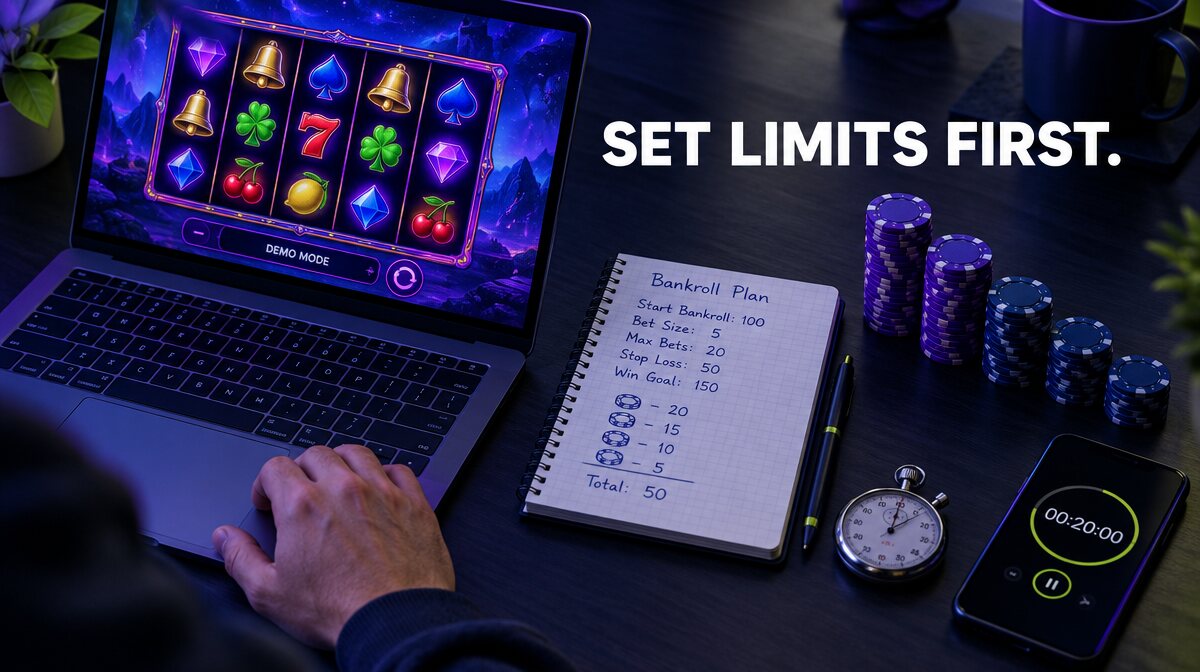
- Set a loss limit first. Treat it as the price of entertainment, not an investment.
- Size your bet to your bankroll. For high volatility, aim for 200 to 300 bets. A $100 bankroll means a bet of about 33 to 50 cents. At a $1 bet, $100 is only 100 bets, and we saw that go broke 83% of the time.
- Set a timer. Spins add up fast. At $1 a spin, 300 spins is $300 of action, even if you only started with $100.
- Check bonus rules. Wagering requirements force you to keep betting, so a high volatility game can drain a bonus quickly. See our guide to casino bonus terms and wagering requirements.
- Stop when you hit your limit. A big win is possible on any spin, but a long losing run does not make one more likely.
What Are the Biggest Slot Volatility Myths?
Is a Slot Due to Pay After a Long Dry Spell?
No. Each spin is independent. Hard Rock Bet says slots have no memory. A game that hasn’t paid in 100 spins is no more likely to pay on spin 101.
Does High Volatility Mean a Higher RTP?
No. European Gaming says volatility and RTP are separate measures. In our two models, the RTP was the same. Only the payout pattern changed.
Does Low Volatility Mean You Won’t Lose?
No. In our low volatility model, about 65% of sessions did not finish ahead after 300 spins. It just lost smaller amounts, more slowly.
Gambling involves risk. Only wager what you can afford to lose, and you must be of legal gambling age where you live. Online casino gambling is not legal in every state. If you or someone you know has a gambling problem, call 1-800-522-4700 (National Council on Problem Gambling) or dial 211.
References
- European Gaming. “Slot volatility explained: What it means for players and why it matters.” Updated September 2, 2026. Checked October 9, 2026.
- Hard Rock Bet. “Slots Volatility and RTP Explained.” Updated August 7, 2026. Checked October 9, 2026.
- Cache Creek Casino Resort. “Slot Machine Volatility: What It Means and Why It’s Important.” Checked October 9, 2026.
- DWZ original simulation: two illustrative slot models at 96% RTP, 200,000 sessions each, 300 spins at $1. Run October 9, 2026.
Related Reading
- US iCasino Revenue Tops $1 Billion Again: What Slower Growth Means for Offshore Casino Players
- What Is a Straddle in Poker? WPT Global’s Straddle Format Explained
- NFL International Games Betting: Do Favorites and Unders Really Hit More?
- US Sports Betting by State 2026: Legal Status, Tax Rates, Launch Dates and Handle
- Casino Poker Games Explained: Three Card Poker, Ultimate Texas Hold’em and Casino Hold’em