
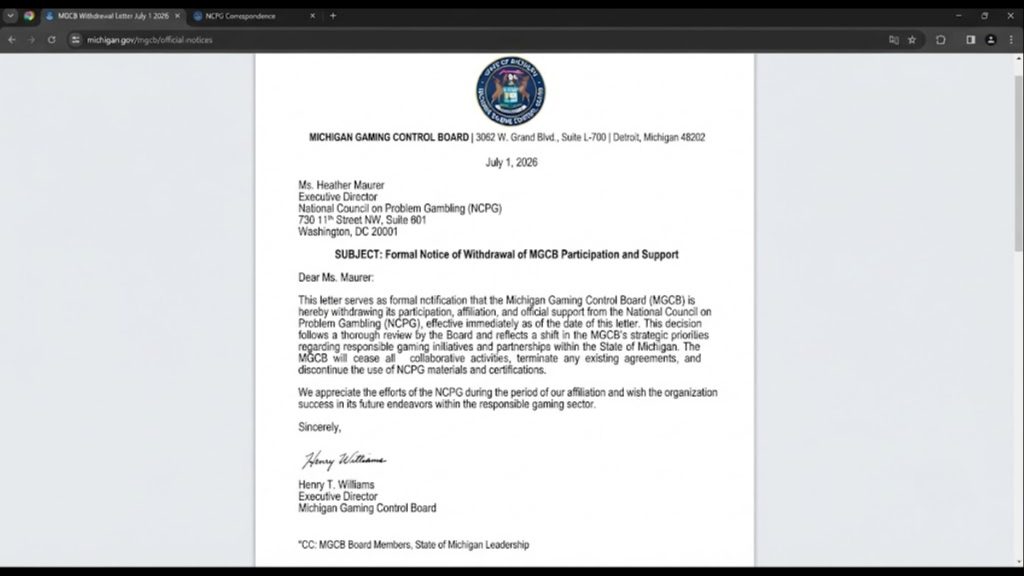
Michigan’s Gaming Control Board formally withdrew from the National Council on Problem Gambling on July 1, 2026, calling prediction market platform Kalshi an “illegal gambling” operation that has no business sitting at the responsible gaming table. MGCB Executive Director Henry Williams pulled membership, canceled conference sponsorships, and yanked every MGCB employee off NCPG boards — effective immediately.
This isn’t a polite policy disagreement. It’s a public divorce that exposes a bigger mess: America’s gambling regulators can’t even agree on what counts as gambling anymore.
The Quick Version
- MGCB withdrew from NCPG on July 1, 2026 after the nonprofit accepted Kalshi under a new “Financial Services & Trading” membership category in May
- Kalshi donated $2 million to NCPG for a “Financial Trader Health and Safety Initiative” — the MGCB views this as buying legitimacy
- Michigan courts blocked Kalshi from offering sports contracts through July 13, 2026, with a $120,000/day fine for noncompliance
- Federal judge denied Polymarket’s Michigan injunction June 17 — prediction markets ARE subject to state gambling laws
- Kalshi chasing a $40 billion valuation while fighting lawsuits across multiple states
What Did the MGCB Actually Say in Its Letter?
Henry Williams laid out three specific objections, and none of them were subtle.
The consumer confusion angle hit hardest. Williams wrote that “NCPG’s partnership with Kalshi creates substantial confusion by suggesting to the public that Kalshi is subject to the same consumer protections, licensing requirements, and regulatory oversight as licensed sports betting operators. It is not.” Michigan runs 13 licensed sports betting platforms. Kalshi went through zero state licensing.
Then there’s Kalshi’s insistence that its sports contracts are “investments,” not bets. Williams wasn’t having it: “The notion that internet sports betting can and should be pursued as a viable means of financial gain or protection against financial loss undermines this position and increases the risk of irresponsible and problem gambling behavior.”
And then the kill shot. He concluded that continued NCPG membership was “inconsistent with the MGCB’s mission, statutory responsibilities, and its commitment to responsible gaming.” Conference sponsorship for Nashville in late July? Canceled. Committee seats? Gone. All references to MGCB affiliation? Ordered removed.
Maya tracked this through three regulatory filings and the MGCB’s public GovDelivery announcement. Pretty clean break for something this messy.
How Did Kalshi Get Into the NCPG to Begin With?
NCPG announced Kalshi’s membership on May 18, 2026 under a brand-new “Financial Trading & Services” category it invented for the occasion. America’s only nonprofit dedicated to fighting gambling addiction created a custom membership tier so a company that multiple courts have called a gambling operator could join without being labeled one.
Kalshi’s $2 million donation funded something called the “Financial Trader Health and Safety Initiative.” Trading. Not gambling. The language is doing a lot of heavy lifting here.
After the backlash, NCPG put out a June 30 press release titled “Membership and Donations Do Not Equal Endorsement.” But when you create a custom category for someone and take $2 million, that ship has sailed — press release or not.
Is Michigan the Only State Fighting Prediction Markets?
Not even close. The state-level war has turned into a full-blown regulatory brawl.
And here’s the number that makes all of this absurd: Kalshi is raising funds at a $40 billion valuation, per the Financial Times. That’s roughly Flutter Entertainment and DraftKings combined. A company that can’t legally operate sports products in Michigan wants to be valued higher than the two biggest legal sportsbook operators on earth.
That’s not a red flag — it’s a whole damn parade.
What Should Michigan Bettors Do Right Now?
Here’s the part nobody in trade press covers: while regulators fight prediction market companies in court and the NCPG deals with its credibility crisis, offshore sportsbooks keep doing what they’ve always done — taking bets, paying out, staying out of the mess.
Irony is thick here. Back in April 2026, the MGCB sent 45 cease-and-desist letters to offshore operators. That same board is now publicly divorcing the nation’s top problem gambling organization. So Michigan will C&D offshore books that have operated for 15+ years with solid track records, but NCPG rolls out a red carpet for a platform facing insider trading scandals and active lawsuits in multiple states.
If you’re a Michigan bettor using offshore books, none of this affects your action. Bovada has served Michigan players since before the state legalized domestic sports betting in 2021. BetOnline has been around even longer. These platforms don’t need NCPG membership or a $40 billion valuation to process your wagers and pay your withdrawals.
I’m not saying offshore books are saints. But they’re stable, they’re predictable, and nobody’s inventing new membership categories to make them sound like something they’re not. For the fastest deposits and cashouts, check our crypto betting guide.
Will Other States Follow Michigan Out of the NCPG?
Michigan was the first state gaming regulator to pull NCPG membership. I’d bet real money they won’t be the last.
Ohio is already weighing a complete mobile sports betting ban through the Save Ohio Sports Act. If Ohio’s gaming regulators also bail on the NCPG over Kalshi, this becomes a trend, not a one-off.
The NCPG’s Nashville conference runs July 22-24. Two sessions will discuss prediction markets head-on — including one titled “Revisiting the Legal Definition of ‘Gambling’ in the Era of Prediction Markets.” That panel will hit different with an empty Michigan chair in the room.
Michigan’s Kalshi TRO expires July 13. After that, expect either a preliminary injunction fight or Kalshi trying to restart operations. Given Judge Maloney’s language calling Polymarket’s arguments “unlikely to succeed on the merits,” Michigan regulators have the upper hand.
This mess won’t resolve before NFL season. If you’re waiting for prediction markets to sort their legal status before placing a fall bet, you’ll be waiting a long time. Offshore books like MyBookie don’t have that problem.
Bottom line: Michigan’s MGCB just told the NCPG that partnering with a company the state considers an illegal gambling operation is a dealbreaker — and they backed it up by walking out completely on July 1, 2026.
📂 Explore more: Michigan