
Quick answer: Reverse line movement occurs when a point spread or total moves against the side receiving most bets. It can hint at influential money on the other side, but it is not proof of a winning bet.
Reverse line movement (RLM) in NFL betting is when a point spread or total moves against the side most bettors are backing — for example, 70% of bets land on the Chiefs, yet the line moves toward their opponent. It matters because it hints that bigger or sharper money may be on the other side. It is a clue, not a sure thing.
Key Takeaways
- Reverse line movement happens when a line moves opposite to the side getting the most bets.
- Ticket percentage counts bets. Money percentage counts dollars. RLM usually shows up when those two numbers disagree.
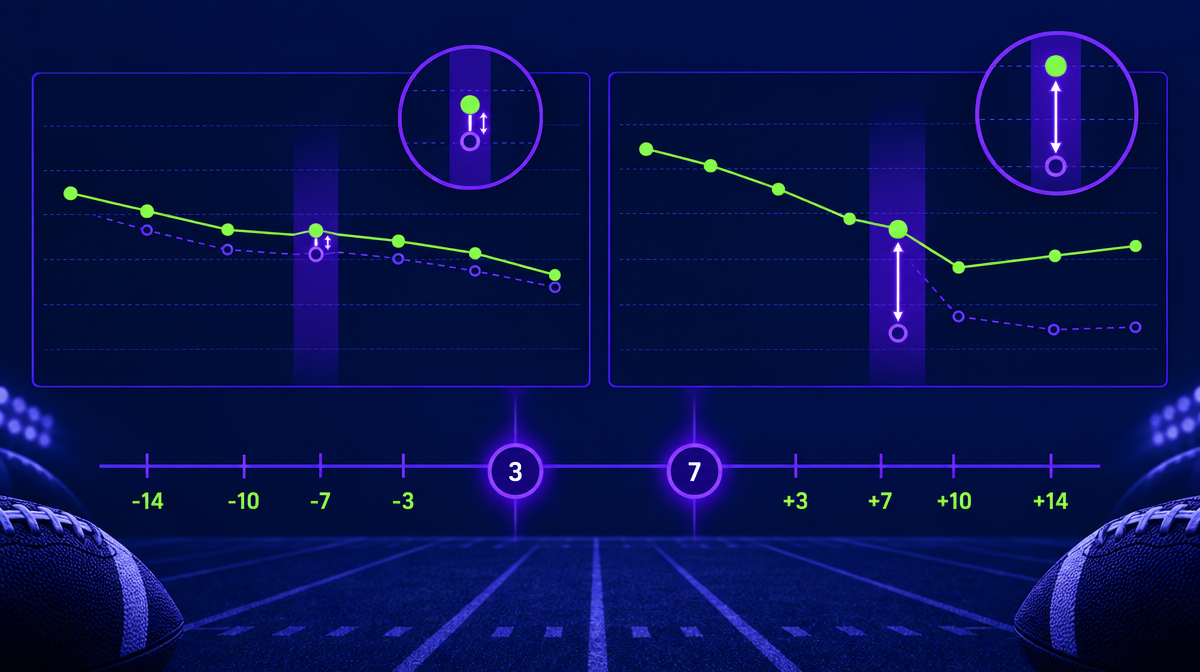
- In the NFL, a move across 3 or 7 matters more than most moves, because those are the most common final margins.
- Injuries, weather, and stale lines can also move a number. RLM is not proof of sharp action.
- Action Network notes that a line move does not guarantee the new number still has value.
Definitions and market caveats checked against Action Network (updated April 28, 2026), Pinnacle Odds Dropper (June 27, 2025), and BetQL's NFL line-movement tracker on September 28, 2026. Example lines are illustrations, not live odds.
Affiliate Disclosure: Daily Wager Zone may earn a commission if you sign up through our links at no extra cost to you. This does not influence our analysis or recommendations.
What does reverse line movement actually mean?
First, a quick term check. A line is the number a sportsbook sets for a game. A point spread is how many points the favorite must win by. Here, “the public” just means casual bettors, who make up most of the bets.
Normally, a line moves toward the popular side. If everyone bets the Cowboys, the book makes the Cowboys more expensive to balance its risk.
Reverse line movement breaks that pattern. The popular side gets cheaper instead of pricier.
Here is a classic NFL example. The Eagles open at -3 against the Giants. By Friday, 70% of spread bets are on the Eagles. But the line drops to Eagles -2.5. The book made the popular team easier to back. That is RLM.
What stands out here is the direction. A book rarely hands the crowd a better number for no reason. Something on the other side is pushing harder.
Why do sportsbooks move a line against the public?
The short answer is that not all money is equal. Books care about who is betting, not just how many people are betting.
Here are the main reasons, as described by Action Network and Pinnacle Odds Dropper:
- Sharp money. “Sharps” are pro bettors with a strong long-term track record. Books respect their bets. One large sharp bet can outweigh hundreds of small public ones.
- Syndicate action. A syndicate is a group of bettors pooling money and data. When a syndicate hits a game, it can move lines at many books at once.
- Steam moves. A steam move is a fast, sudden line change across many books within minutes. It usually follows a burst of sharp betting.
- Risk management. Sometimes a book just has too much exposure on one outcome. It shifts the number to protect itself.
Our take is simple. RLM tells you someone with weight is on the other side. It does not tell you who, or whether they are right.
What is the difference between ticket percentage and money percentage?
This is the key thing beginners miss. There are two ways to measure “public betting,” and they tell different stories.
- Ticket percentage (bet %) is the share of individual bets on each side. A $10 bet and a $10,000 bet each count as one ticket.
- Money percentage (handle %) is the share of total dollars on each side. “Handle” just means the total amount wagered.
Say the Bills have 72% of tickets but only 45% of the money. Fewer people are betting the other side, but they are betting bigger amounts. Big bets are more likely to come from sharp bettors.
When you see a gap like that and the line moves toward the low-ticket side, the RLM signal gets stronger. If tickets and money both favor the same team, a move the other way is harder to explain with betting alone. That is when you should look for news.
Why does reverse line movement matter more in the NFL?
NFL spreads are built around key numbers. These are the final margins that happen most often. The two biggest are 3 (a field goal) and 7 (a touchdown with the extra point). We break these down in What Is a Key Number in NFL Betting.
Because so many games land on 3 or 7, a half-point move around those numbers is a big deal. Going from -3 to -2.5 means the favorite now wins your bet with a 3-point win. At -3, that same result would have been a push, meaning a tie where your stake comes back.
A move from -5.5 to -5 is minor. A move from -3 to -2.5, or -7 to -6.5, against the public is a much louder signal because those margins carry the most weight in final scores.
Two other NFL patterns are worth watching:
- Prime-time games. Sunday, Monday, and Thursday night games draw heavy casual betting. That makes lopsided ticket splits more common. RLM in these games can be easier to spot, because the public side is so obvious.
- Injury news windows. NFL teams release injury reports during the week, with game statuses set by Friday. Inactive lists come out about 90 minutes before kickoff. A line that moves in these windows may be reacting to news, not sharp money.
How do you spot reverse line movement step by step?
Here is a practical workflow you can run before any NFL game.
Step 1: Write down the opening line. The opener is the first number a book posts, often on Sunday night for the next week. Save it. You cannot spot a move without a starting point.
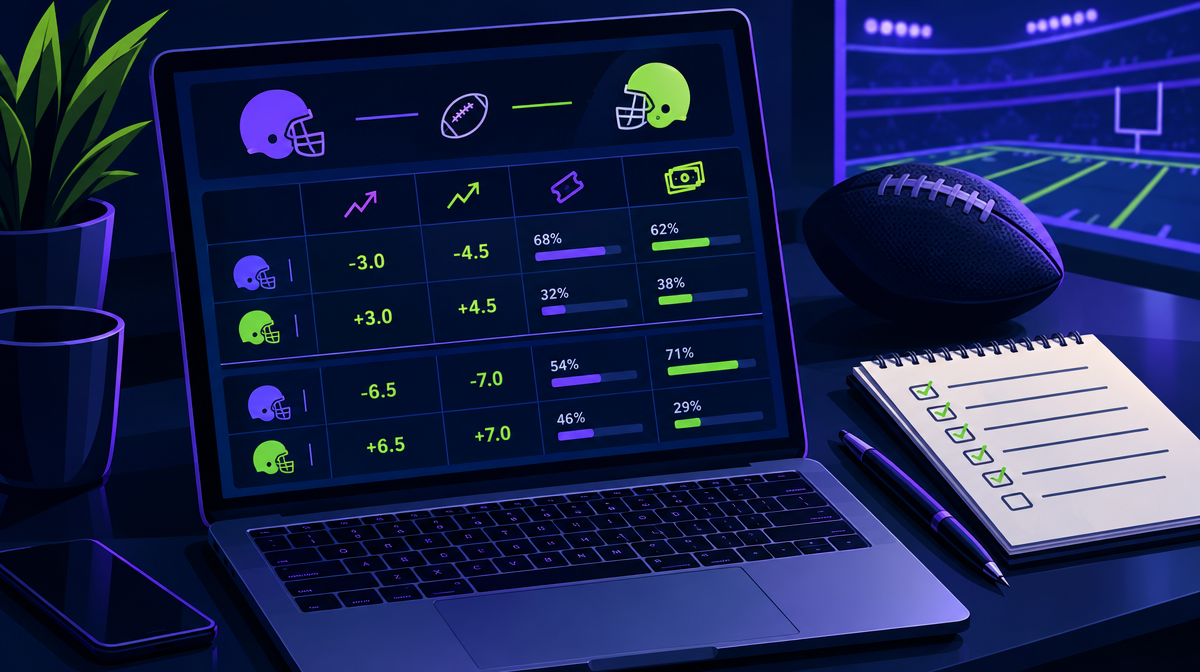
Step 2: Check public betting percentages. Tools like BetQL’s NFL line-movement tracker and Action Network show ticket and money splits. Note both numbers, not just one.
Step 3: Compare the current line to the opener. Did the line move toward the popular side or away from it? If it moved away, you may have RLM.
Step 4: Check more than one sportsbook. Look at the same game at a few books, such as BetOnline and MyBookie. If only one book moved, it may be that book’s own risk. If most books moved together, the signal is stronger.
Step 5: Rule out the news. Search the team’s injury report, the weather forecast, and recent beat-reporter posts. A starting quarterback being ruled out can move a line against the public on its own. That is not RLM in the sharp-money sense. It is just the market pricing new facts.
Step 6: Note whether a key number was crossed. A move off 3 or 7 deserves extra attention.
Step 7: Decide if the number still has value. This is where most bettors slip. If the line already moved from -3 to -2.5, the “sharp” price may have been -3 hours ago. Chasing the new number is not the same bet.
Our take is that Step 5 is the one people skip most often. Skipping it turns a useful signal into a guess.
If you want to use RLM alongside other tools, our Best NFL Betting Strategies guide shows where it fits in a full game plan.
What NFL line-movement scenarios should you know?
This table ranks common scenarios from strongest RLM signal to weakest. The lines are examples, not live odds.
| Rank | Scenario (example) | Ticket % | Money % | What it likely means |
|---|---|---|---|---|
| 1 | Favorite -3 drops to -2.5 at most books, no news | 70% on favorite | 40% on favorite | Strong RLM. Bigger money on the underdog, on a key number. |
| 2 | Favorite -7 drops to -6.5, prime-time game | 75% on favorite | 50% on favorite | Solid RLM. Crowd is heavy, but books still gave up the hook. |
| 3 | Total drops from 47 to 45.5 while 65% bet the over | 65% on over | 45% on over | Possible RLM. Check the weather before trusting it. |
| 4 | Favorite -4.5 drops to -4 at one book only | 60% on favorite | 55% on favorite | Weak signal. Could be one book’s risk position. |
| 5 | Favorite -6 drops to -3 after QB ruled out | 68% on favorite | 65% on favorite | Not RLM. The market priced injury news. |
A hook is the half-point on a spread, like the .5 in -6.5. A total is the combined points both teams score. You bet whether the final total goes over or under the number.
When can reverse line movement fool you?
RLM is easy to overrate. Watch for these traps.
- Moving on air. Action Network points out that books sometimes move a line without big bets behind it. They may be adjusting to other books or to their own projections. It looks like RLM, but no sharp money is involved.
- Stale lines. A stale line is a number one book has not updated yet. If other books already moved, the “movement” you see may just be one book catching up late.
- Weather. Wind is a big one for NFL totals. A strong wind forecast can drop a total even if the public loves the over.
- Unreliable splits. Public betting data comes from a limited set of books. Treat the percentages as estimates, not the whole market.
- The move already happened. Pinnacle Odds Dropper frames RLM as a confirmation tool, not the only reason to bet. We agree. By the time you see the move, much of the value may be gone.
Also, sharp money is not always right. Pros lose bets too.
How should beginners use reverse line movement?
Our take is to treat RLM as a second opinion, not your first reason to bet. Start with your own read on the game. Then check whether the market agrees or disagrees.
If your read and RLM agree, that is a nice confirmation. If they clash, take a closer look. Our NFL Handicapping for Beginners guide walks through how to build that first read.
If you bet in-game, our NFL Live Betting Strategy guide covers how lines react once the ball is kicked off.
References
1. Action Network. “What is Reverse Line Movement in Sports Betting?” Updated April 28, 2026. https://www.actionnetwork.com/education/reverse-line-movement 2. Pinnacle Odds Dropper. “What is Reverse Line Movement (and how to spot it early).” June 27, 2025. https://www.pinnacleoddsdropper.com/blog/reverse-line-movement 3. BetQL. “NFL Betting Line Movement Tracker.” Accessed September 28, 2026. https://betql.co/nfl/line-movement
Gambling involves risk. Only wager what you can afford to lose. Must be 21+ to participate in sports betting or casino gambling where required by law. If you or someone you know has a gambling problem, call 1-800-522-4700 (National Council on Problem Gambling) or dial 211.