
How NFL point spreads, totals and prices work together: what the numbers mean, why 3 and 7 matter, how to find the expected score, and a four-question check before every bet.

An NFL point spread is the number of points the favorite must win by for a bet on it to win, and an over/under (also called the total) is a bet on how many points both teams score together. Those two numbers, plus the price printed next to them, are the core of NFL betting. This guide shows how to read each one, why the margins 3 and 7 matter so much, how the spread and total fit together to show the score the market expects, and where bettors lose money without noticing. Every term gets a plain definition the first time it shows up.
The Quick Version
- The spread is a head start. Bet the favorite and it must win by more than the number. Bet the underdog and it can lose by less than the number and still cash.
- The total ignores who wins. You bet on combined points. A 27-24 game and a 48-3 game can both go Over 45.5.
- The price matters as much as the number. At the standard -110 you must win 52.4% of bets to break even. At -120 you need 54.5%.
- 3 and 7 are special, but not frozen. About 15% of NFL games finish with a 3-point margin and about 9% with a 7-point margin. Moving the extra point back in 2015 shifted a few percent toward 6 and 8.
- Our take: before you pick a side, check three things: the number, the price and whether another book is a half-point better. That one habit is worth more than most “picks.”
What Is an NFL Point Spread?
A point spread is a handicap that makes a lopsided game a near coin flip. The better team, called the favorite, gets a minus number. The weaker team, called the underdog, gets a plus number. Here is a made-up board for a game between two teams:
| Team | Spread | Price |
|---|---|---|
| Home team (favorite) | -6.5 | -110 |
| Away team (underdog) | +6.5 | -110 |
If you bet the favorite at -6.5, it must win by 7 or more. If you bet the underdog at +6.5, you win if it wins outright or loses by 6 or fewer. A 24-20 favorite win means the favorite won the game, but the favorite bet lost. That gap between winning the game and winning the bet trips up almost every new bettor once.
A half point (the .5) is called a hook. It makes a tie on the number impossible, so there is always a winner. When the spread is a whole number, like -7, and the favorite wins by exactly 7, the bet is a push. A push means nobody wins and your stake comes back. For more on how bet types compare, read our guide to NFL moneylines, spreads and totals.
How Do You Read the Price Next to the Spread?
The price, also called the juice or vig, is the sportsbook’s fee for taking your bet. At -110 you risk $110 to win $100. If you win, you profit $100 per $110 risked. If you lose, you lose the $110. Because the winning side pays slightly less than a fair bet would, you have to win more than half your bets just to break even.
The math is simple: break-even win rate = amount risked / (amount risked + amount won). At -110 that is 110 / 210 = 52.4%. Here is how it changes with the price:
| Price | Risk to win $100 | Break-even win rate | Extra wins needed vs. -110 (out of 100 bets) |
|---|---|---|---|
| -105 | $105 | 51.2% | 1.2 fewer |
| -110 | $110 | 52.4% | Baseline |
| -115 | $115 | 53.5% | 1.1 more |
| -120 | $120 | 54.5% | 2.2 more |
| -130 | $130 | 56.5% | 4.1 more |
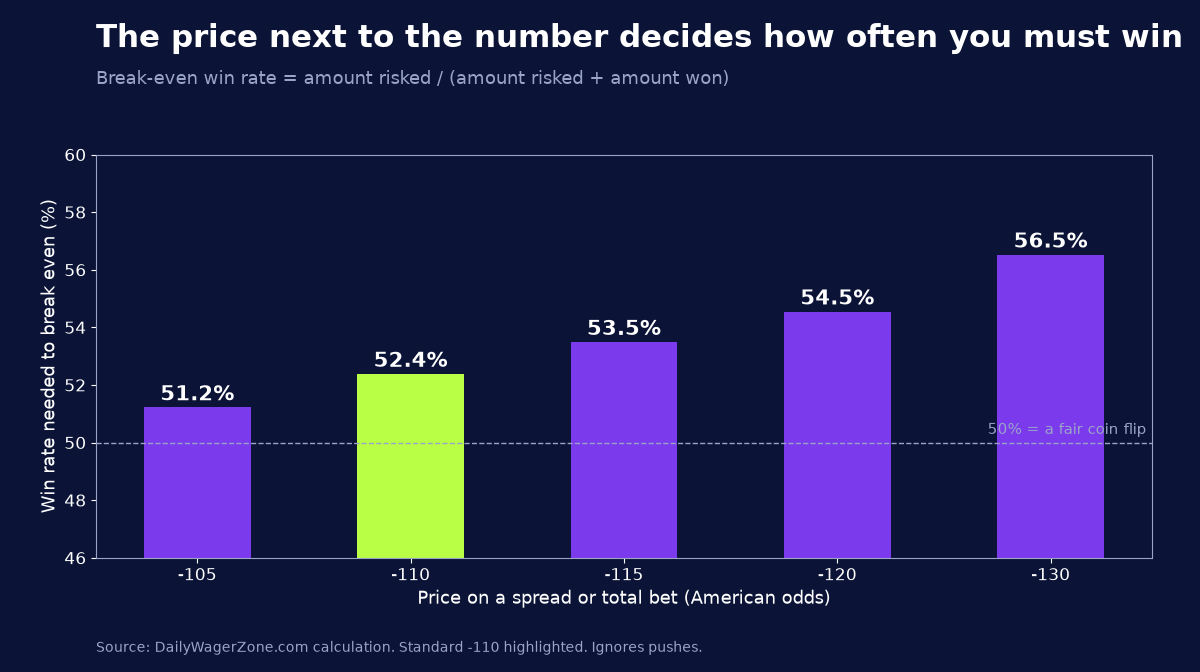
This is why a half point is not the only thing to compare between books. A -3 at -105 can beat a -3 at -120 even though the number looks identical. Our guide to reading NFL betting odds covers American odds in more detail.
What Is an NFL Over/Under (Total)?
A total is a bet on the combined points both teams score. The sportsbook posts a number, and you pick Over or Under. If the total is 47.5, the Over needs 48 or more combined points and the Under needs 47 or fewer. Overtime points count, unless the sportsbook’s house rules say otherwise. A whole-number total, like 47, can push if the teams score exactly 47.
Totals are a scoring forecast, not a winner pick. Weather, wind, injuries (especially at quarterback), pace and indoor or outdoor stadiums all move them. We cover that in detail in our guide to how NFL over/under bets work.
One useful fact on scale: the average posted NFL total was 41.8 from 2000 to 2011, rose to about 45.7 across 2012 to 2020, and averaged 44.7 in the 2025-26 regular season, according to Covers. If you see a total far above or below that range, ask what is driving it.
Why Do 3 and 7 Matter So Much in NFL Spreads?
Because football scores come in chunks. A field goal is 3 points. A touchdown with an extra point is 7. Most one-score games end by one of those amounts, so final margins pile up on certain numbers. Those numbers are called key numbers. Cleanup Hitter’s data on regular-season games from 2000 to 2026 shows a 3-point margin in 14.99% of games and a 7-point margin in 9.09%. Action Network lists 7.25% for a 6-point margin.
| Margin | Share of games (approx.) | Why it happens | Bet that cares |
|---|---|---|---|
| 3 | 15.0% | One more field goal | Spread of -3 or +3 (push risk) |
| 7 | 9.1% | One more touchdown with extra point | Spread of -7 or +7 |
| 6 | 7.3% | Touchdown with a missed extra point, or two field goals | Spread of -6 or -6.5 |
That is why moving from -3 to -3.5 is a much bigger deal than moving from -5 to -5.5. A 3-point game lands on the number about 15 times in 100. Getting +3.5 instead of +3 on an underdog turns a 3-point loss from a push into a win. Getting -2.5 instead of -3 on a favorite turns a 3-point win from a push into a win. Our deeper guide on NFL key numbers shows how to use that, and this short explainer covers the basics. We also put a price on it in our CLV breakdown, where a half-point across 3 was worth about +9.8% expected profit per bet versus about +2.4% across 6, in a simplified model.
Key numbers are not frozen. In 2015 the NFL moved the extra point back to the 15-yard line. Covers found extra points converted at 99.2% in the nine seasons before and 94.1% in the nine seasons after, and teams kicked after 95.2% of touchdowns before versus 90.7% after. The result was a combined 2.4% increase in 6-point and 8-point margins. Seven and three are still the biggest numbers, but 6 and 8 deserve more respect than they got a decade ago.
Totals work differently. Covers found the most common single total numbers show up only about 4% of the time, so totals have key ranges (such as 43 to 51) rather than sharp key numbers. A half-point on a total is usually worth less than a half-point across 3 on a spread.
How Do the Spread and Total Fit Together?
Together they tell you the score the market expects. Take the total and the spread and you can split the points between both teams. The formulas are: favorite = (total + spread) / 2, and underdog = (total – spread) / 2, where the spread is entered as a positive number. These are called implied team totals.
| Total | Spread | Favorite expected points | Underdog expected points | What it suggests |
|---|---|---|---|---|
| 38.5 | -10 | 24.25 | 14.25 | A one-sided, low-scoring script |
| 41.5 | -7 | 24.25 | 17.25 | A favorite expected to win by about a touchdown |
| 45.5 | -3.5 | 24.5 | 21.0 | A close, average-scoring game |
| 48.5 | -2.5 | 25.5 | 23.0 | A shootout between near-equals |
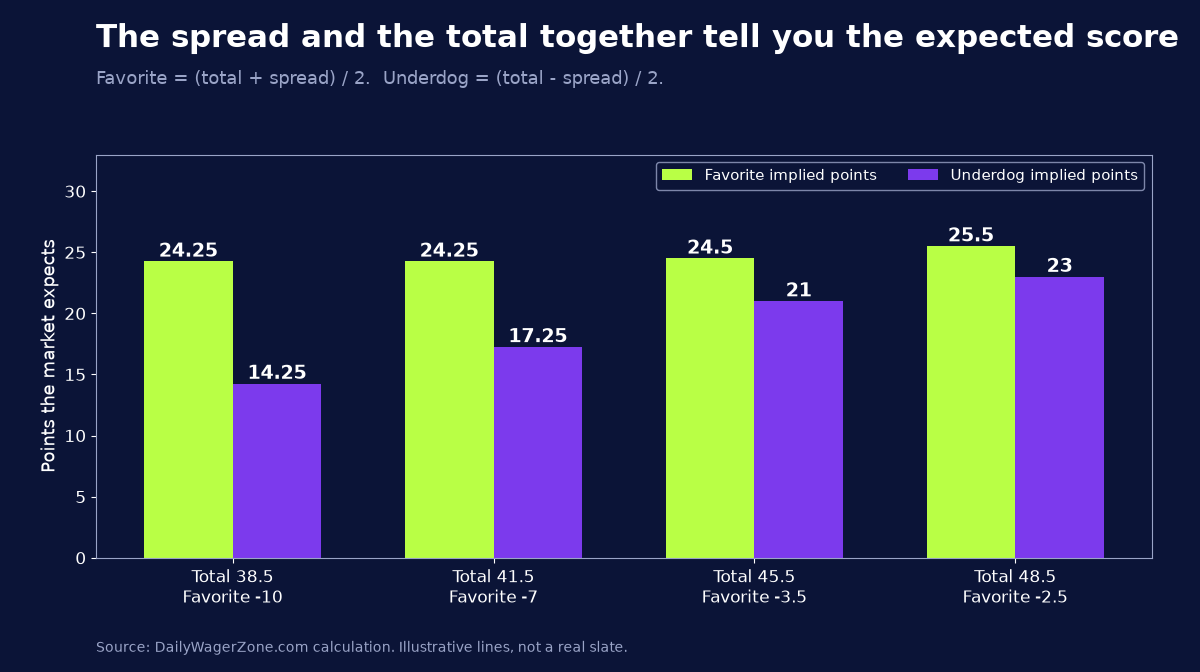
This helps you sanity-check a bet. Suppose you like the Over and the favorite. The table tells you what the market already expects from each team, so you can ask whether you really think the favorite scores more than 24.5. It also shows why a spread and total can move together: if the total drops two points with the spread unchanged, both teams’ expected scores fall by one point.
Why Do NFL Spreads Move and Differ Between Sportsbooks?
Lines start as a model-based number, get tested by early bets, then adjust as news and money arrive. Action Network describes the process: oddsmakers set an opening number from team ratings and adjust it as bettors respond. Different books also have different customers, limits and risk tolerance, so one game can sit at -3 at one book and -3.5 at another. We walk through the full process in how sportsbooks set NFL point spreads.
Two ideas help you judge movement. First, a move in the opposite direction of the public betting percentages is called reverse line movement, and our reverse line movement guide explains why it gets so much attention and where it misleads. Second, the final number before kickoff is the closing line. If you regularly beat it, you are likely getting good prices. We show how to track that in our closing line value guide.
Which Spread and Total Mistakes Cost the Most Money?
- Ignoring the price. A -3 at -120 is not the same bet as a -3 at -105. See the break-even table above.
- Treating every half point as equal. A hook across 3 or 7 matters. A hook at 5.5 matters much less.
- Betting the Over because scoring is fun. Points are exciting to root for, but the number already prices in the expected scoring. Ask whether the total is too high or too low, not whether you want to see points.
- Betting every game on the slate. Pick the few where you have a reason. A weak reason at -110 is still a bet that must win 52.4%.
- Chasing a line you missed. If the number moved against you, the value may be gone. Skip it instead of paying a worse price.
- Forgetting teasers need key numbers. A teaser moves a spread in your favor, usually 6 points, for a lower payout. It works best when it crosses 3 and 7. Our teaser guide and teaser strategy page explain when.
What Should You Check Before Every Spread or Total Bet?
Use this four-question check. It takes about two minutes and uses only information you can see on the board.
- What is the number, and is it on or near a key number? A spread of -3, -3.5, -6.5, -7 or -7.5 is where the half point matters most.
- What is the price? Convert it to a break-even rate. If you need more than 54% to break even, the bet had better have a strong reason.
- Is another book better? A half-point or a cheaper price at a second sportsbook is a free edge. Compare at least two.
- What does the spread plus total imply? Use the formula above. If you disagree with the implied score for one team, you have a reason to bet. If you cannot explain why, you may not have one.
Our NFL betting strategies guide puts these habits next to bankroll sizing and line shopping.
Where Can You Bet NFL Spreads and Totals?
Offshore sportsbooks accept many U.S. players, including those in states without a legal local option. Two we link to are BetOnline and Bovada. Both post full NFL boards with spreads, totals and moneylines. Offshore books are not licensed by U.S. state regulators, so read their terms, payout rules and limits before you deposit. Never bet money you cannot afford to lose. If gambling stops being fun, call 1-800-GAMBLER.
Affiliate disclosure: DWZ may earn a commission if you sign up through these links, at no cost to you. This does not change our analysis.
If spreads and totals are still new, our Sports Betting 101 guide explains odds, moneylines and parlays in the same plain English.
Where Should You Go Next?
| If you want to… | Read this |
|---|---|
| See every bet type side by side | All three core bets side by side |
| Understand how lines are set | Power ratings, openers and why books differ |
| Dig into totals | Totals, weather and pace |
| Learn 3 and 7 | Key numbers 3, 7, 6 and 10 |
| Judge your betting prices | Closing line value and line shopping guide |
| Read line moves | When a line moves against the money |
| Build a plan | Line shopping and bankroll rules |
| Bet responsibly | Responsible NFL betting guide |
References
- Shawn Wronka. “Examining NFL Key Numbers for the 2026-27 Season.” Covers. Checked October 15, 2026.
- Cleanup Hitter. “Frequency of NFL regular-season scores, 2000-2026.” Checked October 15, 2026.
- Action Network. “Key Numbers in NFL Betting, Explained.” Checked October 15, 2026.
- Action Network. “How Are Sports Betting Lines Really Made?” Updated May 8, 2026. Checked October 15, 2026.