Most NFL trades will not move a point spread, but a quarterback trade can move it several points. We matched ESPN’s ten deadline candidates to published line values to show which deals matter.

Most NFL trades will not move a point spread, but a quarterback trade can move it by several points. The 2026 trade deadline is Tuesday, Nov. 10, at 4 p.m. ET, right after Week 9, per ESPN. Oddsmakers have said for years that most players who are not quarterbacks are worth a point or less. So when a trade breaks, check whether the number moved before you bet. If it did not move, the market just told you the trade is not worth points.
The Quick Version
- The point spread is the number of points the favorite must win by. A trade only matters to your bet if it changes that number or the price on it.
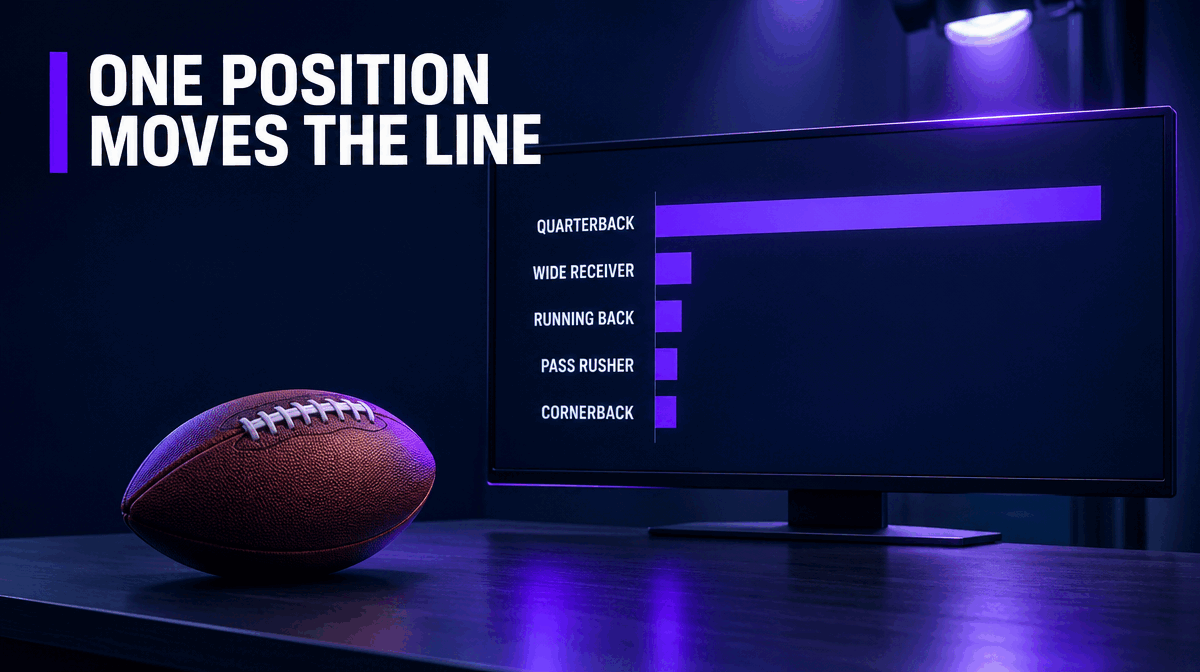
- Quarterbacks are the exception. Published oddsmaker estimates put an elite quarterback at about 5 to 7 points. Most other positions are worth a point or less.
- Nine of the ten names on ESPN’s early-October trade list are not quarterbacks. By those published ranges, none of the nine should move a line by more than a couple of points, and most should move it by little or nothing.
- A half-point can still matter. Near the common margins of 3 and 7, books may change the price instead of the number.
- Our take: do not bet on trade rumors. Wait for the deal to be official, then see what the market did with it.
When Is the 2026 NFL Trade Deadline and Why Does It Matter to Bettors?
The deadline is Nov. 10 at 4 p.m. ET. That is a Tuesday, right after Week 9 ends, according to ESPN. After that time, teams cannot trade players for the rest of the season.
For bettors, the timing matters for one plain reason. Next week’s lines usually go up soon after the weekend games end. So a trade can land after the Week 10 number already exists. If the deal changes what the market thinks of a team, the line has to move to catch up.
ESPN’s early-October preview names ten players who could move. It also says it expects “at least one more quarterback” to be traded before the deadline. That detail is why this guide splits trades by position. The ESPN piece was written about five weeks before the deadline, so rosters and rumors will change.
We have covered a close cousin of this topic before. A new head coach can also shift a number, and we looked at that in our guide to NFL coaching changes and the spread. A player trade is a different question. The coach changes how a whole team plays. A trade changes one spot on the roster.
How Many Points Is a Player Worth on the Spread?
Only a few positions are worth real points. Sports Insights asked oddsmakers at several offshore and Las Vegas books in 2016 how they value players. It reported that “elite quarterbacks are worth roughly 6-points to the spread, but the impact of other positions is surprisingly minimal.” (Sports Insights)
Boyd’s Bets published a similar chart in 2017. Here are both sources side by side. A “point” here means one point on the spread.
| Player type | Published line value | Source |
|---|---|---|
| Elite quarterback | 5 to 7 points (Boyd’s); 6 to 7 for the top tier (Sports Insights) | Both |
| Non-elite starting quarterback | 3 to 4 points | Boyd’s Bets |
| Skill player (receiver, running back, tight end) | 0.5 to 2.5 points | Boyd’s Bets |
| Defensive player | 0.5 to 1 point | Boyd’s Bets |
| Most other players | About 0 to 0.5 points. Sports Insights found about six non-quarterbacks who could move a line, each by half a point. | Sports Insights |
Two cautions apply. First, these are old numbers. Second, they describe an average player at a position, not a specific trade. A great receiver on a team with no other receivers can matter more than the chart says. A great receiver on a deep team can matter less.
There is also a pattern in how books treat the rest of the roster. Sports Insights quoted one oddsmaker as saying that if any defensive player could move a line, it would be a handful of the best pass rushers or shutdown cornerbacks. Boyd’s makes a similar point. Books move a line when the public will bet against a team because a famous player is out. A starting center usually does not do that.
What Would ESPN’s Biggest Trade Candidates Do to a Line?
Here is our own analysis. We took the ten players ESPN listed in its early-October preview and matched each one to the published ranges above. The right-hand column is our read, not a sportsbook’s number. We used ESPN’s description of each player’s role as of early October.
| Player | Position, team | What ESPN said | Our read on the line |
|---|---|---|---|
| Marvin Harrison Jr. | Wide receiver, Cardinals | Tied for fifth on his team in targets, with nine | About 0 to 0.5. He is not his team’s main target right now. |
| Jerry Jeudy | Wide receiver, Browns | Two catches for 26 yards; rookies have taken over the receiver group | About 0. Minimal role. |
| Tony Pollard | Running back, Titans | 173 rushing yards at 4.6 per carry | About 0. Running backs wear down and teams replace them. |
| Khalil Mack | Pass rusher, Chargers | Two sacks in three games | 0 to 0.5. A boost to one unit, not a game changer. |
| Josh Sweat | Pass rusher, Cardinals | No sacks so far in 2026, 12 last season | 0 to 0.5. |
| Josh Uche | Pass rusher, Dolphins | Veteran on a minimum-salary deal | About 0. |
| Maxx Crosby | Pass rusher, Raiders | ESPN does not expect the 3-0 Raiders to trade him | Up to about 1 if he moved. This is the biggest defensive name. |
| Keisean Nixon | Cornerback, Packers | Also a kick returner | 0 to 0.5. |
| Daron Payne | Defensive tackle, Commanders | Contract voids after the season unless he is extended | About 0. |
| Mason Rudolph | Quarterback, Steelers | Backup behind starter Aaron Rodgers | About 0 while Rodgers plays. This changes if Rudolph has to start. |
The pattern is simple. Nine of the ten are not quarterbacks. Using the top end of the published ranges, the two receivers and the running back could not move a line by more than 2.5 points, and the six defenders could not move one by more than 1 point. In our read, most would move it far less.
The one quarterback on the list is a backup. A backup on a team with a healthy starter changes nothing on the board. Based on who ESPN named, we expect most deals on this list to leave the spread alone. A surprise starting-quarterback trade is the one to watch.
Why Does a Quarterback Trade Matter So Much More?
The quarterback touches the ball on almost every offensive play, so oddsmakers value him far above everyone else. Sports Insights gives one real example. When Tom Brady was suspended for the first four games of 2016, the Patriots’ Week 1 line moved six points, from pick’em to +6. The site said that fit its research on elite quarterback value.
The same source shows the limits of that math. For Weeks 2 to 4, the Patriots’ lines moved by less than the rule of thumb. The spreads changed by 3.5 to 4 points against weaker opponents with a capable backup, Jimmy Garoppolo, in the lineup. So the size of the move depends on who comes in and who they play.
Here is a made-up example to show the math. The teams are not real. We built it from Boyd’s published ranges.
| Step | What happens | Spread |
|---|---|---|
| 1. Before the trade | Red’s starting quarterback is worth about 1 point. Blue is the home favorite. | Blue -6.5 |
| 2. The trade | Red acquires a non-elite starter worth about 4 points (Boyd’s range is 3 to 4). | Swing of 3 points |
| 3. After the news | The market catches up. Blue’s edge shrinks by 3 points. | Blue -3.5 |
| 4. What it means | A bettor who had Red +6.5 before the news now holds 3 extra points. A bettor who waits pays the new price. | Early number wins |
Real life is messier. A new quarterback also needs time to learn a playbook, and we do not have data on how fast traded players reach full playing time. So the first game with a new quarterback is a real unknown. If a book moves the line the full amount in his first week, the market is assuming he is ready.
One more finding is worth knowing. Action Network tracked games where one team started a backup quarterback against a starter. In the last decade, there were 77 games where that team’s line moved 7 or more points against it between the lookahead line and the closing line. Those teams covered the spread 52.6% of the time. When the move was 3.5 points or more over the last five seasons, they covered 82 times and failed 67 times, with one push (55%).
That is a backup-quarterback data set, not a trade data set. Games with a backup quarterback often come from injuries or benchings, so we cannot say trades behave the same way. We also would not build a betting system on it. Our take is smaller. Big quarterback line moves are not always the market being right. Sometimes the market overcorrects a little.
What Does a Half-Point Move Cost You?
Sometimes a trade moves a line by only half a point, or not at all. That small change can still matter if the game sits on a key number. A key number is a margin of victory that happens often, like 3 or 7. We explain why in our guide to NFL key numbers.
Sports Insights notes that when a game is on a key number such as 3 or 7, some oddsmakers would rather change the juice than the spread. The juice is the fee built into the price, usually written as -110. At -110 you risk $110 to win $100.
Here is what a price change costs. At -110, you need to win about 52.4% of your bets to break even. At -120, you need about 54.5%. That is a gap of roughly 2.2 percentage points on every bet, from a price change you may not notice. Any odds converter will show you the break-even rate for a price.
How Should You Bet Around the Trade Deadline?
Here is the short checklist we would follow. It comes from the numbers above, not from a system.
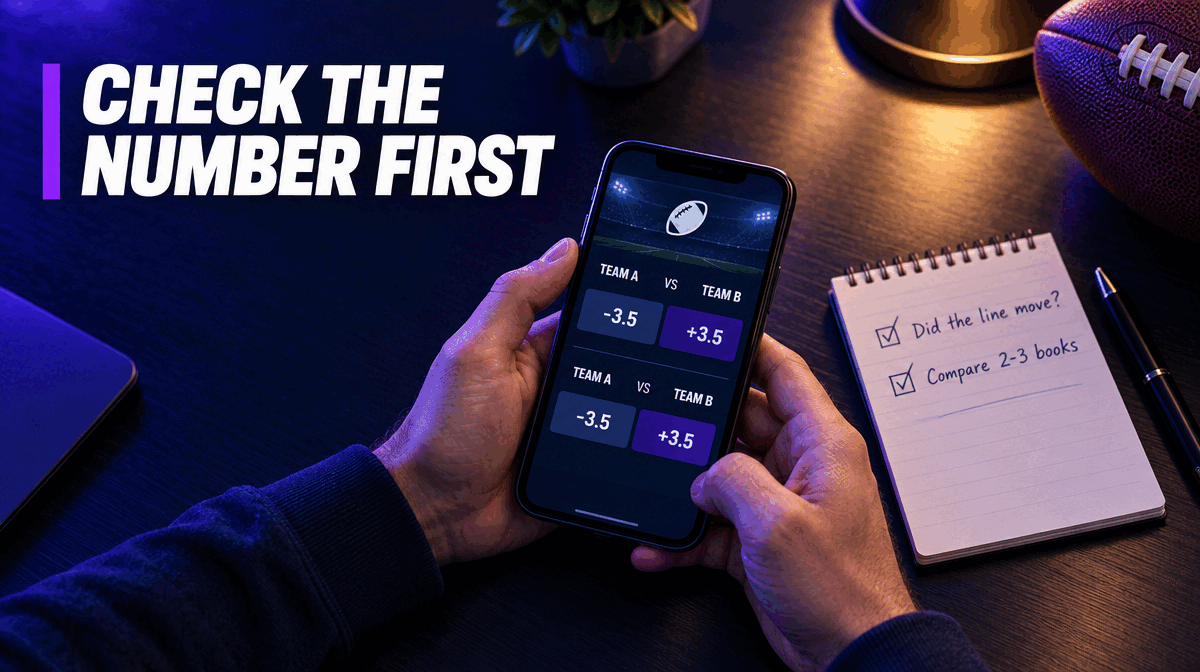
- Check the position first. A quarterback trade is a line event. A pass rusher or a running back is rarely one.
- Skip the rumors. A report that a team is “in talks” is not a trade, and deals can fall through. Wait until it is official.
- See whether the number moved. If the spread stayed the same, the market does not think the deal is worth points. Do not pay extra for a story.
- Compare two or three books after the news. Most books copy a small group of market-making books, as we explain in how sportsbooks set NFL point spreads. You can check spreads at BetOnline and Bovada, but the same advice applies at any book.
- Read the injury report too. A trade can leave a hole on the depth chart. The weekly injury report will show who is actually playing.
- Do not chase a late move. If a line moves a lot after a deal, ask whether the reason is a real edge or just a crowd before you follow it.
- Set your budget first. No trade guarantees a win.
Editor’s Note: The line-value ranges come from 2016 and 2017 articles and may not match today’s sportsbooks. The “our read” column and the quarterback example are our own illustrations, not sportsbook numbers. The ESPN list and player details were published in early October 2026 and will change before the Nov. 10 deadline. We did not place bets or test any sportsbook for this guide. Real lines change by the minute, so check live prices before you bet.
Must be 21+ to bet. Sports betting is not legal in every state. Gambling problem? Call 1-800-GAMBLER (1-800-426-2537) for free, confidential help.
References
- Dan Graziano. “2026 NFL trade deadline: Candidates to move, teams to watch.” ESPN. Published early October 2026. Checked October 13, 2026.
- Evan Abrams. “NFL Backup QB Results Index: Spreads, Situational Edge, Totals & Trends.” Action Network. Updated October 8, 2026. Checked October 13, 2026.
- David Solar. “NFL Player Point Spread Values.” Sports Insights. July 19, 2016. Checked October 13, 2026.
- Jimmy Boyd. “Tips for Handicapping Pro Football Player Values Against the Spread.” Boyd’s Bets. June 15, 2017. Checked October 13, 2026.