NFL spreads start as power ratings, get tested with low-limit openers, then get copied across the market. Here is how one number becomes three different prices, and what that costs you.

A sportsbook sets an NFL point spread in three stages. An oddsmaker turns team ratings into a first number. A few books post that number with small betting limits to see who bets it. Then the rest of the market copies it and adjusts. Lines differ between books because each one has its own numbers, its own customers and its own taste for risk. Here is a real example. For the Bills-Rams Monday night game on Oct. 12, 2026, the Rams were favored by 3 or 3½ points, depending on the sportsbook, per the Las Vegas Review-Journal.
The Quick Version
- The first number starts with power ratings. A power rating is one number for how good a team is on a neutral field. Oddsmakers then adjust for home field, injuries, rest and travel.
- Openers are a test, not a final answer. The first book to post a line keeps bet limits low, often a few hundred dollars, so sharp bettors (proven winners) can correct it cheaply.
- Most books copy. A small group of “market maker” books moves first. Many others follow their price instead of building their own.
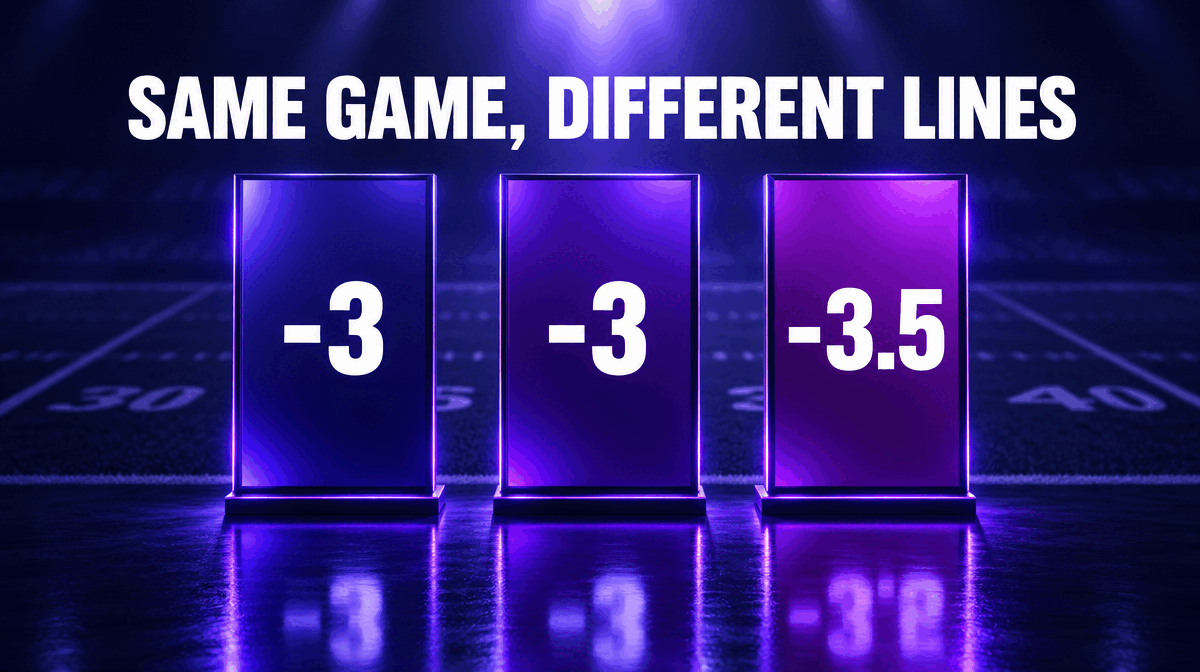
- Books can differ by a half-point or by the price. One book may hold -3 and charge more. Another may sit at -3.5. That gap can change whether your bet wins, loses or pushes.
- Our take: the opening number matters less than the price you actually get. Compare books before every bet.
Is the Point Spread a Prediction or a Price?
It is a price. A point spread is the number of points the favorite has to win by for a bet on it to win. Most people think the spread is the oddsmaker’s guess at the final score. It is closer to a price tag that gets corrected as money comes in.
The old textbook idea is that books just try to get equal money on both sides. Economist Steven Levitt tested that in a 2004 paper in The Economic Journal. He studied about 20,000 NFL bets placed by 285 bettors in an online handicapping contest during the 2001-02 season.
He found that bettors leaned toward favorites. Books did not fight that by balancing the money. Instead, they set prices so favorites covered less than half the time but still drew more than half the bets. Levitt estimated this raised the books’ gross profit margins by 20% to 30% compared with simply balancing the action.
That data is more than 20 years old, and it came from a contest, not a normal betting window. But the lesson still holds up. A spread is a business decision, not just a forecast.
How Do Oddsmakers Build the First NFL Spread?
They start with ratings and then adjust. Action Network puts it simply: all oddsmakers have power ratings that project how teams would match up on a neutral field. They then adjust for home field, injuries, rest, travel and current form.
Here is that process as steps:
- Rate every team. Each team gets one number for how strong it is on a neutral field.
- Subtract. The gap between two teams’ ratings is the neutral-field spread.
- Add home field. The home team gets some points for playing at home.
- Adjust for news. Injuries, a short week, travel and weather can move the number.
- Round to a bettable number. The book picks a whole or half-point number, keeping an eye on the most common final margins.
- Decide how to shade it. The book may nudge the line toward the side it expects its customers to bet. That nudge is called shading.
Steps 1 through 4 are the same work a handicapper does. A handicapper is anyone who studies games to pick winners. Our guide to NFL handicapping for beginners shows how to build your own line that way. Steps 5 and 6 are where the sportsbook’s business side comes in. That is the part most bettors never see.
What Does One Spread Look Like From Rating to Three Different Books?
We built a simple example to show the whole path. The teams, ratings and books below are made up. The math is real.
| Step | What the oddsmaker does | Running number |
|---|---|---|
| 1. Ratings | Home Team is rated 4.0 points better than an average team. Road Team is rated 2.5. | — |
| 2. Subtract | 4.0 minus 2.5 = 1.5 | Home by 1.5 |
| 3. Home field | Add 1.5 points for the home team (an illustrative value) | Home by 3.0 |
| 4. Injury news | Road Team’s top cornerback is out. Call it worth 0.5 points. | Home by 3.5 |
| 5. Opening line | Book A posts it with a low limit | Home -3.5 (-110) |
The “-110” is the juice, also called the vig. It is the fee built into the price. At -110 you risk $110 to win $100.
Now say early sharp bettors (people with a long record of winning) like Road Team +3.5. They bet it at Book A. Book A does not want to move off 3, the most common final margin in the NFL. So it lowers the line to 3 and charges more on the favorite instead. Later, other books post their own prices.
| Book (illustrative) | Home Team price | Road Team price | Why it sits there |
|---|---|---|---|
| Book A: market maker | -3 (-120) | +3 (+100) | Opened -3.5. Sharp bets on the underdog pushed it to 3. It holds 3 and charges extra on the favorite. |
| Book B: copier | -3 (-115) | +3 (-105) | Copied Book A’s move, with its own juice. |
| Book C: recreational-heavy | -3.5 (-110) | +3.5 (-110) | Its customers keep betting the favorite, so it has no reason to drop yet. |
DWZ calculation: break-even win rate = amount risked divided by (amount risked + amount won). At -110 that is 110 / 210 = 52.4%. Also, at -115 it is 115 / 215 = 53.5%. At -120 it is 120 / 220 = 54.5%. At -105 it is 105 / 205 = 51.2%. And at +100 it is 100 / 200 = 50%. Push results are left out.
Same game, very different bets. Here is how each one plays out in dollars:
- Home Team -3 (-120) at Book A. You risk $120 to win $100. If Home Team wins by exactly 3, the bet pushes and you get your money back. You need to win 54.5% of the bets that don’t push just to break even.
- Home Team -3.5 (-110) at Book C. You risk only $110 to win $100. But a 3-point win now loses. You need 52.4% to break even.
- Road Team +3.5 (-110) at Book C. A 3-point loss still wins your bet. You need 52.4% to break even.
- Road Team +3 (+100) at Book A. You risk $100 to win $100, but a 3-point loss is only a push.
Our take: if you like the underdog in a game like this, Book C’s +3.5 is the bet we would look for first. The extra half-point sits on top of the most common NFL margin, and that matters more than 10 cents of juice in most cases. If you like the favorite, the call is closer. You’re choosing between a cheaper bet that loses on a 3-point win and a pricier bet that pushes on one. Our guide to why 3 and 7 matter most shows how often games land on those numbers.
Why Do Sportsbooks Open NFL Lines With Low Limits?
To learn cheaply. A limit is the most a book will let you bet on one line. Action Network says a “market-making” book usually releases the line first, with limits of maybe a few hundred dollars depending on the sport. If the number is wrong, sharp bettors pounce, the line moves, and the book only loses a small amount finding out.
Limits then climb as the week goes on. Action Network says NFL odds tend to open on Sunday, with limit increases through the week and a key increase on Thursday. That is when many of the biggest bettors finally step in, because small early limits aren’t worth their time.
One Las Vegas book has described this timing in public. In 2024, the Westgate SuperBook said it posts its opening NFL lines for the following week on Sunday afternoon and raises limits on NFL sides as the week goes on, per the Las Vegas Review-Journal.
Oddsmaker Matt Metcalf, writing for Circa Las Vegas, calls the opener “just a jumping off point.” It gives professional bettors a starting place to bet the line toward where they think it belongs. He adds that the most respected bettors end up dictating the line, not the bookmaker.
Who Moves the Line First, and Who Copies It?
A small group of books leads. Everyone else mostly follows. Unabated calls the market “largely a game of ‘Follow the Leader.'” The leaders are called market makers. These are books that take bigger bets from sharp players and use that action to find the right price.
Unabated names Pinnacle as the main market maker for very efficient sports like the NFL. It also points to BetCRIS for most other U.S. sports, and says Circa wants to lead in some markets. Those are Unabated’s views, and they can change over time.
Once a number settles, other books copy it. Action Network says they watch an “odds screen,” a live list of every book’s prices, and try not to stray too far. It also describes “moving on air.” That is when a book moves its line only because other books moved theirs, not because of its own bets.
Metcalf gives one more reason books stay close together: arbitrage bettors. These are people who bet both sides at two different books when the numbers are far enough apart to lock in a profit. A book that opens too far from the market invites them in.
Sometimes a line moves against the side most people are betting. That is a separate topic. We cover it in our guide to reverse line movement.
Why Is the Same NFL Game a Different Number at Different Books?
Because every book is a separate business setting its own price. A guide from OddsShopper (Aug. 7, 2026) lists three main causes. We added two more from the sources above.
- Different numbers. Each book builds or licenses its own ratings. Two models rarely land in exactly the same spot.
- Different customers. A book moves its line based on the money it takes. If one side gets hammered at one book but not another, the two numbers drift apart.
- Different risk appetite. Some books hold their number and accept lopsided action. Others move fast. Books with mostly casual customers may shade popular sides, like favorites, because those customers will pay it.
- Different juice. Two books can post the same spread at different prices. In 2024, the Westgate SuperBook offered NFL sides at -108 instead of the standard -110, per the Review-Journal. At -108 you risk $108 to win $100, so you need 51.9% to break even instead of 52.4%.
- Different timing. Books that copy can lag behind the market makers by minutes or more after news breaks.
The Bills-Rams game is a clean real-world case. Before kickoff, the Review-Journal reported the Rams at -3 or -3½ depending on the book. In the same article, VSiN’s Matt Youmans listed his pick as Rams -3 at -120. That is the Book A pattern from our example. Some books hold 3 and charge more juice. Others move the half-point.
Do Offshore Sportsbooks Set Their Own Lines?
Some offshore books have led the market for years. Metcalf writes that in the mid-1990s, many of the most talented bookmakers moved offshore. Certain offshore books became “the gold standard” for opening lines because more money was bet into their numbers than anywhere else. Action Network also says most market-making books today are not in the United States.
That does not mean every offshore site makes its own numbers. Many casual-focused books, offshore or state-licensed, follow the market instead of leading it. We have not verified how any specific offshore sportsbook builds its lines, so treat each book’s number as its own price and compare.
One more thing matters here. Offshore sportsbooks are not licensed by U.S. state gaming regulators. If there is a dispute over a bet or a payout, you will not have a state agency to complain to. Read the house rules, and start small with any new book.
Disclosure: the links below are affiliate links. DWZ may earn a commission if you sign up, at no extra cost to you.
If you already use more than one offshore book, check the same game at each before you bet. For example, compare the spread and the juice at BetOnline and Bovada. Look at both the number and the price.

How Should You Use This Before You Bet an NFL Spread?
Knowing how lines are made should change a few habits. Here is the short checklist we use:
- Find the market number. Check at least two or three books. If most say -3, a book at -3.5 is either slow or shading.
- Compare the price, not just the spread. -3 (-120) and -3 (-110) are not the same bet. Use the odds converter in our parlay calculator and odds converter tool to see the break-even rate for any price.
- Watch the half-points around 3 and 7. Moving through those numbers is worth more than most other half-points.
- Don’t chase openers. Early limits are small and lines move fast. A beginner rarely gets a real edge by racing the sharps.
- Know why a line moved before you follow it. It could be injury news, sharp money or a book copying the market.
- Set your budget first. No line, however good it looks, guarantees a win.
Editor’s Note: The worked example uses made-up teams, ratings and books to show the math. The 1.5-point home-field value and the 0.5-point injury value are illustrative, not estimates for any real team or player. Levitt’s findings come from 2001-02 contest data and may not match today’s market. We did not place bets or test any sportsbook for this guide. Real lines change by the minute, so check live prices before you bet.
Must be 21+ to bet. Sports betting is not legal in every state. Gambling problem? Call 1-800-GAMBLER (1-800-426-2537) for free, confidential help.
References
- Action Network Staff. “How Are Sports Betting Lines Really Made?” Updated May 8, 2026. Checked October 12, 2026.
- Matt Metcalf. “How Lines Are Set: An Oddsmakers Perspective.” Circa Las Vegas. Checked October 12, 2026.
- Jack Andrews. “Who Sets The Betting Line? The Market Makers.” Unabated. August 3, 2026. Checked October 12, 2026.
- Steven D. Levitt. “Why Are Gambling Markets Organised So Differently From Financial Markets?” The Economic Journal 114 (April 2004): 223-246.
- Todd Dewey. “Westgate SuperBook offers reduced juice during football season.” Las Vegas Review-Journal. August 28, 2024.
- VSiN staff (Steve Makinen and Matt Youmans). “NFL betting predictions: Differing views prevail on Monday night game.” Las Vegas Review-Journal. October 11, 2026.
- Sam Smith. “Do Different Sportsbooks Have Different Odds On The Same Game?” OddsShopper. August 7, 2026. Checked October 12, 2026.