
An NFL parlay ties two or more football bets onto one ticket, and every single pick has to win or you lose the whole thing. Payouts look great. That math is also why sportsbooks push parlays harder than any other NFL bet on the board.
The Quick Version
- An NFL parlay combines 2 or more football bets into one wager. All legs must win. One loss kills the ticket.
- Four NFL sides priced at the standard -110 each pay about +1228, so $10 returns $132.83. You need to hit that ticket 7.5% of the time just to break even.
- Coin-flip legs hit a four-leg parlay only 6.25% of the time. That gap is the sportsbook’s profit.
- DWZ analysis of standard pricing: the house edge on a single -110 NFL bet is about 4.5%. Stack six legs and it climbs to roughly 24%.
- Shopping for -105 NFL sides instead of -110 raises a four-leg $10 payout from $132.83 to $145.30 — the same picks, more money.
Never placed one at all? Start with our beginner’s guide to parlay bets, then come back here for the NFL side.
What Does an NFL Parlay Actually Look Like on a Bet Slip?
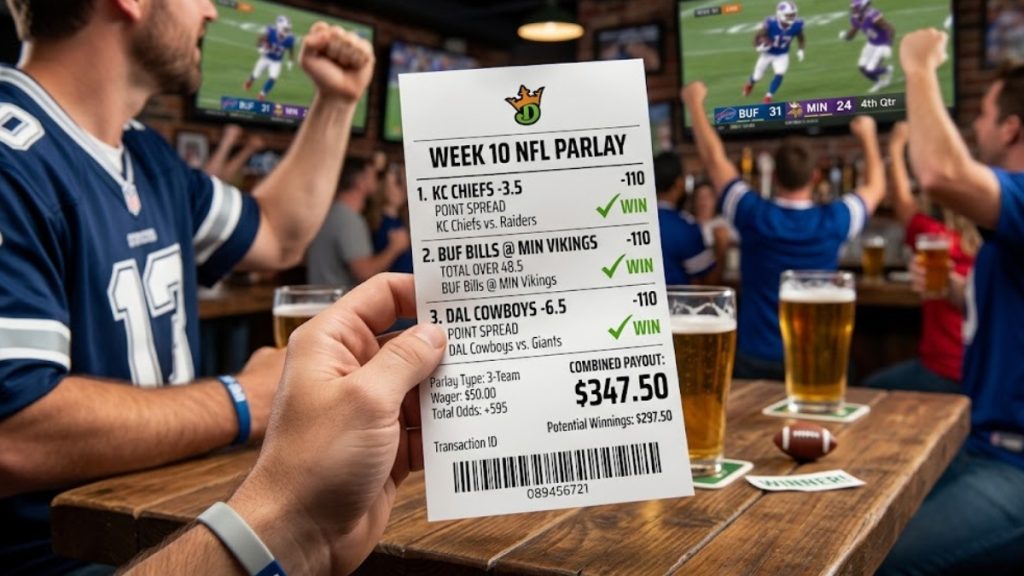
Picture a normal Sunday. You like three things: the Chiefs to win by more than the spread, the Bills–Dolphins game to go over the total points number, and the Cowboys to win outright.
Bet those separately and you have three tickets that live or die on their own. Put them on one parlay and you have a single ticket with three legs. Chiefs cover, over hits, Cowboys win — you get paid. Cowboys lose in overtime and the other two don’t matter. Gone.
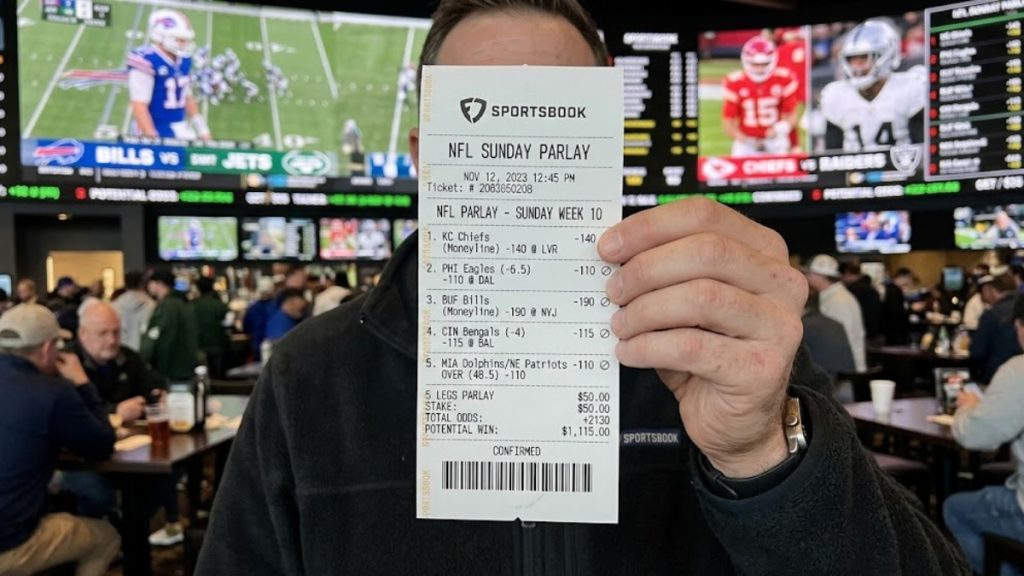
Those teams and picks are illustrative, not live lines. Structure is the part that matters. NFL parlays get built from four pieces, almost always.
- Point spread — the handicap. A team must win by more than the number, or lose by less than it.
- Moneyline — straight up. Pick the winner, forget the margin.
- Total (over/under) — the combined points both teams score, versus a posted number.
- Player props — one player’s stat line, like passing yards or a rushing touchdown. Our NFL player prop bets guide breaks these down.
Mix and match across games and you have a standard multi-game parlay. Pull two legs from one game instead and you have a same-game parlay. Those price differently and carry their own traps.
New to reading the numbers themselves? Start with what NFL betting odds mean — nothing below will land without it.
How Much Does an NFL Parlay Pay?
Payouts are multiplied, not added. Each leg’s odds get converted to a decimal number, all the decimals get multiplied together, and your stake rides the whole chain. You can calculate your parlay payout with our free tool before placing a wager.
NFL sides and totals are usually priced at -110. That’s the sportsbook’s fee, called the vig or juice — you risk $110 to win $100. In decimal terms, -110 equals 1.9091.
Here is what stacking those legs does to a $10 bet. Every figure is DWZ’s own calculation from standard -110 pricing, rounded to the nearest dollar on the odds.
Based on every leg priced at -110. “Returns” includes your $10 stake back. Calculated by DWZ, August 5, 2026.
Look at the last two columns together. That’s the whole story of parlay betting in one place. A six-leg ticket needs to win 2.1% of the time to break even, but truly 50/50 legs only get there 1.56% of the time.
Why Do Sportsbooks Love NFL Parlays So Much?
Because the house edge grows with every leg you add, and NFL Sunday gives bettors a dozen games to add legs from.
Run the same math as a percentage of what you wager. Analysis by DWZ, using -110 legs that each win exactly half the time:
DWZ calculation, August 5, 2026. Expected loss per dollar wagered, all legs at -110 and 50% true win probability.
Six legs at -110 costs you roughly five times more per dollar than one single bet. State regulators see it in their own numbers. Monthly sports wagering reports from the Ohio Casino Control Commission and the New York State Gaming Commission have shown parlay hold running several times higher than straight-bet hold. Hold is the share of all money wagered that the book keeps.
That’s not a scam. Nobody hides it. Books simply price parlays so the fee compounds, and they market them hard because most tickets lose.
Are NFL Parlays Ever Worth the Risk?
Our stance: as a steady strategy, no. As a small, deliberate slice of your betting money, yes — with rules.
Here’s the honest version. Every leg you add multiplies the sportsbook’s fee against you, so a bettor grinding parlays every week is paying 17% to 24% for the privilege. No realistic NFL edge covers that.
But two situations change the picture:
- You’re getting better-than-standard prices. Reduced-juice NFL sides at -105 instead of -110 shrink the fee at every leg. Same four picks, $10 stake: $132.83 at -110 versus $145.30 at -105. That’s $12.47 more on one small ticket. Bovada and BetOnline both post reduced-juice NFL lines during the season, and BetUS and MyBookie price key spots differently from week to week — worth checking all four before you lock anything.
- You genuinely think two legs are linked. If you believe a game turns into a blowout, the favorite’s spread and the over can rise together. Books know this and often shorten same-game prices for it, but not always across separate games.
What doesn’t hold up: the eight-leg lottery ticket. A 1-in-several-hundred shot funded with your regular bet size is entertainment, not betting. Treat it like a ticket to a show, cap it at money you’d shrug off, and keep it separate from the bankroll you use for single bets.
What Are the Key NFL Rules That Wreck Parlays?
Three specific things trip up new NFL parlay bettors, and none of them are obvious until it happens to you.
Pushes shrink your ticket. A push means a tie — the Chiefs win by exactly 3 on a -3 spread. Most books drop that leg and recalculate the parlay at the remaining legs. Your four-leg +1228 quietly becomes a three-leg +596. You didn’t lose, but the payout you were staring at is gone. This matters more in the NFL than in any other sport, because 3 and 7 are the most common final margins in pro football, per historical game data at Pro-Football-Reference. Games landing on exactly 3 are close to a one-in-seven event.
Postponed and cancelled games sit in limbo. If a Sunday game gets moved, most sportsbook house rules hold the whole parlay open until that game is played or officially voided. Read your book’s rules page — offshore books differ from each other on the waiting period.
Cash-out is not guaranteed. Regulated apps advertise early cash-out on live parlays. Offshore books often don’t offer it at all, or offer it on a limited set of markets. If bailing mid-ticket matters to you, confirm it exists before you bet, not after two legs cash.
How Do Parlays Compare to Teasers and Round Robins?
Parlays are one of three ways to bundle NFL bets, and they’re not always the best of the three.
Structural comparison, not pricing. Terms vary by sportsbook.
Teasers are the one most NFL bettors skip and shouldn’t. Buying a two-team spread through both 3 and 7 addresses exactly the margins that break parlays — our teaser bet guide shows how the pricing works. If you want the parlay payout shape with a softer landing, round robin bets split your picks into several small parlays instead of one all-or-nothing ticket.
What Should a Beginner Do Instead of Big NFL Parlays?
Bet single games first, and build the parlay habit only after you can show a profit on straight bets.
The reason is arithmetic, not attitude. A 4.5% fee on single NFL bets is beatable with good line shopping and disciplined picks. Paying 17% on four-leg tickets is not beatable, no matter how sharp your read on a matchup is.
A practical starting setup:
- Keep single bets at 1% to 2% of your bankroll each.
- Cap all parlay action at 5% of your weekly betting money, total.
- Stay at two or three legs. The edge against you doubles between two legs and six.
- Compare the same parlay at two books before you place it. The $12.47 gap in the -105 example above shows up on every ticket you ever place.
More on sizing and pick selection lives in our NFL betting strategies for beginners guide on DWZ.
References
- Pro-Football-Reference — historical NFL game results and margin-of-victory data
- Ohio Casino Control Commission — monthly sports wagering revenue and hold reports
- New York State Gaming Commission — sports wagering handle, revenue, and hold data
- American Gaming Association — US sports betting market research and industry reporting
- NFL.com — official schedule, game status, and postponement announcements
📂 Explore more: Sports Betting Reviews
Related Reading
- Browse All Gambling Guides
- Offshore Sportsbooks That Accept Players from Texas
- How the MLB Wild Card Works — Baseball’s Expanded Playoffs Explained
- What Do NFL Betting Odds Mean and How Do You Read Them?
More in Gambling Guides