
NFL betting odds are numbers that tell you two things: how likely a team is to win and how much money you’d collect on a winning bet. The three main types — point spreads, moneylines, and totals — each use a different format, but they all work on the same idea: a negative number means the favorite, a positive number means the underdog.
Key Takeaways
- A minus sign (−) means favorite. A plus sign (+) means underdog. That applies to spreads, moneylines, and totals.
- Moneyline odds show your payout based on a $100 bet. At −150, you risk $150 to win $100. At +130, you risk $100 to win $130.
- The point spread sets a margin the favorite must win by. If the Chiefs are −6.5, they need to win by 7 or more for a spread bet to pay out.
- Totals (over/under) let you bet on combined points scored, not on which team wins.
- Different sportsbooks post different odds on the same game. Checking two or three books before placing a bet can save you real money.
What Does the Minus Sign Mean in NFL Odds?
A minus sign marks the favorite — the team oddsmakers expect to win. You’ll see it in front of a moneyline, a point spread, or a total.
On a moneyline, the minus number tells you how much you’d need to risk to win $100. Say the Eagles are listed at −180. That means you’d put up $180 for a $100 profit if they win. Your total payout would be $280 (your $180 back plus $100).
Why so much? Because the sportsbook thinks the Eagles are likely winners. The bigger the negative number, the heavier the favorite.
On a point spread, the minus sign means that team needs to win by more than that number. Eagles −3.5 means they must win by 4 points or more for a spread bet to cash. A 3-point Eagles win would lose that bet.
What Does the Plus Sign Mean?
The plus sign tags the underdog. On a moneyline, it shows how much profit you’d earn on a $100 bet.
Cardinals +155 means a $100 bet returns $155 in profit if Arizona wins. Total payout: $255. Underdogs pay more because they’re less likely to win.
On a point spread, Cardinals +3.5 means Arizona can lose by up to 3 points and your bet still wins. They don’t actually have to beat the Eagles — they just need to stay within that margin. That’s what “covering the spread” means. For a deeper breakdown of spread mechanics, see our guide on how to bet on the NFL.
How Do Point Spreads Work in NFL Betting?
The point spread is the most popular NFL bet. It evens out mismatched games by giving the underdog a head start.
Here’s a real-world example. Suppose Week 1 lines look like this:
- The half-point (the .5) exists to prevent a tie, which bettors call a “push.” At −6.5, there’s no middle ground — the bet either wins or loses.
- Both sides of a spread bet usually cost −110 at standard sportsbooks. That −110 price means you risk $110 to win $100. The extra $10 is the sportsbook’s cut, called the “vig” or “juice.” Think of it like a service fee built into every bet.
- Bovada often prices NFL spreads at −110 on both sides. BetOnline matches that on most games. Some books occasionally move to −105 on one side to attract action — that saves you roughly $5 per $100 wagered.
What Is a Moneyline Bet and When Should You Use One?
A moneyline bet strips away the spread. You’re just picking which team wins. No point margin matters.
Here’s how the same game might look on a moneyline:
At −250, you’d need to bet $250 to profit $100 on Kansas City. That’s a steep price. The return on a $100 bet works out to just $40.
Moneylines make the most sense for underdogs or close matchups. When two teams are nearly even, you might see lines like −105 and −115, where the risk and reward feel more balanced.
One thing to watch: moneyline favorites in NFL can get expensive fast. A −300 favorite needs to win three out of four times just to break even after the vig. That math punishes you over a full season.
How Do Over/Under Totals Work?
A total, also called an over/under, is a bet on combined points scored by both teams. The sportsbook sets a number, and you bet whether the real total lands over or under it.
Example: Chiefs vs. Bengals, total set at 47.5.
- Over 47.5 wins if the final combined score is 48 or more (say, 31–20)
- Under 47.5 wins if it’s 47 or fewer (say, 24–17)
You don’t need to care which team wins. Totals let you bet on game pace instead.
Weather matters here. A December game in Green Bay with 25 mph winds will likely see a lower total than a September dome game in Las Vegas. Sharp bettors — experienced bettors who study data closely — watch weather reports, injury news, and pace-of-play stats before betting totals.
Standard pricing on totals is usually −110 on both sides, same as spreads. If you want to combine a total with other bets in the same game, our guide on same-game parlays and their risks.
How Do You Convert Odds Into Implied Probability?
Odds aren’t random. They reflect how likely the sportsbook thinks each outcome is. You can convert any American odds into a percentage with simple math. Try our odds converter tool to compare formats and potential returns.
For negative odds (favorites):
- Take the number without the minus sign, divide by itself plus 100.
- −150 → 150 ÷ (150 + 100) = 150 ÷ 250 = 0.60, or 60%
For positive odds (underdogs):
- Divide 100 by the number plus 100.
- +200 → 100 ÷ (200 + 100) = 100 ÷ 300 = 0.333, or 33.3%
Add the implied probabilities for both sides and you’ll get more than 100%. The extra percentage is the vig — the sportsbook’s built-in margin. On a typical NFL game, both sides combined add up to about 104–106%, meaning the book keeps 4–6% as its edge.
Knowing this math helps you spot value — and it’s the same math behind NFL futures bets, where long-range odds carry even larger implied margins. If you believe the Bengals have a 40% chance to win but their odds imply only 33%, that gap is where experienced bettors look for profitable bets over time.
Why Do Odds Change Before Kickoff?
NFL odds move constantly between the time they open (usually Sunday or Monday for the following week) and kickoff. Three things drive that movement.
- Injury news. A starting quarterback going on the injury report can shift a spread by 2 to 4 points in hours. When the NFL’s official injury report drops on Wednesday, Thursday, and Friday during the season, lines often adjust within minutes.
- Betting volume. Sportsbooks adjust odds to balance the money on each side. If 80% of bets land on the Chiefs, the book may move the spread from −6.5 to −7 to attract action on the Bengals.
- Sharp money. Professional bettors place large, well-researched wagers. When a sharp bettor puts $10,000 on one side, sportsbooks react quickly — sometimes moving a line before smaller bettors even notice.
Watching line movement can tell you where the smart money is going, but it’s not a guarantee. Lines move for lots of reasons.
Where Can You Compare NFL Odds Across Sportsbooks?
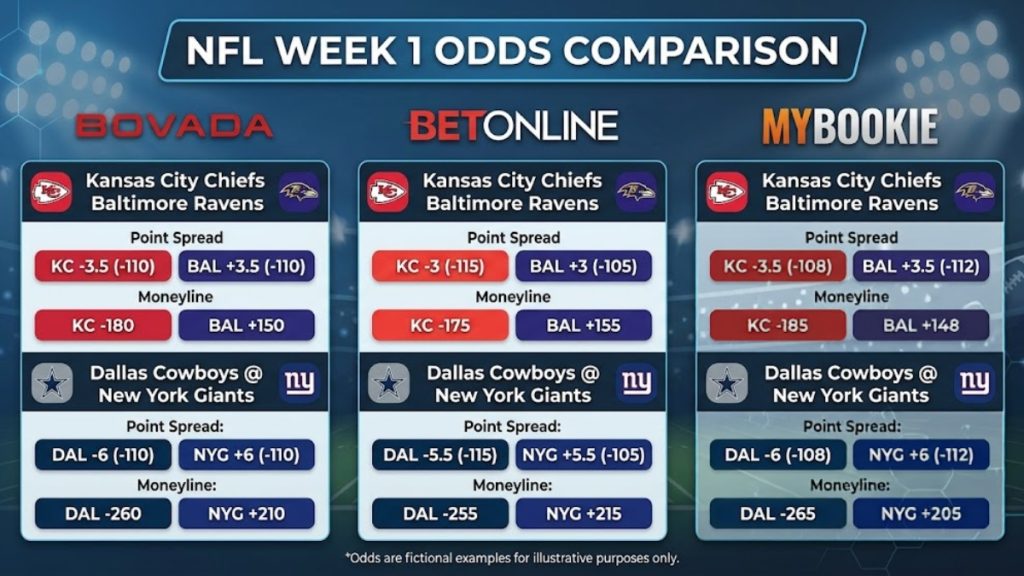
Different books post different numbers on the same game. That matters because small differences add up.
A bettor who likes the Chiefs at −6.5 saves money at Bovada’s −110 versus MyBookie’s −115. On a $110 bet, that’s a $5 difference in risk for the same potential payout. Over 100 bets in a season, that adds up to $500.
This practice is called “line shopping.” It takes about two minutes — check two or three sportsbooks before placing a bet. Bovada, BetOnline, and MyBookie all accept U.S. players and post NFL lines early in the week, which gives you time to compare.
What Mistakes Do Beginners Make When Reading NFL Odds?
A few traps catch new bettors every season.
- Confusing the spread with the moneyline. The spread tells you the margin. The moneyline tells you who wins. Betting Chiefs −6.5 is not the same as betting Chiefs −250. The first needs a 7-point win. The second just needs any win — but at a steep cost.
- Ignoring the vig. Standard −110 pricing means you need to win about 52.4% of your bets to break even, not 50%. That extra 2.4% is the vig eating into your results. If a book offers −105, your break-even rate drops to 51.2% — a real edge over a full season.
- Chasing big favorites. A −400 moneyline sounds safe, but the math says that team needs to win 80% of the time just to break even. NFL upsets happen roughly 35% of the time against the spread, according to historical data from Covers.com. Heavy favorites lose more often than most new bettors expect.
- Not comparing prices. Placing every bet at the same book means you’re leaving money on the table. Even a half-point difference on a spread can turn a loss into a push — read our guide on key numbers in NFL betting to see which margins matter most.
References
- NFL Official Schedule and Game Information.
- Covers.com — NFL ATS Records and Historical Trends.
- American Gaming Association — Sports Betting Revenue Tracker.
- Bovada Sportsbook — NFL Betting Lines.
- BetOnline — NFL Odds and Lines.
📂 Explore more: Sports Betting Reviews
Related Reading
- Browse All Gambling Guides
- Offshore Sportsbooks That Accept Players from Texas
- How the MLB Wild Card Works — Baseball’s Expanded Playoffs Explained
- NFL Week 1 Betting Guide 2026 — Key Matchups, Spreads and Early Value
More in Gambling Guides