

A run line bet is baseball’s version of a point spread — the favorite must win by at least two runs, and the underdog can lose by one run and still pay out. Run line MLB betting gives you better odds on favorites and a safety net on underdogs, and understanding the mechanics puts you ahead of bettors who stick to moneylines alone.
A run line bet adds extra risk compared to a traditional moneyline wager because the team must win by a specific margin. If you’re new to baseball betting, understanding how moneyline betting works can help you compare different wager types and find better value.
Key Takeaways
- The standard MLB run line is always 1.5 runs — favorites at -1.5, underdogs at +1.5
- Run line favorites pay plus-money odds (often +120 to +180), while the same team’s moneyline might cost -200 or more
- About 30% of MLB games are decided by one run, per Covers’ historical data — that margin makes run line bets riskier but more rewarding
- Bovada, BetOnline, and MyBookie all list run lines on every MLB game — line shopping across books can mean better payouts on the same bet
What Exactly Is a Run Line in Baseball?
A run line adds a 1.5-run spread to the final score. Take the favorite at -1.5 and your team has to win by two or more. Take the underdog at +1.5 and that team can lose by one run while your bet still cashes.
Think of it this way: a spread (where one team gets a head start) in football might be 7 points. In baseball, the spread stays locked at 1.5 runs because games are lower-scoring.
A $100 bet on a -1.5 favorite at +150 odds returns $150 profit if the team wins by two or more. That same team on the moneyline (a straight bet on who wins, no spread) might sit at -220, so you’d risk $220 just to win $100. Our payout calculator can help you review potential returns before betting.
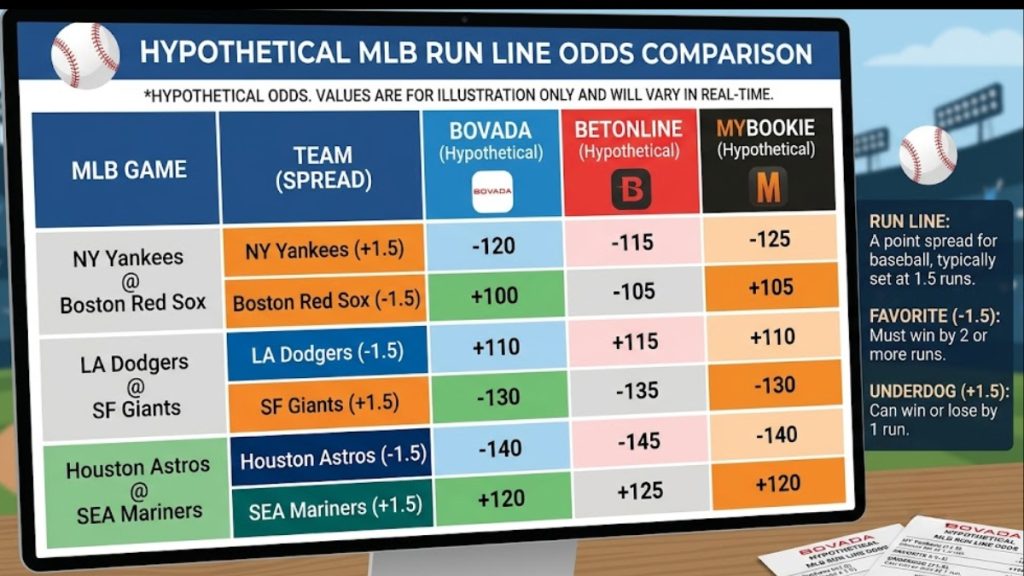
How Do Run Line Odds Compare Across Offshore Books?
Odds vary by sportsbook. Here’s a hypothetical example showing how run line pricing might differ across three offshore books:
| Sportsbook | Favorite -1.5 | Underdog +1.5 | Vig Spread |
|---|---|---|---|
| Bovada | +145 | -165 | 20 cents |
| BetOnline | +140 | -160 | 20 cents |
| MyBookie | +135 | -155 | 20 cents |
These numbers are illustrative. Always check each sportsbook’s current lines before betting.
In this example, the 10-cent gap between +145 and +135 means $10 more profit per $100 bet on the same outcome. Line shopping (checking odds at multiple sportsbooks before betting) takes 30 seconds and puts real money back in your pocket over a full season.
All three books accept crypto deposits, so funding multiple accounts and shopping lines is straightforward.
When Does the Run Line Beat the Moneyline?
Two situations stand out.
- Big favorites. When a moneyline costs -250 or steeper, the -1.5 run line on that team often pays +130 to +160. You’re adding risk — the team now has to win by two — but the payout jumps from about $40 profit per $100 to $130 or more.
- Underdogs you believe will keep it close. Taking +1.5 on a dog means you win even on a one-run loss. The price is steep, often -160 to -180, so you’d risk $170 to win $100.
Action Network’s 15-season study shows run line bets produce roughly -2.0% ROI long term for both favorites and underdogs. The vig (the sportsbook’s built-in fee) eats returns, so selective betting beats volume.
Do Run Line Bets Count in Extra Innings?
Yes. Run line bets settle on the final score, extra innings included. A 4-3 loss in 12 innings still covers +1.5. Games need at least nine full innings — or 8.5 if the home team leads — for run lines to have action, per Bovada’s posted settlement rules as of July 2026. BetOnline follows the same standard.
Rain-shortened games follow each book’s house rules. Check your sportsbook’s terms before placing run line bets on days with weather concerns.
Our MLB betting strategy guide covers starter-versus-bullpen splits that help spot run line value after the All-Star Break. The BetUS spread betting walkthrough breaks down spread wagering basics.
References
- Covers.com MLB run line data and historical one-run game percentage updated March 2026
- Action Network 15-season moneyline vs run line ROI comparison updated April 2026
- Bovada MLB run line settlement rules, accessed July 2026
📂 Explore more: Sports Betting Reviews
Related Reading
- Browse All Sports Betting Reviews
- How to Bet on the NFL: A Beginner’s Guide for 2026
- What Are NFL Player Props and How Do Depth Charts and Injuries Shape Them?
- What Is NFL Preseason Betting and How Does It Work?