

A moneyline bet is a wager on which team or player wins, with no point spread involved. If you’re wondering how to place a moneyline bet, it’s simple: pick the winner, and you get paid. That makes the moneyline the simplest bet in sports — and the best starting point for anyone new to a sportsbook.
Key Takeaways
- A moneyline bet asks one question: which side wins? No point spread, no total, just the winner.
- Negative numbers (like -150) show how much you risk to win $100. Positive numbers (like +130) show how much profit a $100 bet returns.
- On a $50 bet at -150 odds, you’d profit $33.33 if you win. At +130, that same $50 bet returns $65 in profit.
- The American Gaming Association reported $119.84 billion in legal U.S. sports betting handle for 2024, with moneyline wagers making up the largest share of single-game bets, per AGA’s 2024 annual report.
- Start with single moneyline bets on a sport you follow before trying parlays (combined bets that need every pick to win).
What Is a Moneyline Bet?
A moneyline bet is the most basic wager in sports. You pick which team wins. If your team wins, you get paid. If they lose, you lose your bet.
No point spread. No margin of victory. Every major sport offers moneyline betting: NFL, NBA, MLB, NHL, soccer, UFC, and more. Baseball and hockey rely on the moneyline more than any other bet type because scoring margins tend to be small.
Here is the key difference from a spread bet. A spread asks a team to win by enough points. A moneyline only asks them to win. If you’re still getting comfortable with betting, the moneyline is where you start.
How Do Positive and Negative Moneyline Numbers Work?
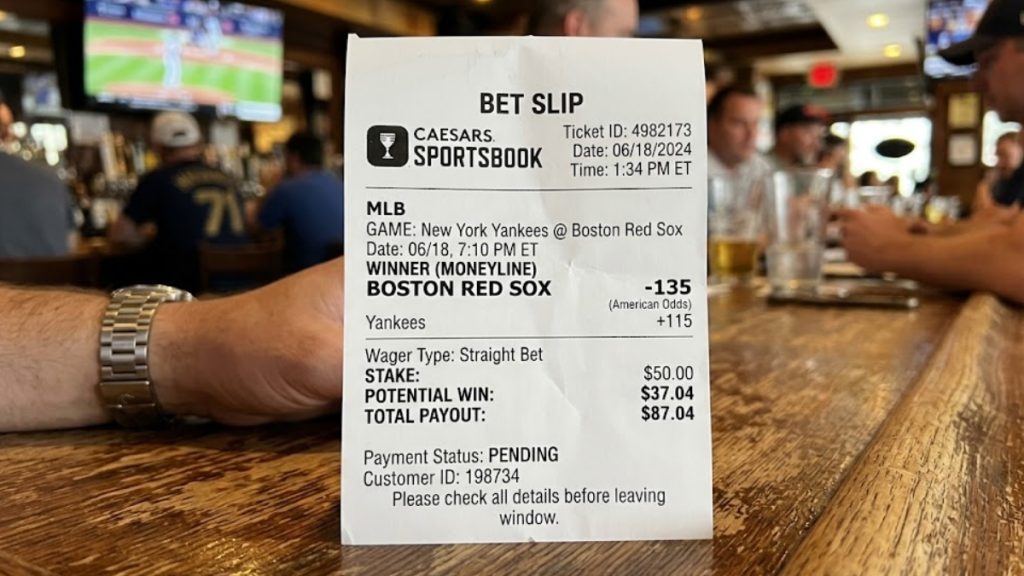
American odds use two formats: negative numbers for the favorite and positive numbers for the underdog. The favorite is the team expected to win. The underdog is the team expected to lose. Use our calculator to check the potential return before you place your wager.
- Negative odds (-150, -200, -300): This is the favorite. The number tells you how much money you need to risk to win $100 in profit. At -150, you risk $150 to win $100. At -200, you risk $200 to win $100.
- Positive odds (+130, +200, +350): This is the underdog. The number tells you how much profit a $100 bet returns. At +130, a $100 bet pays $130 in profit. At +200, that same $100 bet pays $200 in profit.
Think of it this way. Negative numbers answer: “How much do I put up to win $100?” Positive numbers answer: “How much do I get back on a $100 bet?”
Not every game has a clear favorite. When two teams are evenly matched, you might see both listed close to -110. A -110 line means you risk $110 to win $100 — and that extra $10 is the sportsbook’s built-in fee, called the vig (short for vigorish). It’s how the sportsbook makes money on every game regardless of the outcome.
Sportsbooks adjust these numbers as bets come in, moving the line to balance the money on each side.
How Do You Calculate Your Moneyline Payout?
You don’t need $100 or $150 to bet. The odds scale to any dollar amount.
For negative odds, divide 100 by the moneyline number (drop the minus sign), then multiply by your bet.
Example: You bet $50 on a team at -150.
- 100 / 150 = 0.6667
- 0.6667 x $50 = $33.33 profit
- Total payout: $50 stake + $33.33 profit = $83.33
For positive odds, divide the moneyline number by 100, then multiply by your bet.
Example: You bet $50 on a team at +130.
- 130 / 100 = 1.30
- 1.30 x $50 = $65 profit
- Total payout: $50 stake + $65 profit = $115
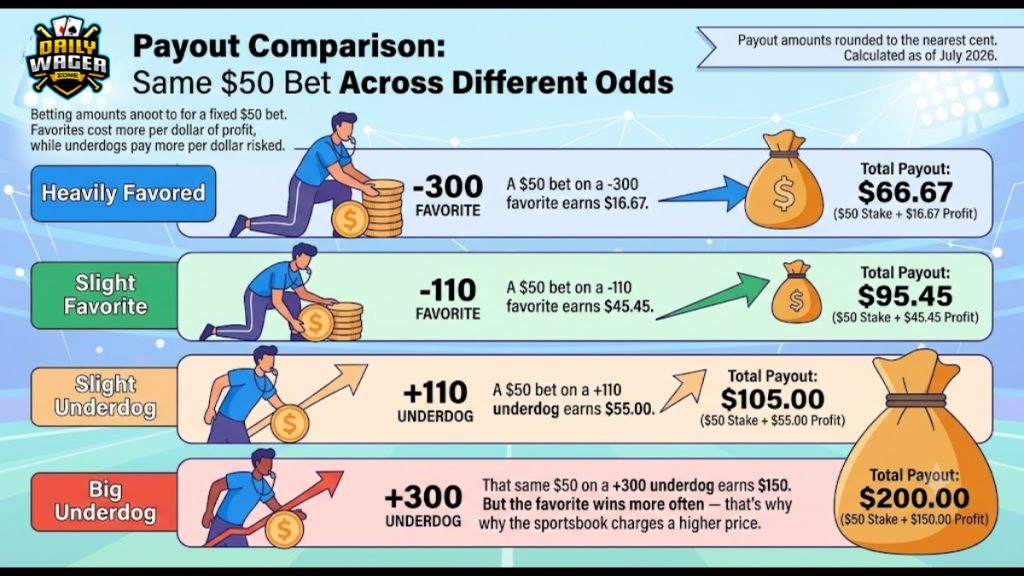
DWZ Payout Comparison: Same $50 Bet Across Different Odds
Payout amounts rounded to the nearest cent. Calculated as of July 2026.
Favorites cost more per dollar of profit, while underdogs pay more per dollar risked. A $50 bet on a -300 favorite earns $16.67. That same $50 on a +300 underdog earns $150. But the favorite wins more often — that’s why the sportsbook charges a higher price.
How Does the Moneyline Compare to Spread Betting?
Spread betting adds a point handicap. A team listed at -6.5 must win by 7 or more points for a spread bet to pay. The moneyline removes that layer — win by 1 or win by 30, the bet pays the same.
Here is when the moneyline makes more sense than the spread:
- Close games. If you think a 3-point underdog wins outright, the moneyline pays better because you’re taking on more risk.
- Low-scoring sports. In MLB and NHL, the spread is usually 1.5 runs or goals (called the run line or puck line). Many bettors prefer the moneyline because one-run and one-goal games happen constantly — about 30% of all MLB games in the 2025 season were decided by a single run, per Baseball Reference game log data.
- Underdogs you believe in. A +200 moneyline underdog pays 2-to-1. If you think they win even 35% of the time, that bet has positive expected value over repeated wagers. Expected value is the average profit or loss per bet if you placed it many times.
When does the spread make more sense? When a heavy favorite’s moneyline price gets steep. Risking $300 to win $100 on a -300 favorite means one loss wipes out three wins. The spread usually prices both sides near -110, keeping the cost flat. For a full primer on point spreads, check out our beginner’s guide to spread betting.
Where Can You Place a Moneyline Bet Online?
Placing a moneyline bet online takes about two minutes.
- Create an account. Sign up at a sportsbook, verify your email, and enter basic personal details.
- Make a deposit. Fund your account — crypto deposits (Bitcoin, Ethereum, Litecoin) are typically faster and carry no fees from the sportsbook’s side.
- Find your game. Open the sport you want, then click the specific matchup. The moneyline is usually the first bet type listed.
- Click the odds. Tap the moneyline number for the team you want. The bet will appear on your bet slip (the running ticket on the side or bottom of the screen).
- Enter your stake. Type how much you want to bet. The slip will show your potential payout before you confirm.
- Confirm. Hit “Place Bet.” Once accepted, the bet is locked in and cannot be canceled.
Offshore sportsbooks that list moneyline bets across all major U.S. sports include Bovada, which offers reduced-juice pricing on select NFL moneylines at -110 versus the standard -115 per its July 2026 odds board, and BetOnline, which accepts bettors from all 50 states and lists moneylines for MLB, NBA, and NHL alongside same-day crypto payouts, per its published terms as of July 2026. For a detailed walkthrough of Bovada’s platform, see our full Bovada sportsbook review.
What Mistakes Should First-Time Moneyline Bettors Avoid?
- Chasing heavy favorites. A -400 moneyline means risking $400 to win $100. That team might win 80% of the time — but one loss erases four wins. In the 2024-25 NBA season, teams favored at -400 or steeper lost outright 14.3% of the time, per Covers.com closing-line data.
- Ignoring the vig. Two teams at -110 each sounds like a coin flip. It’s not. The combined implied probability is 52.4% + 52.4% = 104.8%. That extra 4.8% is the sportsbook’s margin. You need to win more than 52.4% of your -110 bets just to break even.
- Betting too much per game. A safe starting point is 1% to 2% of your total betting bankroll on each wager. If you have $500 set aside for sports betting, that’s $5 to $10 per game.
- Skipping the research. Check starting pitchers in baseball, injury reports in football and basketball, and recent form. A moneyline price reflects the sportsbook’s estimate of win probability — but that estimate can lag behind late-breaking news. DWZ’s second-half MLB betting strategies walk through what to check before an MLB moneyline bet.
- Parlaying too early. A parlay combines multiple moneyline bets into one ticket. All picks must win for the bet to pay. Stick with single bets while you’re learning.
Soccer moneylines carry one more twist. Most sports have two outcomes: Team A or Team B wins. Soccer adds a third — the draw. If you bet a soccer moneyline and the match ends tied after 90 minutes, your bet loses. DWZ’s guide to betting on soccer explains how three-way moneylines work.
References
- BetOnline. “Payment Methods and Terms.” BetOnline.ag, accessed July 2026.
- American Gaming Association. “2024 Commercial Gaming Revenue Tracker.” AGA, 2025.
- Baseball Reference. “2025 MLB Game Logs — One-Run Games.” Sports Reference LLC, 2025.
- Covers.com. “NBA Closing Line Results — 2024-25 Season.” Covers Media Group, 2025.
- Bovada. “Sportsbook Odds and Promotions.” Bovada.lv, accessed July 2026.
📂 Explore more: Sports Betting Reviews
Related Reading
- Browse All Sports Betting Reviews
- How Does MLB Run Line Betting Work?
- How to Bet on the NFL: A Beginner’s Guide for 2026
- What Are NFL Player Props and How Do Depth Charts and Injuries Shape Them?