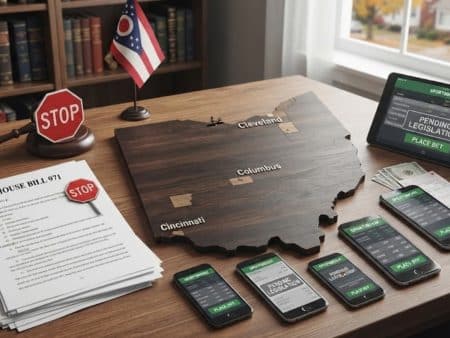

With the Ohio Sports Betting Bill June 2026 now a topic of heated debate, Ohio Governor Mike DeWine just told a public forum that signing sports betting into law was his “biggest mistake” as governor. Not a minor regret. Not a “maybe we should have done it differently.” His. Biggest. Mistake. And he’s backing that up with action — credit card bans, prediction market restrictions, and an administration that’s actively hostile to the industry it created four years ago.
Ohio has turned into the most dangerous state in America for sports betting expansion. Three separate crackdowns are happening at once, and bettors are losing tools by the month.
Why Did Ohio’s Governor Call Sports Betting His Biggest Mistake?
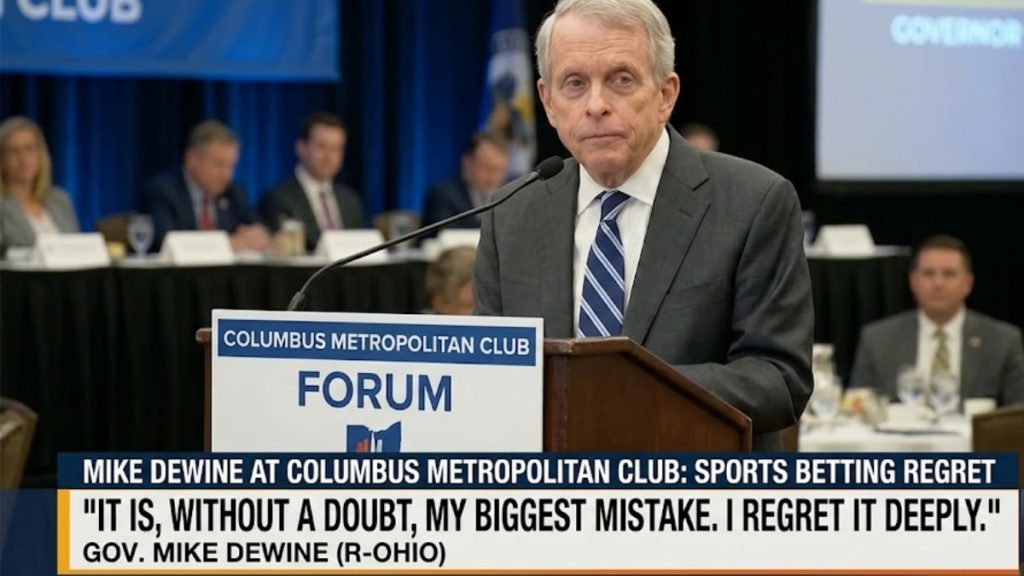
DeWine didn’t mince words at last week’s Columbus Metropolitan Club forum. Speaking with about 230 days left before he’s term-limited out of office, the Republican governor laid it out: “What I did not anticipate — and I should have — is the massive, massive amount of money that these gambling companies would come in… and they flood the airways.”
He signed HB 29 in December 2021, making Ohio the 30th state to legalize sports betting. It launched on January 1, 2023. Now he wants to burn it down.
DeWine specifically called out:
- Advertising saturation — gambling companies flooding TV, radio, billboards, and phones
- Increased gambling losses — more Ohioans betting and losing money
- Athlete harassment — bettors targeting athletes online over prop bet outcomes
This isn’t some random state senator grandstanding. This is the sitting governor saying he broke his own state. I’ve covered gambling legislation in 15+ states and I’ve never seen an executive admit fault this publicly. It’s the kind of statement that gives ammunition to every anti-gambling lawmaker in every other state.
The timing matters too. Ohio’s gubernatorial race is heating up, and DeWine just endorsed Republican Vivek Ramaswamy. The anti-gambling stance could become a campaign issue. If the next governor runs on DeWine’s regret, Ohio bettors are looking at years of hostile leadership.
What Is the Ohio Prediction Markets Ban Bill?
Rep. Sean Brennan (D-Parma) dropped House Bill 887 in May — the “Ohio Public Employee Event-Wagering Ethics Act.” It would ban every government employee and public official in Ohio from touching prediction markets.
Under HB 887:
- Public officials and state employees cannot maintain prediction market accounts
- No buying, selling, or trading event contracts of any kind
- No using government information to inform trades
- Statewide elected officials and employees at agencies like the Ohio Casino Control Commission, Ethics Commission, and Department of Commerce face extra restrictions
- Financial interest bans — certain officials can’t hold stock in prediction market companies or take money from them
- Criminal penalties — violations are a first-degree misdemeanor with fines up to $10,000 per violation
Brennan was blunt: “Ohioans deserve confidence that public officials and state employees are acting solely in the public interest.”
The bill specifically carves out licensed sports gaming already regulated under Ohio law. This is aimed squarely at platforms like Kalshi and Polymarket.
HB 887 will be assigned to an Ohio House committee for public hearings. Given DeWine’s stance and the bipartisan appetite for prediction market regulation, this has real legs.
For context, Ohio Sen. Sherrod Brown also pushed a federal resolution banning Senate members from prediction markets, which the U.S. Senate actually passed. Ohio is leading the national anti-prediction-market charge from both the state and federal level.
How Will the Ohio Credit Card Sports Betting Ban Work?
The Ohio Casino Control Commission (OCCC) proposed a rule amendment in May that would ban credit card deposits on all licensed sportsbook platforms. If adopted, Ohio becomes the 10th state to pull credit cards from sports betting.
This isn’t legislation — it’s a regulatory rule change, which means it can move faster. The OCCC doesn’t need the legislature to act. DeWine’s administration can push this through on its own.
The practical impact for bettors: you’d need to use debit cards, bank transfers, PayPal, Venmo, or other non-credit payment methods. No more putting tomorrow’s rent on a parlay with your Visa.
Honestly? This one’s hard to argue against. Betting on credit is a recipe for disaster. I talked to a sharp I know in Columbus who said half his buddy’s group was running up credit card debt chasing losses. That’s not sustainable for anyone.
States that already ban credit card sports betting include Connecticut, Illinois, Indiana, Kentucky, Maryland, New Hampshire, Tennessee, Vermont, and Washington D.C.
Is Sports Betting Still Legal in Ohio Right Now?
Yes. Ohio sports betting launched January 1, 2023, and remains fully legal and operational. You can bet online through apps like DraftKings, FanDuel, BetMGM, Caesars, and others. Retail sportsbooks operate at casinos and racinos. The Ohio Lottery also manages sports gaming through Type C licenses at bars and restaurants.
What’s changed and changing:
The Save Ohio Sports Act — that wild bill we covered last month — is still floating around too. That would ban mobile betting, cap wagers at $100, eliminate parlays, and restrict betting to casinos only. Combined with DeWine’s public statements, Ohio is under siege from every angle.
How Does Ohio Compare to Other States Pulling Back on Sports Betting?
Ohio’s not alone in the backlash wave, but the governor publicly calling it his biggest mistake puts the Buckeye State in a category by itself.
The national backlash scoreboard:
- Massachusetts is pushing a 51% tax and prop bet ban through the legislature
- Colorado passed deposit caps and ad restrictions (but the prop bet ban got stripped)
- Tennessee just signed a sweepstakes ban and prediction market manipulation felony into law
- Illinois enacted a Chicago per-bet tax
But Ohio’s situation is unique because the attacks are coming from the top. When a governor calls his own signature legislation a mistake, it creates permission for every regulator, legislator, and commission in the state to go hard. The OCCC credit card ban proposal came just weeks after DeWine started ramping up the rhetoric. That’s not a coincidence.
The DraftKings-funded super PAC “Win For America” has already been spending in Ohio state races, targeting lawmakers hostile to the industry. One Ohio candidate, Stephanie Stock, warned supporters on Facebook that mailers from “American Conservatives Fund” were actually from a gambling PAC. She lost her primary.
What Should Ohio Bettors Watch For Next?
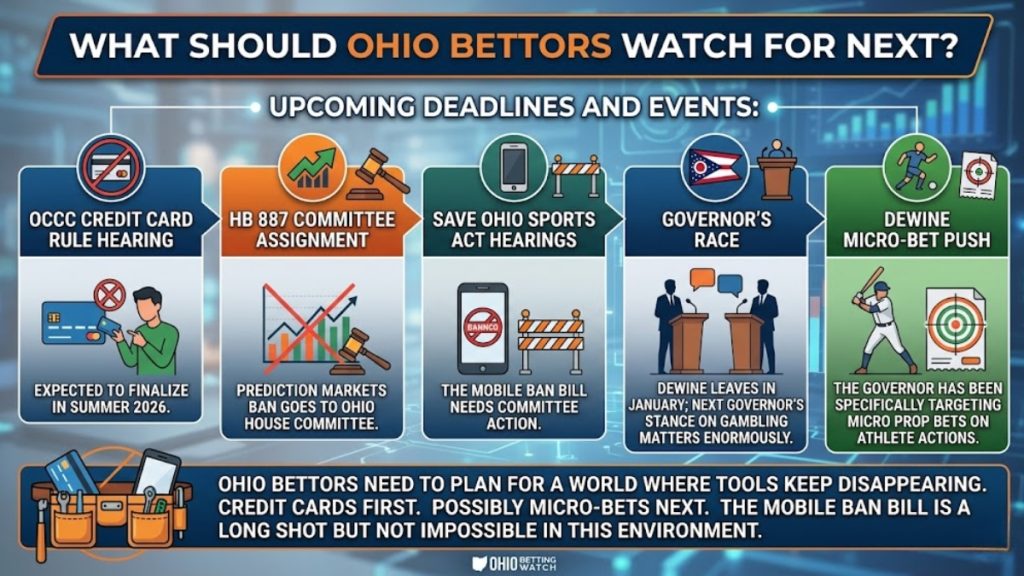
Upcoming deadlines and events:
- OCCC credit card rule hearing — expected to finalize in summer 2026
- HB 887 committee assignment — prediction markets ban goes to Ohio House committee
- Save Ohio Sports Act hearings — the mobile ban bill needs committee action
- Governor’s race — DeWine leaves in January; the next governor’s stance on gambling matters enormously
- DeWine micro-bet push — the governor has been specifically targeting micro prop bets on athlete actions
Ohio bettors need to plan for a world where tools keep disappearing. Credit cards first. Possibly micro-bets next. The mobile ban bill is a long shot but not impossible in this environment.
If you want betting freedom that doesn’t depend on what Columbus decides next, offshore options like Bovada, BetUS, MyBookie, BetOnline, and Everygame sit outside Ohio’s regulatory reach. They still take credit cards, still offer props, still do in-game betting. No affordability checks, no limitation notices. The trade-off is you lose state consumer protections — but for bettors watching Ohio’s regulatory walls close in, it’s worth knowing your alternatives.
Stay locked on Buckeye State betting news and our gambling legislation tracker for updates.
Frequently Asked Questions
As of June 1, 2026, yes. The OCCC proposed the credit card ban as a rule change, but it hasn’t been finalized yet. Expect it to take effect sometime in summer 2026 unless there’s major pushback during the comment period.
Not directly — the bill only targets government employees and public officials. Regular Ohioans would still be able to use prediction market platforms. But it signals where Ohio’s heading on prediction market regulation, and broader restrictions could follow.
The Save Ohio Sports Act proposes exactly that, but it would require both chambers of the legislature to pass it and the governor to sign it. Even with DeWine’s anti-gambling stance, killing a market that generates significant tax revenue is a heavy political lift. Watch the committee hearings to gauge real momentum.
📂 Explore more: Ohio