
The Big Beautiful Bill’s sports betting tax provision is officially a five-alarm crisis. UFC CEO Dana White sent a letter to President Trump on May 11 demanding Congress reverse the 90% gambling loss deduction cap buried inside the One Big Beautiful Bill Act (OBBBA) — and if you’ve placed a single legal wager in 2026, this affects you directly.
The short version: the federal government changed how gambling losses are deducted from your taxes, and the math is so broken that you can now owe the IRS money even when you’re losing. White called the current law “irrational,” and after tracking this provision through three committee hearings and two failed reversal attempts, I can confirm he’s being generous.
What Did the Big Beautiful Bill Actually Change?
The OBBBA, signed into law in July 2025, capped gambling loss deductions at 90% of losses — effective January 1, 2026.
Before: win $10,000 and lose $10,000, you’re break-even, zero tax liability. Now you can only deduct $9,000 of those losses. The IRS says you owe tax on $1,000 of “income” that doesn’t exist.
The gambling industry calls this “phantom income.” I call it a phantom tax on every bettor in America.
How the Phantom Tax Hits Your Wallet
Here’s what this looks like for real sports bettors — not million-dollar poker pros:
That break-even bettor owed nothing under the old rules. Now they owe $110 on money they never made. The moderate winner who netted $1,000 in actual profit faces a $374 tax bill — an effective rate of 37%.
The Tax Foundation ran numbers on poker pro Daniel Negreanu’s 2025 WSOP results and found his take-home pay got cut nearly in half. Their analysis showed a bettor netting $50,000 could face a $55,500 tax bill — an effective rate above 100%.
The Joint Committee on Taxation estimated $1.1 billion in revenue over eight years. But if even a fraction of bettors move offshore, that projection collapses.
Why Dana White Opposes the One Big Beautiful Bill
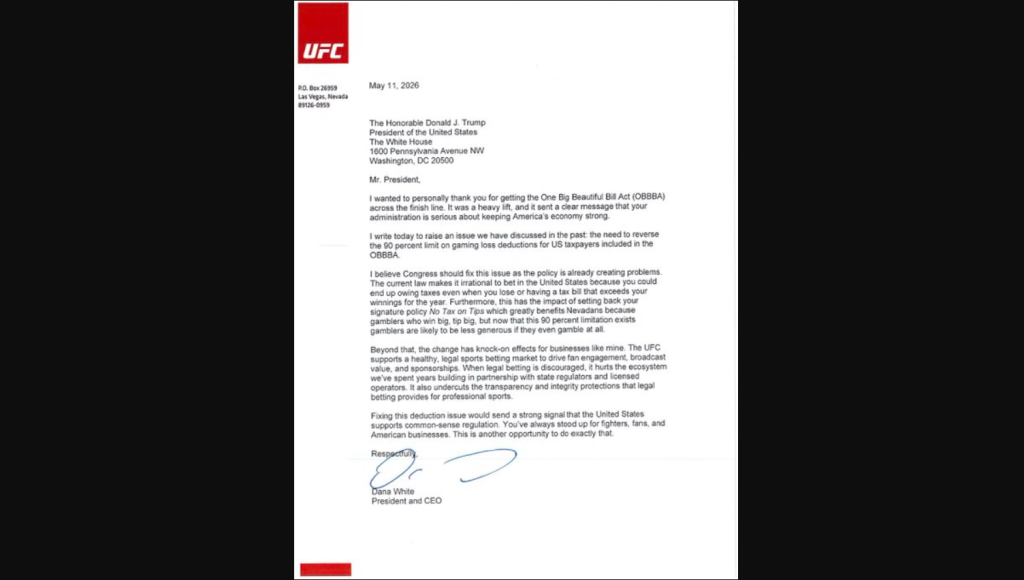
White’s letter, written on UFC letterhead and first reported by gambling journalist Dustin Gouker, doesn’t pull punches.
“The current law makes it irrational to bet in the United States because you could end up owing taxes even when you lose,” White wrote. He tied it to the UFC’s bottom line: “When legal betting is discouraged, it hurts the ecosystem we’ve spent years building in partnership with state regulators and licensed operators.”
He also jabbed at the contradiction with Trump’s No Tax on Tips policy — gamblers who win less, tip less. Smart argument.
The American Gaming Association backed the push. “Restoring the 100 percent gambling loss deduction remains a top priority for the AGA,” senior VP Chris Cylke told ESPN.
White is the highest-profile sports executive to challenge this provision — and as a high-stakes gambler with real White House access, this letter carries weight.
Where Congress Stands on a Fix
Three bills are in play to reverse the cap:
- FAIR BET Act — Rep. Dina Titus (D-NV) and Rep. Guy Reschenthaler (R-PA). Bipartisan, stalled since late 2025.
- WAGER Act — Rep. Andy Barr (R-KY).
- FULL HOUSE Act — Senators Catherine Cortez Masto (D-NV), Ted Cruz (R-TX), and Jacky Rosen (D-NV).
None have reached a floor vote. Here’s what most people miss: this provision wasn’t a policy statement. It was a procedural hack. The Senate needed a budget line item to satisfy the Byrd Rule, and Senator Mike Crapo’s finance committee inserted the 90% cap because it scored just enough revenue on paper. The original House bill didn’t include it.
That’s how a provision affecting millions of bettors became law — as a budget footnote nobody fought.
What the One Big Beautiful Bill Means for Bettors
White warned the provision could push bettors toward offshore markets. He’s not speculating — it’s already happening. When the legal market taxes phantom income, platforms like Bovada and BetOnline look a lot more attractive. While Congress stalls, bettors are doing the math and moving their action to platforms where phantom taxes aren’t part of the equation.
Track your wins and losses meticulously — the 90% cap makes record-keeping critical. And keep an eye on those three bills. If White’s letter generates enough pressure, we could see movement before football season.
Other Gambling Legislation Moving This Week
Colorado sent a sports betting protections bill to Governor Polis — they’d become the first state to limit daily deposits on betting apps. This follows their earlier SB26-131 reform.
New Jersey is advancing AB 4003, banning sportsbooks from sending promotions to bettors using responsible gambling tools.
Minnesota’s Senate approved a ban on sports prediction markets targeting Polymarket and Kalshi, effective August 1 if signed. Traditional sports betting stays legal.
Frequently Asked Questions
The One Big Beautiful Bill Act caps gambling loss deductions at 90% of losses (previously 100%). Bettors who break even or lose overall can still owe federal taxes on “phantom income” — the 10% of losses they can no longer deduct.
Yes. Under 2026 OBBBA rules, if you win $5,000 and lose $5,000, you can only deduct $4,500. The IRS treats the remaining $500 as taxable income even though you broke even.
The FAIR BET Act is bipartisan legislation by Rep. Dina Titus (D-NV) and Rep. Guy Reschenthaler (R-PA) to restore the full 100% gambling loss deduction. It has not received a floor vote.
Yes. On May 11, 2026, UFC CEO Dana White sent a letter to President Trump urging reversal of the 90% gambling loss deduction cap. No White House response has been reported.
Three bills — the FAIR BET Act, WAGER Act, and FULL HOUSE Act — have bipartisan support. Congressional action may accelerate before the 2026 NFL season, but no vote is scheduled as of May 2026.
📂 Explore more: Gambling Guides