
The real risks of offshore sportsbooks come down to five things: no guaranteed payouts, no state-regulated player protection if something goes wrong, limited legal options when disputes happen, crypto payment complications, and a growing wave of state-level crackdowns that could cut off your access overnight. If you are considering gambling online, it’s important to be aware of the Risk of Offshore Sportsbooks Betting and the problems that can arise since offshore books sit outside U.S. regulation, and that gap creates problems most bettors don’t think about until their money is on the line.
Key Takeaways
- The FBI warned in December 2025 that Americans wager roughly $673.6 billion per year through illegal and unregulated markets, per American Gaming Association estimates from August 2025
- Offshore sportsbooks operate outside U.S. state licensing, so bettors have no state regulator to call if a payout is delayed or denied
- At least 15 states plus Washington, D.C. have sent cease-and-desist letters to offshore operator Bovada as of December 2024, according to Birches Health reporting
- Crypto deposits at offshore books are irreversible — once Bitcoin leaves your wallet, no bank or payment processor can reverse the transaction
- By August 2025, 50 state attorneys general sent a joint DOJ letter demanding enforcement action against offshore operators, per NAAG
How Do Offshore Sportsbooks Actually Work?
An offshore sportsbook is a betting site that operates from another country — places like Costa Rica, Curacao, Antigua, or Panama. That means the company may hold a license from its home jurisdiction — not from any U.S. state.
You create an account, deposit money (usually through crypto or an e-wallet), place bets, and request withdrawals — the same process as any legal sportsbook. The difference is what happens behind the scenes.
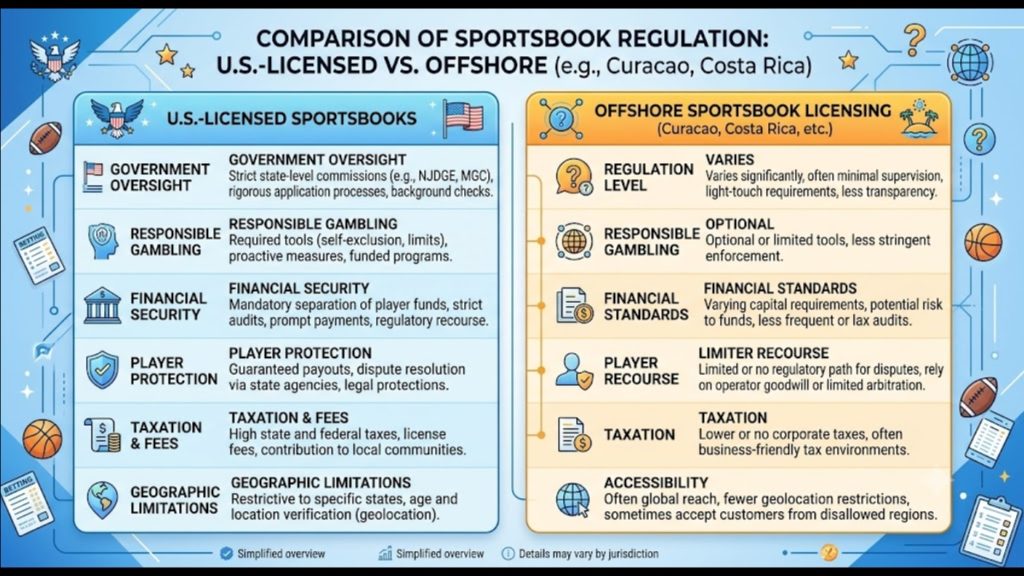
Licensed U.S. sportsbooks must hold player funds in segregated accounts, run identity verification, and give bettors a formal dispute process. Offshore operators answer to their home jurisdiction’s regulators — and those rules vary wildly. Costa Rica, one of the most common home bases, does not specifically regulate online sportsbooks that serve foreign customers.
Bovada and BetOnline have operated for over a decade. Others vanish overnight.
What Happens If an Offshore Book Refuses to Pay You?
This is the biggest risk. If a U.S.-licensed sportsbook withholds your winnings, you file a complaint with your state gaming commission. They investigate. The book can lose its license.
With an offshore book, you have no equivalent process. No U.S. state regulator has authority over a company in Costa Rica. Your options are the book’s customer support, forums like OSGA (the Offshore Gaming Association), or accepting the loss.
A 2023 study published in the Journal of Gambling Studies (Choi, 2023, PMC) found that some offshore operators “engage in shady practices to take money out of the players’ bank accounts.” The study noted that lack of regulatory accountability is the core structural problem.
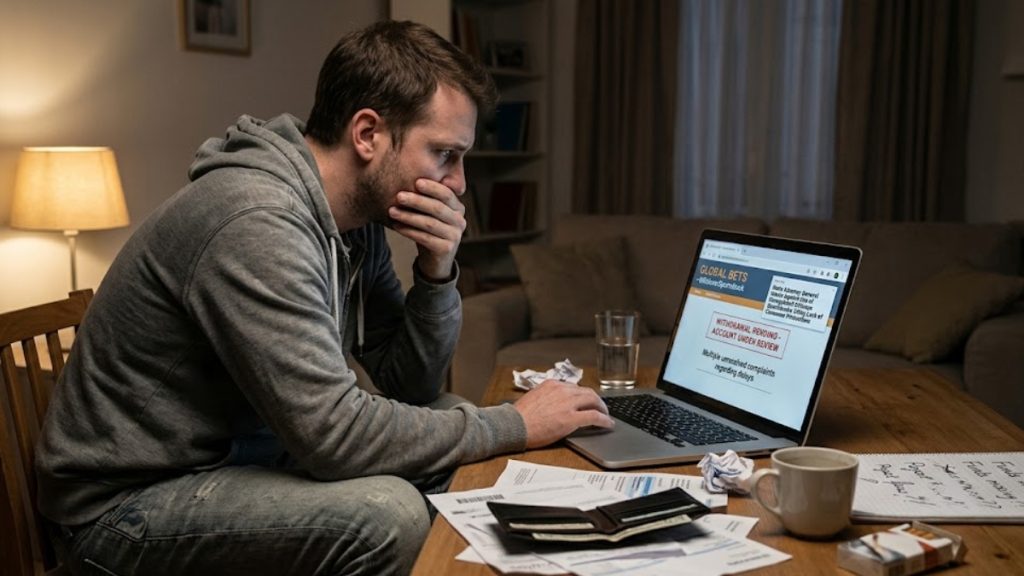
Here is what that looks like in practice. You deposit $500 in Bitcoin, run it up to $2,000, and request a withdrawal. The book could delay your payout for weeks, demand extra verification, cap your weekly withdrawal amount, or close your account. You cannot call a state regulator. You cannot file a chargeback because crypto transactions are final.
That doesn’t mean every offshore book operates this way. Established operators like BetOnline have been in business since 2001. But the risk of having no backup plan is real, and it’s the single biggest difference between offshore and regulated betting.
Are Offshore Sportsbooks Actually Illegal?
The legal picture is complicated, and most bettors get it wrong.
Federal law — specifically the Wire Act of 1961 and the Unlawful Internet Gambling Enforcement Act (UIGEA) of 2006 — targets the operators and payment processors, not individual bettors. UIGEA makes it illegal for financial companies to process transactions for unlawful online gambling. That is why offshore books push crypto: Bitcoin transactions bypass the banking system UIGEA regulates.
No widely reported case exists of a U.S. bettor being criminally prosecuted solely for placing a bet at an offshore sportsbook. But “not prosecuted” is different from “legal.” State laws vary. In states where sports betting is legal and regulated — 39 states plus D.C. per the FBI’s December 2025 reporting — using an unlicensed offshore book may violate those state laws, depending on the specific jurisdiction.
Enforcement has focused on operators and their banking channels rather than individual bettors. Still, the FBI’s December 2025 Public Service Announcement specifically warned that “individuals engaged in illegal gambling risk funding organized crime activity and becoming vulnerable to violence, extortion, and fraud.”
Why Are States Cracking Down on Offshore Books Right Now?
The crackdown accelerated in 2024. In May 2024, a coalition of seven state gaming regulators — from Colorado, Nevada, New Jersey, Michigan, Illinois, Louisiana, and Mississippi — formally asked the U.S. Department of Justice to prioritize enforcement against offshore sportsbooks and online casinos, per Birches Health reporting.
Michigan fired the first direct shot. In May 2024, the Michigan Gaming Control Board sent a cease-and-desist letter to Harp Media, the company operating Bovada, after an investigation found Michigan residents could access the site. Connecticut followed in June 2024. By December 2024, at least 15 states plus Washington, D.C. had restricted Bovada access, according to Birches Health tracking.
| State Action | Date | Details |
|---|---|---|
| Michigan cease-and-desist to Bovada | May 2024 | MGCB investigation found site accessible to MI residents |
| Connecticut cease-and-desist | June 2024 | Followed Michigan’s enforcement model |
| Kansas, Louisiana, Pennsylvania | September 2024 | Bovada voluntarily restricted access after receiving letters |
| Arizona restriction | November 2024 | Department of Gaming issued cease-and-desist |
| Total states restricting Bovada | December 2024 | 15 states plus Washington, D.C. |
In August 2025, 50 state attorneys general sent a joint letter to the DOJ urging enforcement against illegal offshore gambling operations, citing estimates that illegal online gaming exceeds $400 billion in annual volume with more than $4 billion in lost state tax revenue, per NAAG.
If your state sends a cease-and-desist letter to your offshore book, you could lose access to your account with little warning. That happened in Michigan and Connecticut after Bovada blocked site access. Bovada still processed crypto withdrawals through customer support, but the experience showed how quickly access can change.
What Extra Risks Come with Crypto Deposits?
Most offshore books now steer bettors toward cryptocurrency deposits. Bitcoin, Litecoin, and Ethereum are the most common options. The appeal is clear: faster transactions, no bank involvement, and lower fees.
But crypto adds a layer of risk that cash or card deposits at licensed books do not have. Sending Bitcoin to a sportsbook wallet address is final. If you send funds to the wrong address or the book’s wallet is compromised, the money is gone. No bank can reverse it. No payment processor can issue a chargeback (a forced refund from your bank). Our crypto betting guide walks through the deposit process, but understanding the irreversibility is the first step.
Price swings add another wrinkle. If you deposit $500 worth of Bitcoin today and the price drops 10% before you bet, your bankroll just shrank to $450 without placing a single wager. Some books convert your deposit to USD immediately. Others hold it in crypto, leaving you exposed to price changes.
How Can You Tell a Safe Offshore Book from a Risky One?
No offshore sportsbook is “safe” in the same way a state-licensed book is safe. But some are far more reliable than others. Here is what to check before depositing:
Track record matters most. Books that have operated for 10+ years and consistently paid bettors carry less risk than sites that launched last month. Bovada has been around since 2011. BetOnline has operated since 2001. That longevity does not guarantee future payouts, but it is the strongest signal available.
Check complaint databases. OSGA (osga.com) tracks complaints and rates operators. BookmakersReview.com maintains player dispute records. Reddit’s r/sportsbook surfaces payout issues in real time. If a book has a pattern of slow payouts or frozen accounts, those reports will exist.
Read the terms before depositing. Rollover requirements — the number of times you have to bet your deposit plus bonus before you can withdraw — are a common source of disputes at offshore books. A 10x rollover on a $500 deposit plus a $500 bonus means you need to wager $10,000 before you can pull out a single dollar.
Start small. Deposit the minimum, place a few bets, and request a withdrawal. Testing the payout process with a small amount costs less if something goes wrong. Our MyBookie review and BetUS breakdown cover the specific payout timelines for those platforms.
What Does All of This Mean for Bettors in States Without Legal Sports Betting?
If you live in a state like Texas or California where legal sports betting is not available, offshore books remain widely used for online betting — and that is exactly the situation regulators are warning about. Texas still has no legal sports betting path.
Offshore books give you access to betting markets your state does not offer. In exchange, you accept: no guaranteed payouts, no regulatory protection, legal gray areas, crypto complications, and the chance that your state could block access at any time.
Understanding those risks before you deposit a single dollar is the only real protection available.
References
- FBI Internet Crime Complaint Center, “Great Odds, High Risk” Public Service Announcement, PSA251217, December 2025.
- American Gaming Association, illegal and unregulated market estimate ($673.6 billion annually), August 2025, cited in FBI IC3 PSA
- Choi, S., “Examining the Use of Offshore Online Gambling Sites,” Journal of Gambling Studies, 2023 — PubMed Central
- Birches Health, “Dangers of Offshore Sportsbooks: States Cracking Down,” updated December 4, 2024.
- National Association of Attorneys General, 50-state attorney general coalition letter to DOJ on offshore gambling, August 5, 2025 — naag.org
- Legal Sports Report, Michigan cease-and-desist to Bovada/Harp Media, May 2024.
📂 Explore more: Sports Betting Reviews
Related Reading
- Browse All Sports Betting Reviews
- How Does MLB Run Line Betting Work?
- How to Bet on the NFL: A Beginner’s Guide for 2026
- What Are NFL Player Props and How Do Depth Charts and Injuries Shape Them?