

Sports betting bankroll management is the habit of setting aside one fixed pot of money for betting and risking only a small, steady slice of it on each bet. Why does that matter? Bet size, not pick quality, is what usually wipes out a new bettor before football season is half over.
If you’re exploring other forms of online wagering, you can also compare best online poker sites for real money before deciding where to play.
Key Takeaways
- Your bankroll is money set aside only for betting. Rent money, grocery money, and credit cards aren’t a bankroll.
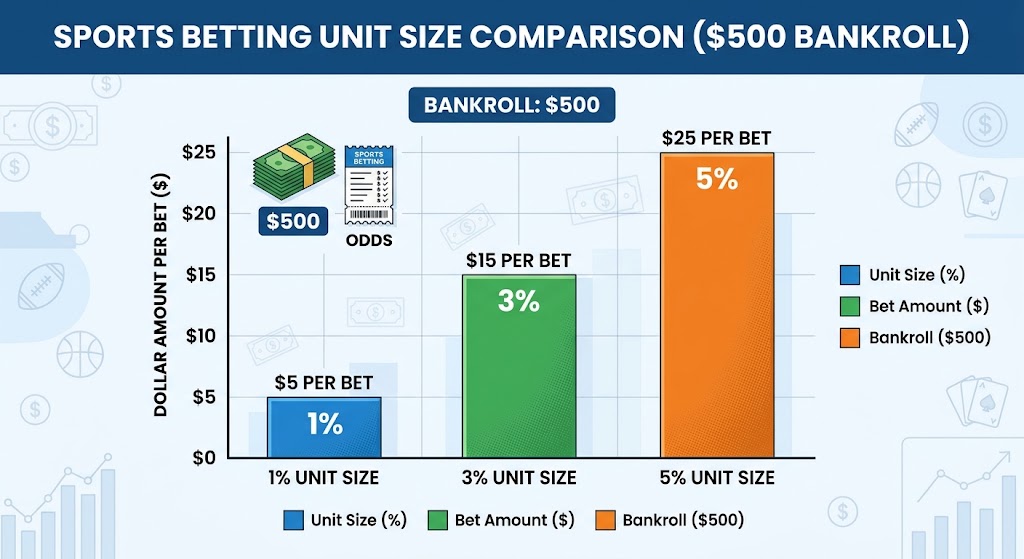
- Most beginners risk 1% to 3% of that pot per bet. On a $500 bankroll, that’s $5 to $15 a bet.
- At the standard price of -110, you need to win 52.38% of your bets just to break even. You risk $110 to win $100.
- An eight-loss streak costs 40% of a $500 bankroll at $25 bets, but only 16% at $10 bets. Same picks, very different damage.
- Recalculate your bet size once a month, not after every win or loss.
What Is Sports Betting Bankroll Management?
Bankroll management is a set of simple rules that decide two things: how much money you bet with in total, and how much of it goes on any single bet. Two words do most of the work here.
Your bankroll is the total pot you have set aside for betting and nothing else. Your unit is the standard amount you put on one bet, written as a percentage of that pot. If your bankroll is $500 and your unit is 2%, one unit is $10.
That’s the whole system. You pick a pot, you pick a unit, and you keep the unit the same size no matter how the last bet went.
Nothing here helps you pick winners. What it buys you is something else: enough bets to find out whether your picks are any good. If you want the wider beginner picture first, start with our Sports Betting 101 guide and come back to the money side.
Why Does Your Bankroll Size Matter?
Bet size decides how long you survive a cold run, and cold runs are guaranteed.
Here’s the math that most guides skip. At -110 odds, the most common price on a point spread (the margin of victory a favorite has to cover), you risk $110 to win $100. Winning half your bets still loses money, because the sportsbook keeps a cut built into the price. That cut is called the vig, short for vigorish.
To break even at -110 you need to win 52.38% of your bets. So even a sharp bettor loses roughly 47 bets out of every 100. Losing streaks aren’t bad luck. They’re the job.
The table below is DWZ analysis using flat bets on a $500 bankroll. It shows what one eight-loss streak does at three different unit sizes.
Same picks in all three rows. The only change is the number on the ticket.
How Do You Set a Sports Betting Budget You Can Actually Stick To?
Pick a dollar figure you could lose entirely without changing anything about your month. That figure is your bankroll.
Work through it in this order:
- Choose a season or a month, not “whenever.” A single NFL season is a clean window. So is one calendar month.
- Name the amount. Say $400 for the season. Write it down.
- Check the pain test. If losing all $400 would mean a late bill, cut it to $200 and stop negotiating with yourself.
- Fund it once. Move the money into the sportsbook in one or two deposits, then leave your card out of it.
- Set your unit. One percent to three percent of the pot. On $400, that’s $4 to $12 a bet.
The funding step matters more at offshore books than most people expect. Offshore sites lean on crypto, and a Bitcoin deposit is one-way. There’s no chargeback and no “call the bank.” Books like Bovada and BetOnline also skip the state-mandated deposit-limit tools you see on licensed U.S. apps, so the limit has to come from you.
One practical fix: keep the season bankroll in your own wallet or bank, and move over only the current month’s slice.
What Is Flat Betting and Why Do Beginners Use It?
Flat betting means every bet is the same size, every time, win or lose. For almost everyone, it’s the right starting system.
If your unit is $10, you bet $10 on the game you love and $10 on the game you sort of like. No doubling after a loss. No tripling because a game is on national TV.
Flat betting keeps one bad night from mattering. Your results also become readable, since every bet carries the same weight.
Here’s how the common approaches compare.
Two notes on the bottom rows. The Kelly criterion came from John Kelly Jr. at Bell Labs in 1956, and it works only if you can put an honest number on your win chance. Most beginners can’t, which is why half-Kelly and quarter-Kelly exist.
Martingale is not a strategy at all: six straight losses starting at $10 requires a $640 bet to get even.
How Should You Size Your Bets for an NFL Season?
Divide your season bankroll by the 18 weeks of the NFL regular season, then keep each bet at 1% to 3% of the pot.
An example with real numbers. Your bankroll is $600. Your unit is 2%, so $12 a bet. Divide $600 by 18 weeks and you get about $33 a week, which is roughly two or three bets per Sunday.
No single Sunday can blow that plan up, and it lasts into January.
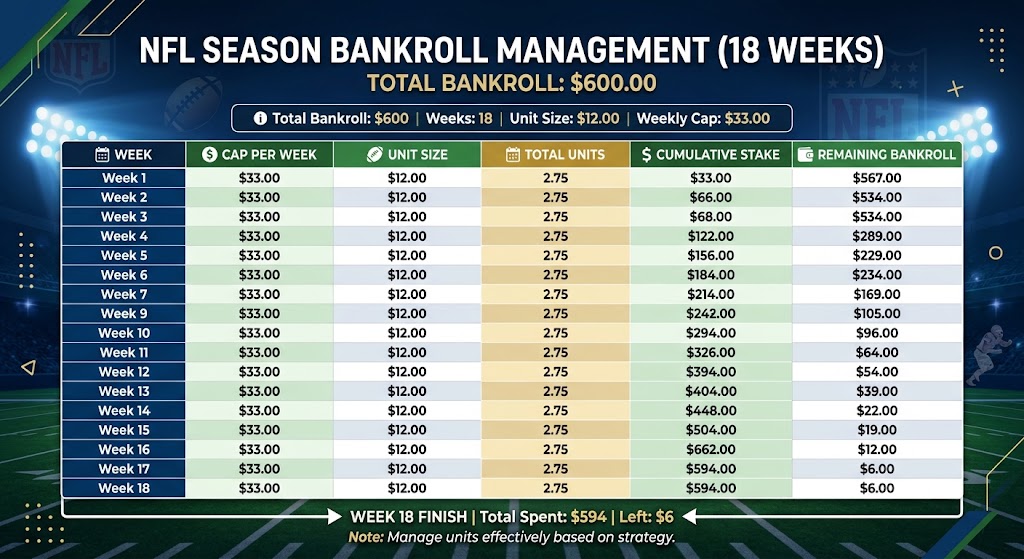
Then leave the unit alone until the month ends. Recalculating after every result is how people end up betting $80 in Week 3 to get back to even.
Line shopping stretches the same bankroll further. If one book prices a spread at -110 and another has the same side at -115, a $50 bet wins $45.45 at the first and $43.48 at the second. Two dollars on one ticket is small. Small or not, it’s why holding accounts at two or three books beats loyalty to one. Bovada, MyBookie, and BetUS are a common combination. The price you pay is the only part of betting you fully control.
One warning on parlays. Multi-leg bets pay more because they win less often, so treat any parlay as part of your normal unit, never as a bonus bet on top of it. Our breakdown of same-game parlay risk shows what those tickets actually cost, and how NFL odds work covers the pricing behind them.
What Are the Biggest Bankroll Mistakes Bettors Make?
The most expensive mistake is chasing: raising your bet size to win back money you already lost.
Chasing shows up in five familiar forms.
- Doubling after a loss. Your worst bet becomes your biggest bet, which is backwards.
- Depositing mid-slate. A second deposit on Sunday afternoon is an emotional decision wearing a math costume.
- Betting a fixed dollar amount with no pot behind it. “Putting $50 on every game” isn’t a plan if you never decided what $50 is a slice of.
- Counting bonus money as bankroll. A 100% deposit match usually carries rollover terms, meaning you must wager the bonus several times before it converts to withdrawable cash. Read the terms before you count that money.
- Betting more sports than you follow. A $400 bankroll spread over four leagues is four small samples instead of one useful one.
The scale of the money here is worth seeing. U.S. sportsbooks took $12.06 billion in bets in May 2026, per the American Gaming Association’s Commercial Gaming Revenue Tracker, and betting is now live in 39 states plus Washington, D.C., per the AGA’s State of Play map as of August 2026. None of that money moves in your favor by default, because the vig is priced into every one of those tickets.
For the picking side of this, NFL betting strategies for beginners covers what to look for once your money rules are set, and how to bet on the NFL walks through placing the actual bet.
When Should You Step Back and Reevaluate?
Step back the moment betting stops being money you set aside and starts being money you need back.
Clear signals to stop and reset:
- You’ve lost 30% or more of your bankroll and you’re betting bigger, not smaller.
- You deposited outside your plan more than once this month.
- You’re hiding the amount from a partner, or guessing instead of knowing your total.
- You’re betting games you wouldn’t watch, just to have action.
The reset itself is boring on purpose. Withdraw what’s left, take a week off, then rebuild the pot at half the old size with a smaller unit. Nothing about your record changes if you sit out seven days.
If any of those signals feel familiar, the National Council on Problem Gambling runs a free, confidential helpline at 1-800-522-4700, 24 hours a day.
References
- National Council on Problem Gambling — Help & Treatment
- American Gaming Association — State of Play Map
- American Gaming Association — Commercial Gaming Revenue Tracker
- Covers.com — Sports Betting Bankroll Management and ROI Guide
- ESPN — Rookie Bettors Camp: Ultimate Bankroll Survival Guide
Related Reading
- Browse All Sports Betting Reviews
- How Does MLB Run Line Betting Work?
- How to Bet on the NFL: A Beginner’s Guide for 2026
- What Are NFL Player Props and How Do Depth Charts and Injuries Shape Them?