

Editorial note: This page is an independent data reference. It contains no affiliate links and does not recommend or promote any sportsbook. For those interested in sports betting tax rates by state, this guide presents unbiased information. Sports betting is for adults 21+ (age minimums vary by state). If gambling stops being fun, call or text 1-800-GAMBLER for free, confidential help, 24/7.
Key findings
- Sports betting is legal in 39 states plus Washington, D.C. In 31 of those states and D.C., you can bet online statewide. Eleven states still have no legal sports betting.
- State tax rates on sportsbook revenue run from 6.75% (Iowa and Nevada) to 51% (New York, New Hampshire and Rhode Island). That top rate is 7.5 times the bottom one. Tennessee is the outlier: it taxes 1.85% of every dollar wagered rather than revenue.
- Five states have raised sports betting taxes since 2024: Illinois, New Jersey, Maryland, Louisiana and North Carolina. Chicago added its own 10.25% city tax on January 1, 2026.
- State sports betting tax collections jumped 32.4% in 2025 to $3.71 billion, faster than the 22.8% growth in sportsbook revenue (American Gaming Association).
- North Carolina’s 18% revenue tax and Tennessee’s 1.85% handle tax took almost the same bite in 2025: about 1.8% of every dollar wagered in each state (DWZ calculation from AGA data).
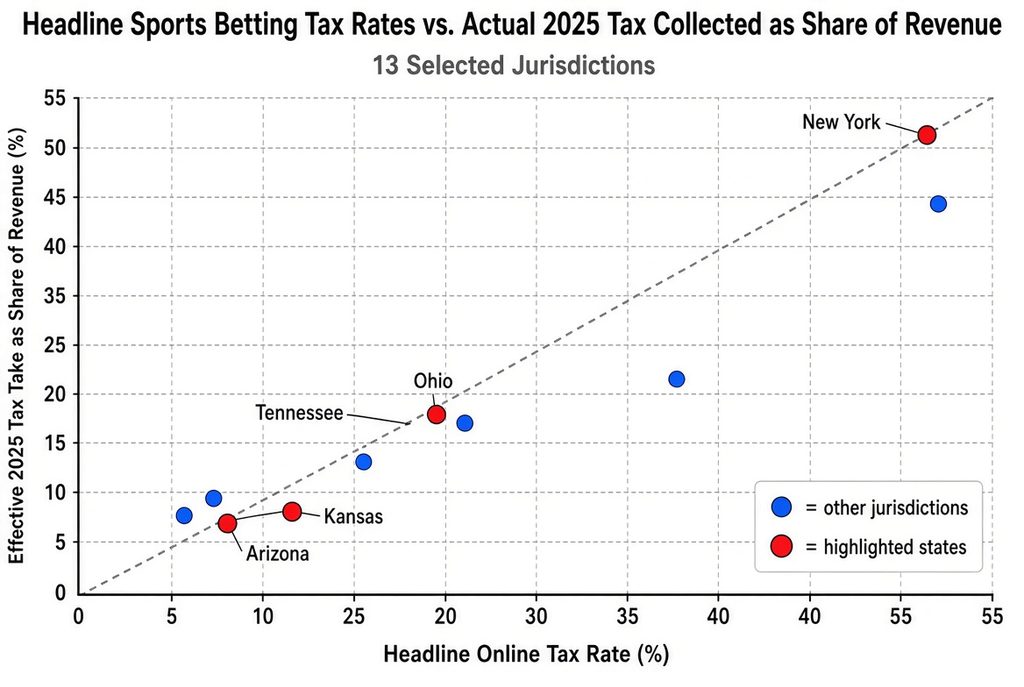
- The headline rate isn’t the whole story. Our comparison of 13 jurisdictions found Arizona collected about 6.4% of reported sportsbook revenue in 2025 against a 10% online rate, while New York collected about 52%.
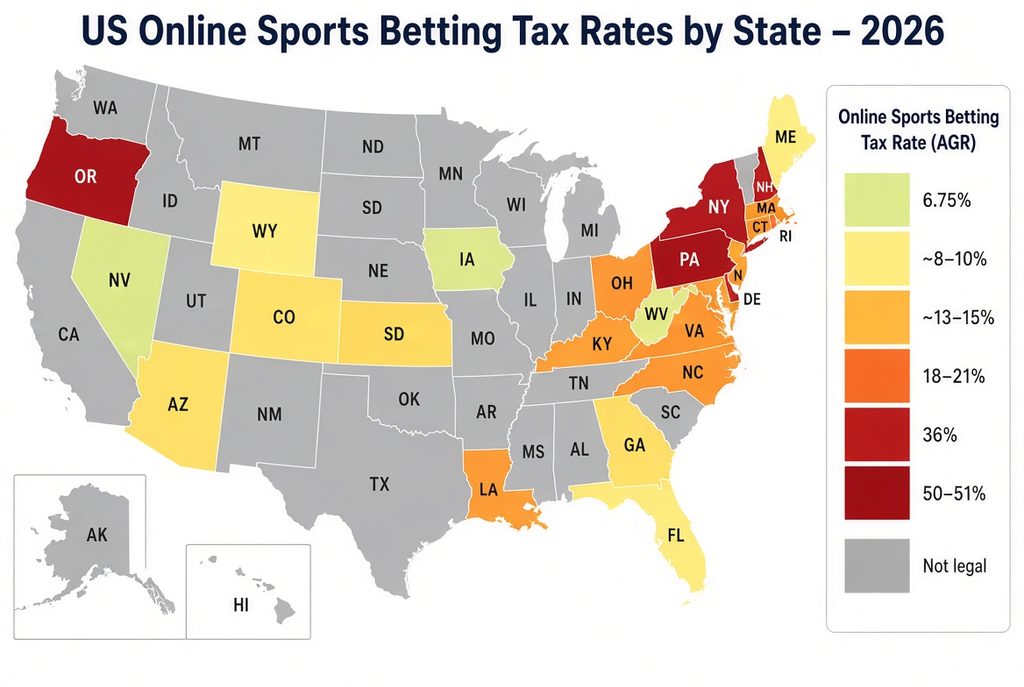
How many states have legal sports betting in 2026?
At the close of 2025, legal sports betting was offered in 39 states plus the District of Columbia, according to the American Gaming Association’s (AGA) State of the States 2026 report. No new state passed a law authorizing sports betting in 2025. Missouri was the only new market: it went live on December 1, 2025, with eight retail sportsbooks and eight mobile platforms.
Here’s how that breaks down:
- 31 states + D.C. allow online betting statewide (or districtwide in D.C.).
- 8 states limit betting to retail sportsbooks or on-site betting: Mississippi, Montana, Nebraska, New Mexico, North Dakota, South Dakota, Washington and Wisconsin.
- 11 states have no legal sports betting: Alabama, Alaska, California, Georgia, Hawaii, Idaho, Minnesota, Oklahoma, South Carolina, Texas and Utah.
One change is already on the books for 2026. Wisconsin Gov. Tony Evers signed 2025 Wisconsin Act 247 on April 9, 2026. The law allows tribally run online sports betting, but online wagering can’t begin until the state’s tribal agreements are finalized. As of a July 3, 2026 local report, online betting was not yet live. We could not confirm a launch date.
Most of these markets are young. Of the launch dates we could verify (table below), 10 of the 14 that have launched went live in 2021 or later.
US sports betting by state: the 2026 table
Tax rates below are the state’s tax (or state share) on sportsbook revenue, also called gross gaming revenue (GGR). That’s the money left after winning bets are paid. Revenue is AGA’s 2025 calendar-year figure for commercial sports betting, compiled from state regulators. Rates are current as of October 6, 2026.
| State | Legal status | State tax on sportsbook revenue | Recent change | 2025 sports betting revenue |
|---|---|---|---|---|
| Alabama | Not legal | — | — | — |
| Alaska | Not legal | — | — | — |
| Arizona | Online + retail | 8% retail / 10% online | — | $838.7M |
| Arkansas | Online + retail | 13% up to $150M; 20% above | — | $61.5M |
| California | Not legal | — | — | — |
| Colorado | Online + retail | 10% | Promo deductions capped (2022 law) | $589.1M |
| Connecticut | Online + retail | 13.75% | — | $265.9M |
| Delaware | Online + retail | State-run revenue share (AGA: ~40% effective) | — | $34.2M |
| District of Columbia | Online + retail | 10% or 20% retail / 20% or 30% online (by license type) | Mobile market opened up (2024 law) | $94.5M |
| Florida | Online + retail (tribal) | Tribal compact revenue share (AGA: 10–15.75%) | — | Not published |
| Georgia | Not legal | — | — | — |
| Hawaii | Not legal | — | — | — |
| Idaho | Not legal | — | — | — |
| Illinois | Online + retail | 20%–40% graduated, plus $0.25–$0.50 per online bet; +2% Cook County; +10.25% Chicago | Raised 2024 and 2025; Chicago tax from Jan. 1, 2026 | $1,476.6M |
| Indiana | Online + retail | 9.5% | — | $570.5M |
| Iowa | Online + retail | 6.75% | — | $274.5M |
| Kansas | Online + retail | 10% | — | $295.9M |
| Kentucky | Online + retail | 9.75% retail / 14.25% online | — | $337.4M |
| Louisiana | Online + retail | 10% retail / 21.5% online | Online raised from 15% (Aug. 2025) | $557.4M |
| Maine | Online + retail | 10% | — | $68.2M |
| Maryland | Online + retail | 15% retail / 20% mobile | Mobile raised from 15% (June 1, 2025) | $793.2M |
| Massachusetts | Online + retail | 15% retail / 20% online | 51% bill pending (SB 302) | $865.2M |
| Michigan | Online + retail | 8.4% | Per-bet tax proposed (Feb. 2026); not enacted as of our check | $685.6M |
| Minnesota | Not legal | — | — | — |
| Mississippi | Retail / on-site only | Up to 8% state + ~3–4% local (same as casino games) | — | $49.8M |
| Missouri | Online + retail | 10% | Launched Dec. 1, 2025 | $104.4M (December only) |
| Montana | Retail / on-site only | Lottery-run (no separate tax rate) | — | $10.3M |
| Nebraska | Retail only | 20% | — | $9.3M |
| Nevada | Online + retail | 6.75% | — | $601.4M |
| New Hampshire | Online + retail | ~51% online / 50% retail (revenue share) | — | $103.6M |
| New Jersey | Online + retail | 9.75% retail / 19.75% online | Online raised from 13% (July 2025) | $1,177.2M |
| New Mexico | Retail only (tribal) | No state tax (tribal) | — | Not published |
| New York | Online + retail | 10% retail / 51% online | — | $2,553.9M |
| North Carolina | Online + retail (tribal) | 23% online | Raised from 18% (July 7, 2026) | $734.6M |
| North Dakota | Retail only (tribal) | No state tax (tribal) | — | Not published |
| Ohio | Online + retail | 20% | Doubled from 10% (2023); 40% proposal rejected (2025) | $1,040.3M |
| Oklahoma | Not legal | — | — | — |
| Oregon | Online only | Lottery revenue share (undisclosed) | — | $101.3M |
| Pennsylvania | Online + retail | 36% | — | $883.7M |
| Rhode Island | Online + retail | 51% (state share) | — | $40.8M |
| South Carolina | Not legal | — | — | — |
| South Dakota | Retail / on-site only | 9% | — | ~$1.0M |
| Tennessee | Online only | 1.85% of handle (amount wagered) | — | $700.2M (AGA estimate) |
| Texas | Not legal | — | — | — |
| Utah | Not legal | — | — | — |
| Vermont | Online only | 31%–33% (negotiated revenue share) | — | $25.0M |
| Virginia | Online + retail | 15% | — | $846.1M |
| Washington | Retail / on-site only (tribal) | No state tax (tribal) | — | Not published |
| West Virginia | Online + retail | 10% | — | $60.8M |
| Wisconsin | Retail only (tribal); online authorized | No state tax (tribal) | Online legalized Apr. 9, 2026; not yet live | Not published |
| Wyoming | Online + retail | 10% | — | $27.4M |
Notes: Revenue is AGA’s commercial sports betting gross revenue for calendar 2025. It excludes tribal sportsbooks and Florida’s tribal mobile market. Some states tax revenue after promotional deductions, so a state’s own “taxable revenue” can be lower. Pennsylvania’s regulator, for example, reports $602.5 million. Tennessee doesn’t publish revenue, so its figure is an AGA estimate based on reported handle. AGA’s separate revenue tracker lists Arizona at $912.1 million; we use the state-summary figure ($838.7M) for consistency. All sportsbooks also pay a 0.25% federal excise tax on handle.
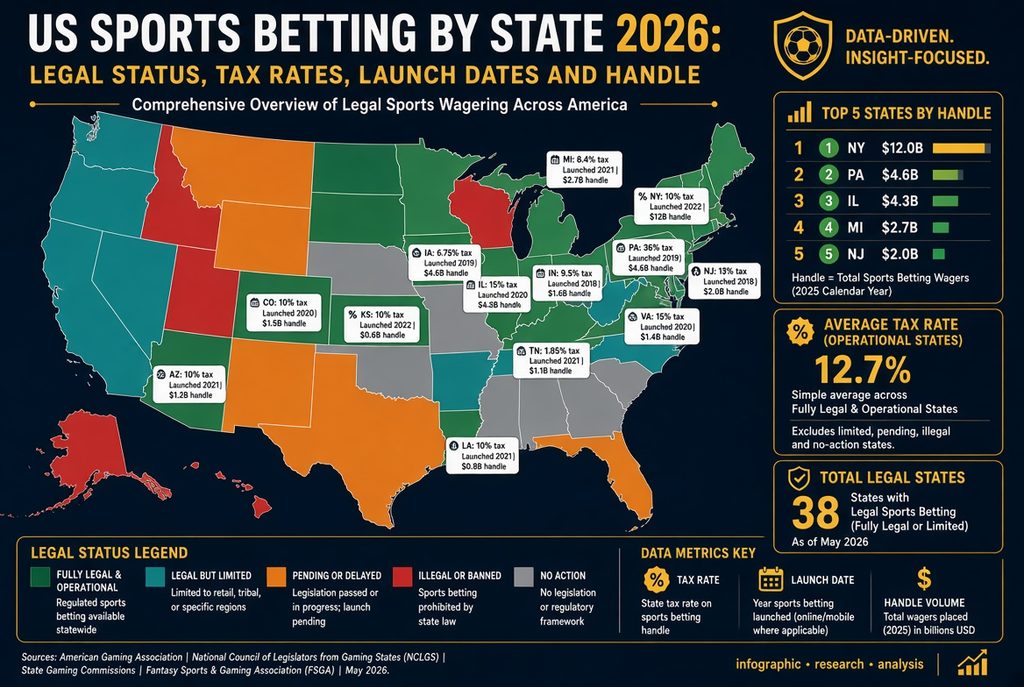
When did sports betting launch in each state?
AGA’s state summaries give launch timing for the states below. We list only dates stated in that report or in a state source; we didn’t fill gaps from memory or unofficial trackers.
| State | Launch | Notes |
|---|---|---|
| Delaware | June 2018 (full-scale retail); January 2024 (first mobile platform) | Parlay-only NFL betting existed earlier |
| Mississippi | August 2018 | Casino sportsbooks only |
| New Hampshire | December 2019 (mobile) | Single operator under lottery contract |
| Tennessee | November 2020 | First online-only state; no retail books |
| Wyoming | September 2021 | Online |
| Louisiana | October 2021 (retail); January 2022 (online) | |
| Maryland | Late 2021 (retail); November 2022 (mobile) | |
| Ohio | January 2023 | Online and retail together |
| Massachusetts | Early 2023 | Retail and mobile |
| Kentucky | September 2023 | |
| Maine | November 2023 (mobile) | Tribal-partnered mobile platforms |
| Vermont | January 2024 | Online only, three operators |
| North Carolina | March 2024 (online) | |
| Missouri | December 1, 2025 | Eight retail books, eight mobile platforms |
| Wisconsin | Online authorized April 9, 2026 | Not live as of a July 3, 2026 report |
How much do Americans bet on sports? 2025 handle
Americans legally wagered $166.94 billion on sports in 2025, up 11.0% from 2024, according to AGA’s Commercial Gaming Revenue Tracker. That’s the “handle,” meaning the total amount bet before any winnings are paid out.
AGA doesn’t publish a complete state-by-state handle table, and state regulators report handle on different bases (some by fiscal year, some net of voided bets). So instead of filling 39 rows with mismatched numbers, we list full-year 2025 handle only where an official figure was published and we could verify it.
| State | 2025 handle | Change vs. 2024 | Reported by |
|---|---|---|---|
| Pennsylvania | $8.8 billion | +5.19% | Pennsylvania Gaming Control Board |
| North Carolina | $7.27 billion | +34.3% | AGA, from North Carolina Lottery Commission data |
| Tennessee | $5.87 billion | +10.8% | AGA, from Tennessee Sports Wagering Council data |
| Kentucky | More than $3 billion | +14.0% | AGA, from state data |
| Vermont | $235.1 million | +18.3% | AGA, from state data |
| Wyoming | $234.5 million (online) | About +11.9% | AGA, from Wyoming Gaming Commission data |
| Montana | $68.1 million | +2.4% | AGA, from Montana Lottery data |
| United States | $166.94 billion | +11.0% | AGA (commercial markets) |
One comparison stood out. Tennessee is the only state that taxes handle instead of revenue. Its sports betting tax revenue of $107.6 million works out to about 1.83% of its $5.87 billion handle. North Carolina’s $132.2 million under its old 18% revenue tax works out to about 1.82% of its $7.27 billion handle. Two very different tax designs took almost the same slice of every dollar bet in 2025.
That parity is already gone. At North Carolina’s 2025 hold (about 10.1% of handle), the new 23% rate would collect roughly 2.3% of handle. That’s simple arithmetic, not a forecast; actual results depend on hold and betting volume.
Which states have the highest and lowest sports betting tax rates?
Highest (online):
- New York: 51%. Nine online operators agreed to that rate through a competitive licensing process. It isn’t set in statute. New York’s mobile sportsbooks paid about $1.32 billion in tax in 2025.
- New Hampshire: ~51% online (50% retail), set through revenue-sharing terms with its operator.
- Rhode Island: 51% state share. The state lottery runs the market.
- Pennsylvania: 36%.
- Vermont: 31%–33%, a negotiated revenue share. The 2023 law set a 20% floor.
Illinois belongs near the top, too, even though its headline brackets top out at 40%. It’s the only state with a per-bet tax: $0.25 on each of an operator’s first 20 million online bets per year and $0.50 on each bet after that. On top of that come Cook County’s 2% and Chicago’s 10.25%.
Lowest:
- Iowa and Nevada: 6.75%. These are the joint lowest rates in the country.
- Michigan: 8.4%. Online sports betting is taxed after deducting free bets and other promotions.
- South Dakota: 9%.
- Indiana: 9.5%.
- Colorado, Kansas, Maine, Missouri, West Virginia and Wyoming: 10%.
Tennessee doesn’t fit either list. It taxes 1.85% of handle, meaning every dollar bet, win or lose. In 2025 that came to roughly 15% of AGA’s estimated revenue (see the comparison below).
Which states raised sports betting taxes in 2024–2026?
| State | Before | After | Effective | What changed |
|---|---|---|---|---|
| Illinois | 15% flat | 20%–40% graduated | 2024 budget law | Rate tied to operator revenue size |
| Illinois | — | + $0.25/$0.50 per online bet | July 1, 2025 | First per-bet sports betting tax in the US |
| Chicago, Ill. | — | + 10.25% city tax | Jan. 1, 2026 | City tax on bets placed within city limits |
| New Jersey | 13% online | 19.75% online | FY2026 budget (signed June 30, 2025) | Online casino and sports betting rates aligned |
| Maryland | 15% mobile | 20% mobile | June 1, 2025 | Extra 5% goes to the state General Fund |
| Louisiana | 15% online | 21.5% online | August 2025 | Retail rate stayed at 10% |
| North Carolina | 18% | 23% | July 7, 2026 (Session Law 2026-41) | Also a 6% tax on prediction markets from Jan. 1, 2027 |
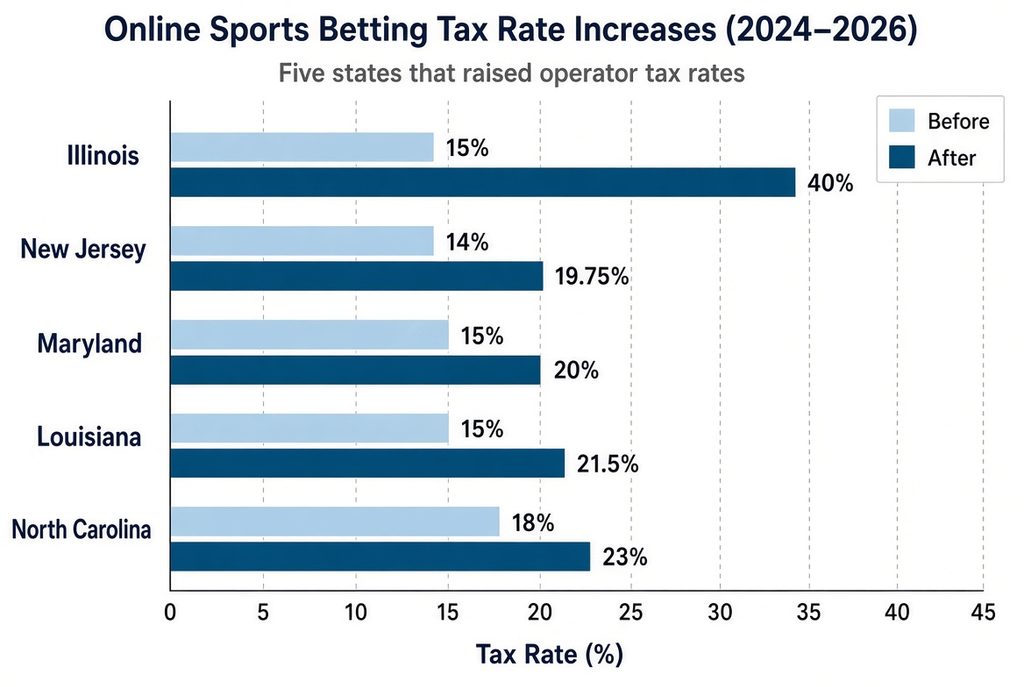
A clear pattern: hikes keep landing below the first ask. Of the increases and proposals we tracked:
- North Carolina: the state Senate passed 36% in 2025. The final 2026 rate is 23%.
- Maryland: Gov. Wes Moore proposed 30% in 2025. Lawmakers set 20%.
- New Jersey: the governor proposed 25% in 2025. The budget settled at 19.75%.
- Ohio: Gov. Mike DeWine proposed doubling the rate to 40% in 2025. The legislature left it at 20%, noting it had already doubled it from 10% in 2023.
Legislators are clearly willing to raise sportsbook taxes. They’re also negotiating them down, usually by a third or more.
Headline rate vs. what states actually collect
Statutory rates don’t tell you how much a state actually collects. Promotional deductions, fixed fees and handle-based formulas all change the math. We divided each state’s reported 2025 sports betting tax revenue by its 2025 sportsbook revenue for the 13 jurisdictions where AGA published both figures for calendar 2025. We left Illinois out because its published tax total ($429 million) covers fiscal year 2025, not the calendar year.
| State | Headline online rate | 2025 sports betting tax revenue | 2025 sportsbook revenue | Tax as % of revenue (DWZ calculation) |
|---|---|---|---|---|
| New York | 51% | $1,320M (mobile) | $2,548.3M (mobile) | 51.8% |
| Oregon | Undisclosed lottery share | $47.5M | $101.3M | 46.9% |
| New Hampshire | ~51% | $45.5M | $103.6M | 43.9% |
| Vermont | 31%–33% | $7.3M | $25.0M | 29.2% |
| District of Columbia | 20%–30% | $22.1M | $94.5M | 23.3% |
| Ohio | 20% | $209.2M | $1,040.3M | 20.1% |
| North Carolina | 18% (2025 rate) | $132.2M | $734.6M | 18.0% |
| Tennessee | 1.85% of handle | $107.6M | $700.2M (est.) | 15.4% |
| Virginia | 15% | $118.2M | $846.1M | 14.0% |
| Kentucky | 14.25% | $46.5M | $337.4M | 13.8% |
| Wyoming | 10% | $1.9M | $27.4M | 6.9% |
| Kansas | 10% | $19.4M | $295.9M | 6.6% |
| Arizona | 10% | $53.7M | $838.7M | 6.4% |
What the numbers show:
- New York collects more than half of every revenue dollar. Its tax take alone ($1.32 billion) exceeds total sportsbook revenue in every other state except Illinois.
- In Arizona, Kansas and Wyoming, the state collected well under the 10% headline rate. In Arizona and Wyoming, AGA’s data shows operators can deduct free bets and promotions before tax. AGA noted Arizona’s 2025 tax revenue still rose 25.7%, partly because operators could deduct slightly less in promotions than in 2024. AGA’s data doesn’t explain the Kansas gap. Deductions and reporting timing are possible reasons, but we couldn’t verify that.
- Tennessee’s handle tax works out to about 15% of revenue, close to Virginia’s 15% headline rate. Tennessee’s figure rests on AGA’s revenue estimate, so treat it as approximate.
- Nationally, states took about 21.9% of revenue. That’s $3.71 billion in sports betting taxes on $16.96 billion of revenue in 2025, based on AGA’s national totals.
Do higher taxes mean worse promos and odds for bettors?
The evidence is strongest where a tax hits each bet directly. Here’s what is documented and what is only claimed:
- Illinois’s per-bet tax reached bettors’ wallets. After the per-wager tax began, FanDuel started charging customers a $0.50 per-bet fee, and BetRivers raised its minimum stake (Capitol News Illinois). The number of bets placed in the fall fell to 28.5 million from 33.6 million a year earlier.
- Promo deduction rules shape the bonuses you see. Colorado passed a 2022 law that gradually caps deductible promotions at 1.75% of each operator’s handle. Michigan, Wyoming and Arizona let operators deduct some free bets before tax. When a state shrinks or removes that deduction, every bonus dollar costs the operator more.
- Operators warn of worse odds and fewer promotions, but that’s their claim. During North Carolina’s 2026 debate, the Sports Betting Alliance argued higher taxes could mean “worse odds and fewer promotional offers,” per WRAL. We haven’t seen published data isolating that effect.
Our read: taxes on revenue mostly squeeze operator margins and promo budgets. Per-bet taxes and city surcharges are far more likely to show up as a visible fee or a higher minimum bet. If you bet in a high-tax state, check each app’s fee and minimum-stake terms, not just the welcome offer.
What sports betting tax proposals are pending in 2026?
These items were live or unresolved at our last check. Status can change quickly.
- Massachusetts: SB 302, the “Bettor Health Act,” would raise the rate from 20% to 51%. It would also cap wagers at $1,000 a day and $10,000 a month and ban bonus promotions and same-game parlay ads. A legislative committee approved it in March 2026.
- Michigan: Gov. Gretchen Whitmer’s FY2027 budget proposed an Illinois-style $0.25–$0.50 per-bet tax. Both chambers passed budget bills without it in spring 2026. We found no enacted change as of October 6, 2026.
- Ohio: SB 199 would add a 2% fee on wagers on top of the 20% tax. The chair of the gaming committee said in April 2026 that it likely wouldn’t advance this year.
- Illinois: State lawmakers have backed bills to block Chicago’s city tax. Sportsbooks sued Chicago over the tax, then dropped their bid to block it immediately. We couldn’t confirm a final ruling.
- Kansas: A House committee advanced a bill to add a 2% sports wagering tax to fund property tax relief. Operators’ contracts lock in the current 10% rate, and AGA notes lawmakers were warned a rate change could face a legal challenge.
Prediction markets are the other pressure point. Sports event contracts pay no state gaming tax. In February 2026, AGA estimated they had already diverted more than $500 million in potential sports betting tax revenue. By its September 2026 tracker, AGA put lost potential gaming taxes from these platforms at an estimated $1.5 billion since the start of 2025. North Carolina will start taxing prediction market fee revenue at 6% in 2027. For background, see our coverage of the CLARITY Act’s defeat in the Senate.
Where is sports betting still not legal?
Eleven states have no legal sports betting as of October 2026: Alabama, Alaska, California, Georgia, Hawaii, Idaho, Minnesota, Oklahoma, South Carolina, Texas and Utah. They include the two most populous states, California and Texas. Minnesota has come closest in recent sessions; our Minnesota sports betting explainer covers where that debate stands.
Our take
Three things stand out to me in this data.
- First, the tax story is about direction, not just level. Five states raised rates in roughly two years, and we found no state that cut one. With 2025 tax collections up 32.4%, sports betting looks to budget writers like reliable money, and I expect more states to follow North Carolina in 2027 sessions.
- Second, headline rates mislead. A “10% state” can collect closer to 6% after promo deductions, and Tennessee’s 1.85% handle tax collects more as a share of revenue than Kentucky’s 14.25%. Anyone comparing states should use effective take, not just the statute.
- Third, growth is slowing. AGA’s tracker described “months of near zero handle growth” from December 2025 until the World Cup lifted July 2026 handle 31.9% to $11.60 billion. Rising taxes plus flattening handle is the combination to watch, because that’s when operators trim promos and push fees onto bettors.
For state-level detail, see our guides to North Carolina’s 2026 tax changes, Maryland’s sports betting laws and taxes and Virginia’s sports betting laws.
Methodology: how we compiled this data
- Legal status comes from AGA’s State of the States 2026 (published May 12, 2026), which covers all jurisdictions at the close of 2025. We then checked 2026 changes, including Wisconsin’s Act 247 and North Carolina’s Session Law 2026-41.
- Tax rates start from AGA’s 2025 state-by-state regulation table, prepared with VIXIO Regulatory Intelligence. We checked every rate that changed in 2024–2026 against an official source: the North Carolina General Assembly session law, New Jersey P.L. 2025 c. 66, Maryland Lottery and Gaming, Louisiana R.S. 27:625, the Illinois Gaming Board, the City of Chicago and the Kentucky Department of Revenue. Where AGA’s text and table disagreed (Kentucky’s retail rate), we used the state’s official figure (9.75%).
- Revenue is calendar-2025 commercial sports betting gross revenue from AGA’s state summaries, which are compiled from state regulators. The state figures total about $16.88 billion, in line with the report’s national $16.89 billion. AGA’s revenue tracker and February 2026 release use a slightly higher national figure, $16.96 billion; we use that figure only alongside the tracker’s matching tax and handle totals.
- Handle is shown only where a state regulator or AGA’s state summary published a full-year 2025 figure.
- Effective take is our own calculation: reported 2025 sports betting tax revenue divided by 2025 sportsbook revenue. We only included jurisdictions where both figures were published. For New York, we used mobile tax and mobile revenue.
- Limitations: Rates are simplified. Some states add local taxes, license fees or deductions. Tribal markets (Florida, New Mexico, North Dakota, Washington, Wisconsin, and tribal books elsewhere) generally don’t publish revenue. Tennessee’s revenue figure is an AGA estimate, because Tennessee publishes handle and tax but not revenue. Launch dates and 2025 handle appear only where AGA’s report or a state regulator stated them; blank rows mean we couldn’t verify a figure, not that it’s zero. Illinois’s published tax total is for fiscal 2025, so it’s excluded from the effective-take comparison. Sources were checked October 6, 2026 (see our sources log for each figure).
Sources
- American Gaming Association, State of the States 2026 (May 12, 2026)
- American Gaming Association, “Commercial Gaming Revenue Hits $78.7 Billion in 2025” (Feb. 26, 2026):
- American Gaming Association, Commercial Gaming Revenue Tracker, CY 2025 (PDF):
- American Gaming Association, Commercial Gaming Revenue Tracker, July 2026 update (Sept. 24, 2026):
- North Carolina General Assembly, Senate Bill 257 / Session Law 2026-41, Section 44.7 (signed July 7, 2026):
- New Jersey Legislature, P.L. 2025, c. 66 (approved June 30, 2025).
- Maryland Lottery and Gaming, June 2026 sports wagering release.
- Louisiana R.S. 27:625 (via Justia)
- Illinois Gaming Board, FAQs on New Statutory Sports Wager Tax (June 17, 2025):
- Illinois Gaming Board, 2025 Annual Report
Bet responsibly
Sports betting should be entertainment, never a way to make money or recover losses. You must be 21 or older in most states, and age limits vary. Set a budget before you bet, and use the deposit limits and self-exclusion tools every licensed app is required to offer. If gambling is causing problems for you or someone you know, call or text 1-800-GAMBLER (1-800-426-2537), available 24/7. Our responsible betting guide has more practical tips.
Cite this data
If you reference this data, please credit Daily Wager Zone and link to this page: https://dailywagerzone.com/sports-betting-tax-rates-by-state-2026/