
Massachusetts Senate Bill 302 could make the Bay State the first in the country to ban all prop bets and live wagering on regulated sportsbooks. If you’re following the progress of Massachusetts SB 302, there’s a lot at stake for bettors and operators alike. The bill — branded the “Bettor Health Act” — passed committee 5-0 in March, sits in Senate Ways and Means right now, and the legislative session dies in July. Five weeks to decide whether Massachusetts becomes the most restrictive legal betting market in America.
And the sportsbook industry is throwing obscene money at Massachusetts politicians to kill it.
I’ve tracked this bill since Sen. John Keenan first introduced it, watched the committee testimony, and followed the industry’s counter-attack unfold. This isn’t just a Massachusetts story. If SB 302 passes, it sets a template a dozen other states are already eyeing.
What Does SB 302 Actually Do to Sports Betting in Massachusetts?
SB 302 would gut the current market in four ways. Keenan, a Quincy Democrat who voted to legalize sports betting in 2022 and later publicly apologized for it, designed this bill as a wrecking ball.
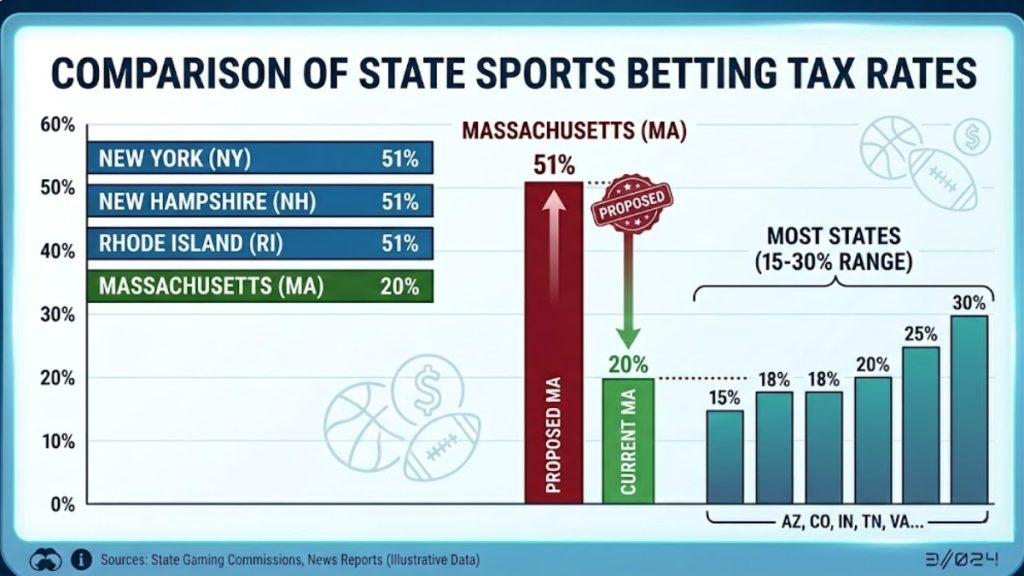
The 51% tax would match New York, New Hampshire, and Rhode Island — the highest in the nation. Massachusetts collected $120.47 million in sports betting tax revenue during FY2025 at 20%. Under SB 302, that balloons to roughly $306 million. If operators bother sticking around.
Co-sponsors include Rep. Lindsay Sabadosa and Sen. Patricia Jehlen. The Joint Committee on Economic Development and Emerging Technologies passed it without a single no vote before sending it to Senate Ways and Means.
Why Is a $43 Million Super PAC Fighting This Bill?
The industry pooled $43 million into a federal super PAC called “Win For America.” DraftKings alone dropped $19.5 million. FanDuel and Fanatics covered the rest.
This PAC targets state legislative races — attacking candidates who support regulation and boosting industry-friendly ones. In Ohio, a candidate warned voters that mailers from “American Conservatives Fund” were actually gambling-company funded. She lost. In Illinois, the PAC spent $196,000 attacking one progressive candidate in two weeks. More than his entire nine-month campaign budget. He lost too.
DraftKings CEO Jason Robins told investors the company is “experimenting” with the PAC. Real casual about spending $19.5 million to influence state elections.
Here’s the part that should make Massachusetts bettors pay attention. Over four days in January, DraftKings execs donated $19,800 to Rep. Aaron Michlewitz — chair of House Ways and Means, the gatekeeper for SB 302. Same window, $17,750 to House Speaker Ron Mariano. Both men decide whether the bill ever reaches a floor vote.
Mariano’s spokesperson says donations don’t affect legislation. I’ve covered enough statehouses to know better.
Has Any State Banned Prop Bets Before?
No state has pulled off a blanket prop bet ban for all sports. That’s exactly why the industry is terrified of SB 302.
Colorado came closest. In March 2026, legislators introduced a reform package with a total prop bet ban. DraftKings’ Chief Legal Officer trotted out the standard line — banning props “risks pushing bettors toward unregulated offshore operators.” The Campaign for Fairer Gambling testified there’s zero evidence tighter rules drive consumers offshore. The companies just don’t want lower profits.
Colorado’s prop bet ban got stripped before the bill passed the Senate. We covered the full details in our Colorado deposit caps and credit card ban breakdown. A similar push in Louisiana died in March over tax revenue fears.
SB 302 would be genuinely unprecedented. And every week of delay makes it more likely the bill runs out the clock in July.
What Does This Mean for Massachusetts Bettors Right Now?
Even before SB 302 reaches a vote, Massachusetts bettors are dealing with tighter rules. New Gaming Commission regulations went into effect yesterday — June 1 — requiring sportsbooks to notify bettors whenever their accounts get limited. First-of-its-kind rule in the country.
But if SB 302 passes? No props. No live betting. A grand a day, max. The books would jack up the vig to cover that 51% tax rate, meaning worse odds on everything. We tracked what happened in New York after their 51% tax launched — odds run 2-3 points worse than offshore lines. Consistently.
For anyone in Massachusetts who bets props or hammers live lines — which is a huge chunk of the betting population — the regulated market becomes damn near useless.
That’s where offshore books come in. Bovada, BetOnline, and MyBookie already serve Massachusetts residents, accept crypto, and offer every prop and live bet the regulated apps might lose. BetOnline’s casino promos and MyBookie’s boosted odds don’t answer to Beacon Hill.
Not telling anyone to do anything illegal. Offshore books exist in a legal gray area for players. But if SB 302 passes and you want to bet Jaylen Brown’s assist total during a Celtics game, the regulated apps won’t let you. Check our crypto betting guide if you want to know how deposits work.
States like Ohio and Tennessee are going through their own crackdown cycles too — our legal updates page tracks all of it. The bigger picture is clear: regulated markets are tightening, and having offshore accounts as backup isn’t paranoia. It’s common sense.
Frequently Asked Questions
1. Is sports betting legal in Massachusetts right now?
Yes. Retail launched January 31, 2023. Online sportsbooks went live March 10, 2023, with seven licensed operators. SB 302 wouldn’t ban sports betting — it would ban specific bet types and raise taxes dramatically.
2. What is the Bettor Health Act?
Senate Bill 302, introduced by Sen. John Keenan. Raises the tax from 20% to 51%, bans all prop bets and in-play wagering, caps deposits at $1,000/day and $10,000/month, requires affordability checks, bans sportsbook ads during live broadcasts. Passed committee 5-0 in March 2026.
3. Would Massachusetts be the first state to ban all prop bets?
Yes. Several states ban college athlete prop bets, but no state has banned prop bets across all sports. Colorado and Louisiana tried in 2026. Both failed. Massachusetts is the furthest along.
4. Can Massachusetts bettors use offshore sportsbooks?
Bovada, BetOnline, and MyBookie accept Mass residents. They operate outside U.S. jurisdiction. No documented prosecutions of individual bettors exist, but these platforms lack the consumer protections of state-regulated books.
5. When does the Massachusetts legislative session end?
July 2026. SB 302 must clear both chambers before then or it dies. It currently sits in Senate Ways and Means — the committee whose chair received nearly $20,000 in DraftKings-connected donations this year.
📂 Explore more: Massachusetts