

A moneyline bet picks which team wins the game, straight up. A run line asks a team to win by 2 or more runs, or to stay within 1 run if it loses, and a total — the over/under — is a bet on the combined runs both teams score. Those three markets carry almost all MLB betting volume, and this guide walks through each one in plain English with dollar examples you can copy.
Key Takeaways
- Moneyline: pick the winner. Margin does not matter. A 1-0 win pays the same as a 12-0 win.
- Run line: baseball’s version of a point spread, set at 1.5 runs on nearly every game. Favorites need to win by 2 or more.
- Total (over/under): the combined runs by both teams. Most MLB totals land between 7 and 10 runs.
- Break-even math matters more than picking winners. A -150 favorite has to win 60% of the time just to keep you even.
- Starting pitchers move baseball odds more than any other factor, and most books void moneyline bets if a listed starter is scratched.
- Extra innings count toward totals and run lines unless the market says nine innings only. Check your book’s rules page.
———————-
What Is a Moneyline Bet in Baseball?
A moneyline bet is a bet on which team wins. That’s it. No margin, no spread, no adjustment. If your team wins by one run in the 14th inning, you get paid the same as if they won 10-1.
The odds tell you two things: who the sportsbook expects to win, and what your payout looks like. Minus numbers mark the favorite. Plus numbers mark the underdog. Use our odds calculator to review potential returns before placing a wager.
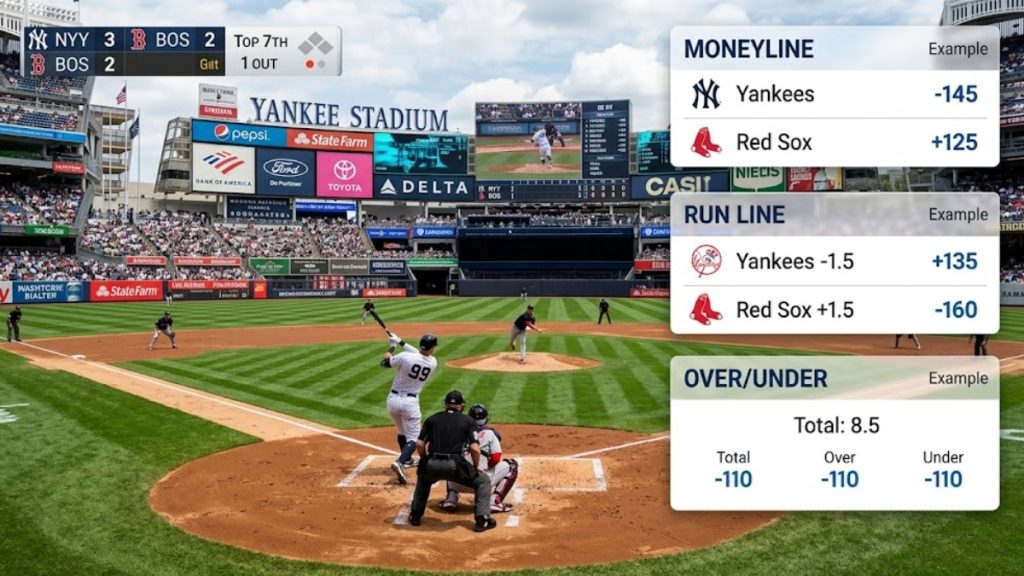
Here’s the format you’ll see on a baseball page. These numbers are an example to show the layout, not a live line:
Read it like this. A minus number is what you risk to win $100, so at -150 you put up $150 to win $100.
A plus number is what you win on a $100 bet. At +130, a $100 bet wins $130.
You do not have to bet $100. That’s just the standard unit books use to display the price. A $20 bet at -150 wins $13.33. A $20 bet at +130 wins $26.
Baseball favorites are usually cheaper than football or basketball favorites. One team rarely dominates a single game the way a good NFL team can. Even the best MLB teams lose 60-plus games a season, which keeps moneyline prices in a tighter band than most sports.
Want the step-by-step on placing one? Read how to place a moneyline bet.
What Is the Run Line in MLB Betting?
The run line is baseball’s point spread, and it’s almost always 1.5 runs. The favorite is listed at -1.5. The underdog is listed at +1.5.
To win a -1.5 bet, your team must win by 2 runs or more. A one-run win loses the bet, even though the team won the game. To win a +1.5 bet, your team must either win outright or lose by exactly 1 run.
Because the line sits on a half run, a tie is impossible. There’s no push and no refund. One side wins, one side loses.
Example format, again with made-up numbers:
Notice the flip. On the moneyline the Dodgers were the favorite at -150. Take them at -1.5 and they become a plus-money bet, because winning by two is harder than just winning. Backing the underdog with a run and a half in your pocket costs you the better price.
One-run games are the whole story here. Baseball produces them constantly, which is exactly why the run line pays what it does.
There’s a quirk that beginners miss. The home team does not bat in the bottom of the ninth if it’s already ahead. A home favorite you backed at -1.5 can be leading 3-2 with the visitors down to their last out, and the game just ends.
No last chance to pad the lead. Road favorites always get their final at-bat, so they get one more inning of scoring chances to cover.
That’s a small edge, not a system. It’s worth knowing before you assume -1.5 is the “safe” version of a moneyline bet. It isn’t. It’s the cheaper version, and cheap has a reason.
What Are Totals and Over/Under Bets in Baseball?
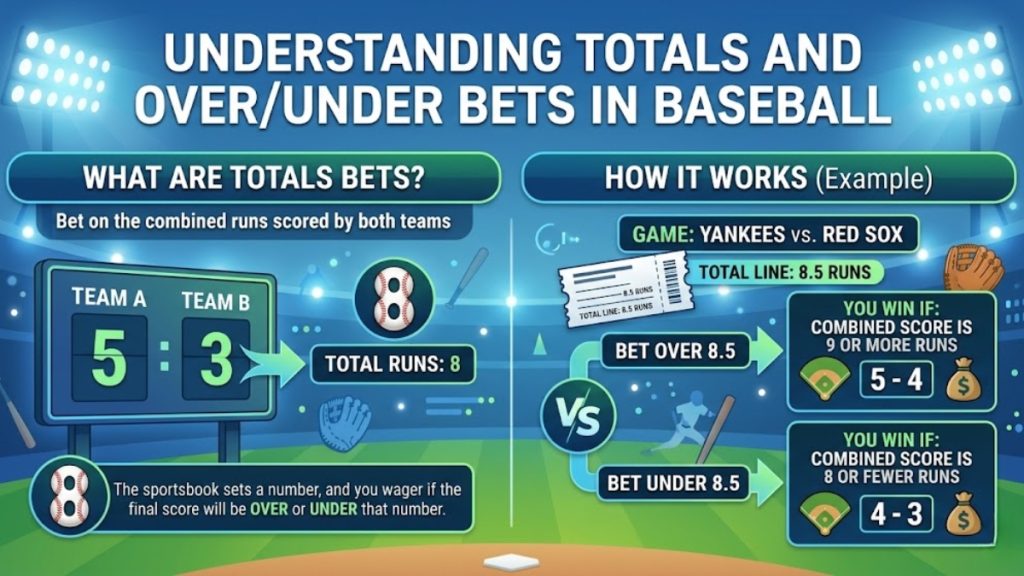
A total is the combined runs scored by both teams. The sportsbook posts a number, usually with a half run attached, and you bet whether the real result finishes above or below it.
- Say the total is 8.5. Nine or more runs means the over wins. Eight or fewer means the under wins.
- Final score 5-4 equals 9 runs, so the over cashes. A 4-4 finish equals 8 runs, so the under cashes.
- The half run does the same job it does on the run line. It removes ties.
Both sides carry their own price. You’ll see something like Over 8.5 (-105) and Under 8.5 (-115). Books shade those prices instead of moving the whole number when money comes in on one side.
MLB teams have averaged roughly 4.4 runs per game in recent seasons, per Baseball-Reference league data. Two teams at that rate lands you near 8.8 combined, which is why so many totals sit between 8 and 9.5. Pitcher-friendly matchups drop to 7. Hot afternoons in a small ballpark push toward 10 or 11.
Four things move a total:
- The two starting pitchers. The biggest input by far.
- The ballpark. Coors Field in Denver plays high because thin air carries the ball. Pitcher-friendly parks like Oracle Park in San Francisco play low.
- Weather. Wind blowing out helps hitters. Wind blowing in kills fly balls. Heat helps the ball travel.
- Bullpen quality. Relievers cover a big chunk of the innings in most games.
Now the settlement rule that costs people money. Extra innings count. Since 2023, MLB regular-season extra innings start with an automatic runner on second base, which makes scoring easier and quietly helps overs. That rule is not used in the postseason.
If you want a nine-inning-only market, look for a total labeled “9 innings” or bet the first five innings instead.
MLB also added a pitch timer in 2023. League data showed the average nine-inning game dropped to 2 hours 40 minutes that season, down from 3 hours 4 minutes in 2022, per MLB. Faster games have not meaningfully changed run scoring, so don’t treat pace as a totals signal.
Which MLB Bet Type Should a Beginner Use?
Different questions call for different markets. Use this as a starting frame, not a rulebook.
My honest take for a first-timer: start on moneylines only. One decision, one outcome, no margin math. Add totals once you can look at two starting pitchers and explain why a game should be low scoring. Save run lines for later.
Deeper in-season angles live in our MLB betting strategy breakdown.
What Do These MLB Betting Odds Actually Cost You?
This is the part most beginner guides skip. Every price carries a built-in break-even win rate. Beat it and you profit. Fall short and you lose, even if you win more bets than you lose.
The fee baked into the odds is called the vig, short for vigorish. It’s how the book makes money. To see it, convert the price into the win rate you need.
Math behind it: for a minus price, divide the number by itself plus 100. For -150, that’s 150 ÷ 250, or 60%. And for a plus price, divide 100 by the number plus 100. For +180, that’s 100 ÷ 280, or 35.7%.
Run the numbers on a season of -200 favorites. Bet $100 on 100 of them and win 65 times. You collect $3,250 in profit and lose $3,500. You picked the winner in nearly two out of three games and still finished down $250.
Flip it. Bet $100 on 100 underdogs at +150 and win 42. That’s $6,300 in profit against $5,800 in losses. You lost 58 bets and made $500.
Price, not record, decides who wins long term. That single table is worth more to a new bettor than any pick.
Line shopping is the practical follow-through. The same game might be -150 at one book and -145 at another. On a $100 bet that gap is $2.30. Over 200 bets a season, small gaps like that add up to real money, which is why serious bettors keep accounts at two or three books.
How Do Starting Pitchers Affect MLB Odds?
More than anything else on the board. A starting pitcher can handle five or six innings by himself, so a single roster note can swing a game’s price hard. No other major sport hands that much control to one player.
Books post most MLB games a day ahead with both starters listed. If a starter changes, the market changes.
That leads to a rule you need to understand before you bet: the listed pitcher rule.
At most sportsbooks, a moneyline bet is only valid if both listed starters actually throw the first pitch. If one is scratched, the bet is voided and your stake comes back. Some books let you choose “action” instead, meaning the bet stands no matter who pitches, and your price gets adjusted to the new line.
Run lines and totals often work differently. At many books, those markets stay live even after a pitching change, sometimes with a repriced number. The rules are not identical across books, so read the baseball section of your book’s rules page before you bet a full card. Bovada, BetOnline, MyBookie, and BetUS all publish these rules in their help sections.
Two more pitching wrinkles worth knowing:
- Openers. Some teams start a relief pitcher for one inning, then bring in the guy who actually throws four or five. A listed “starter” who only faces three batters tells you very little about the total.
- Bullpen usage. If a team burned three relievers the night before, the back end of today’s game gets softer. Late-inning scoring lives there, and casual bettors almost never check it.
Both leagues have used a designated hitter since 2022, so you no longer get the old National League games where pitchers hit and totals sagged. That change is permanent and already priced in.
Where Can You Bet on MLB Games From the U.S.?
Depends entirely on your state. More than 30 states run licensed sportsbooks with their own apps. Plenty of others have no legal option at all, and residents there use offshore books that accept U.S. customers.
Offshore books are online sportsbooks licensed outside the United States, usually in Panama or Curaçao. They take deposits by card or crypto and post MLB markets on the full schedule. DWZ covers this side of the market because that’s where a lot of readers actually bet.
The four we rate highest for baseball:
Ratings are DWZ Trust Ratings based on market coverage, payout speed, and platform reliability.
Three things to check yourself before betting anywhere:
- Read the baseball rules page. Listed pitcher handling, extra-inning settlement, and postponement rules vary.
- Confirm withdrawal methods and minimums before you deposit.
- Compare the same game across two books. Price differences are common.
New to any of this? Start with our sports betting basics guide.
What MLB Betting Mistakes Do Beginners Make Most?
- Betting big favorites because they feel safe. A -250 favorite needs to win 71.4% of the time to break even. That’s a brutal bar over a 162-game season.
- Ignoring the starting pitcher. Team names sell the bet. Pitchers decide it.
- Treating +1.5 as insurance. It’s not free protection. You pay for it with a worse price, so bad nights cost more.
- Loading up parlays. Stacking five games multiplies the vig against you. Parlays have a place, and small ones can be fun, but they are not a path to steady profit. See what a parlay bet is and when to try one.
- Chasing losses. Doubling your stake after a bad beat is how a $50 night becomes a $500 night.
- Betting every game. There are 15 games most days. Sitting out 13 of them is a skill.
- Skipping the rules page. People learn the listed pitcher rule the hard way, usually at 7:05 p.m. on a Tuesday.
How Do You Place Your First MLB Bet?
Five steps, start to finish:
- Pick one game with a pitching matchup you can explain in a sentence.
- Choose one market. Moneyline first. Skip run lines and totals until you’re comfortable.
- Set your stake at 1% to 2% of the money you’ve set aside for betting. If that’s $200, you’re betting $2 to $4.
- Check the price at a second book before you confirm. Take the better number.
- Write down what you bet and why. Twenty bets later, that note is your best coaching tool.
That’s how to bet on MLB games without wasting money in week one.
Want to see what a full day of games looks like? Pick a weekday, scan the board, and map each game to moneyline, run line, or total before first pitch.
A Word on Keeping It Safe
Betting on baseball should cost you no more than a night out. Set a monthly amount before the season and stop when it’s gone. Never bet money meant for rent, food, or bills.
If betting stops being fun, help is free and confidential. The National Council on Problem Gambling runs a 24/7 helpline at 1-800-522-4700, and every book listed here offers deposit limits and self-exclusion tools. Use them early rather than late.
References
- National Council on Problem Gambling — National Helpline.
- MLB — Official Baseball Rules.
- MLB — Glossary of rules and statistics.
- Baseball-Reference — MLB league year-by-year run scoring data.
- Bovada — Sportsbook help and rules.
- BetOnline — Sportsbook help and rules.
Related Reading
- Browse All Events Coverage
- How the MLB Wild Card Works — Baseball’s Expanded Playoffs Explained
- NFL Week 1 Betting Guide 2026 — Key Matchups, Spreads and Early Value
- Is Online Gambling Legal in North Carolina? Betting Laws, Apps and 2026 Tax Changes