
An NFL over/under bet is a wager on whether both teams will combine to score more or fewer points than a number the sportsbook sets. If you’re wondering how does over under work in NFL games, you do not have to pick a winner. You just pick a side of the number.
Key Takeaways
- An over/under, also called a total, is a bet on the combined score of both teams, not on who wins.
- If the total is 44.5, the Over needs 45 or more points and the Under needs 44 or fewer.
- Most totals are priced at -110 on both sides, which means you risk $110 to win $100.
- Weather, injuries, pace of play, and stadium type all move NFL totals.
- A total with a whole number, like 44, can end in a push, which means your bet is refunded.
What Is an Over/Under Bet in the NFL?
An over/under bet is a wager on the total points scored by both teams in one game. People also call it a “total” or “O/U.” The sportsbook posts a number. You bet that the final combined score lands over it or under it.
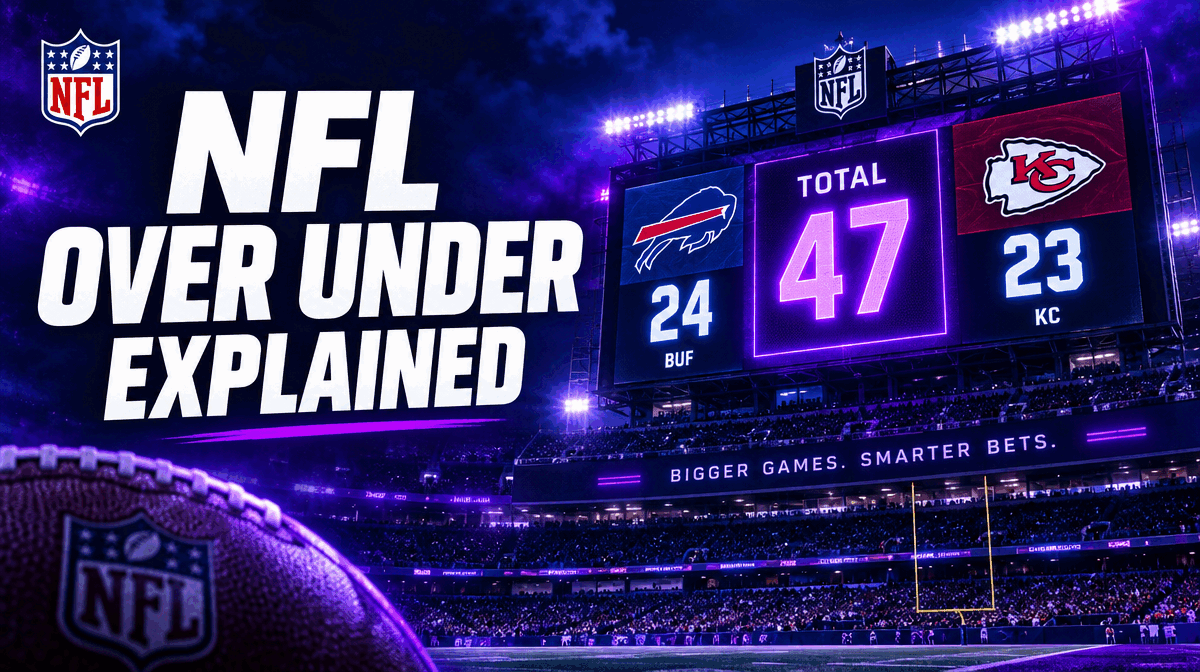
Here is a simple example. Say the Chiefs play the Bills and the total is 47.5.
- The final score is Chiefs 27, Bills 24. That adds up to 51. The Over wins.
- The final score is Chiefs 20, Bills 17. That adds up to 37. The Under wins.
It does not matter who wins the game. A 48-0 blowout and a 24-24 tie both cash an Over 47.5 ticket. Overtime points count too, unless the sportsbook’s house rules say otherwise.
That half point in 47.5 matters. It is called a “hook.” It means the game cannot land exactly on the number, so there is always a winner and a loser. When the total is a whole number, like 47, a final combined score of exactly 47 is a push. A push means nobody wins and your stake comes back to you.
If you want to see how totals fit next to the other two main bet types, read our guide to NFL moneyline, spread, and totals bets.
How Do Sportsbooks Set the NFL Over/Under Number?
Oddsmakers, the people who set betting lines, build each total from a scoring forecast. As CBS Sports explains, totals are largely set by an algorithm. Then they get adjusted for the matchup, weather, and injury news.
The first number posted for a game is the opening line. For NFL games, openers usually show up early in the week. From there, the number can move. This is called line movement.
Lines move for two main reasons:
1. New information. A starting quarterback gets ruled out. A storm shows up in the forecast. The number shifts to match the new reality.
2. Betting action. If a lot of money comes in on one side, the book may move the total to balance its risk.
So a game that opens at 44.5 might close at 42.5 by Sunday. That drop tells you the market now expects less scoring. The final number before kickoff is called the closing line.
How Do You Read an NFL Over/Under Betting Line?
A total on a betting board usually looks like this:
| Bet | Line | Price |
|---|---|---|
| Over | 45.5 | -110 |
| Under | 45.5 | -110 |
Here is what each piece means.
- The number (45.5): The combined score the game needs to beat or stay below.
- The price (-110): How much you risk to win $100. At -110, you bet $110 to win $100. Bet $11 and you win $10.
- The juice: That extra $10 is the sportsbook’s cut. It is also called the “vig,” short for vigorish. It is how the book makes money.
Sometimes the prices are not even. You might see Over 45.5 at -115 and Under 45.5 at -105. That means the book thinks the Over is a little more likely, so it costs more to bet. A minus sign means you risk more than you win. A plus sign means you win more than you risk.
New to reading prices like this? Our NFL betting odds explained guide walks through every number on the board.
What Factors Move NFL Over/Under Totals?
A total is a scoring forecast. Anything that changes how many points a game should produce can move it. These are the big ones.
Pace of play. Pace means how fast a team runs plays. Teams that snap the ball quickly get more plays per game. More plays usually means more chances to score. Slow, run-heavy teams burn clock and shrink the game.
Weather. Strong wind is the biggest weather factor. It makes passing and field goals harder. Heavy rain and snow can cause fumbles and slow offenses down. Cold alone matters less than most people think. Check out how weather affects NFL betting for a full breakdown.
Injuries. A missing starting quarterback is the biggest injury swing for a total. But offensive line and top receiver injuries matter too. On the other side, a banged-up defense can push a total higher.
Indoor vs. outdoor. Games in domes or under closed roofs have no wind or rain. Kickers and passers work in perfect conditions. Books know this and price it in.
Divisional games. Division rivals play each other twice every season. They know each other’s schemes well. Many bettors believe that familiarity can lead to tighter, lower-scoring games. Treat that as a lean to check, not a rule.
The point spread. The spread tells you how much the book expects one team to win by. You can use it with the total to find each team’s implied team total. That is the number of points the market expects from each side. Take a 45.5 total with one team favored by 3.5. Split it and you get about 24.5 points for the favorite and 21 for the underdog.

When Should You Take the Over in an NFL Game?
The Over makes sense when you think the game will produce more scoring than the market expects. Look for these setups:
- Two fast-paced offenses. More plays on both sides means more scoring chances.
- Weak defenses on both sides. Especially pass defenses that give up big plays.
- A dome game with good weather-proof offenses. No wind, no rain, clean conditions.
- Key defensive injuries. A missing top pass rusher or cornerback can open things up.
- A likely shootout script. “Game script” means how the game is expected to play out. If both teams will need to throw to keep up, points can pile up.
The key word is “expects.” A game between two great offenses might already have a total of 52. Your job is to decide if 52 is too low, not just whether the offenses are good.
When Should You Take the Under in an NFL Game?
The Under makes sense when you think scoring will come in lower than the number. Look for these setups:
- Strong wind in the forecast. Wind hurts passing and kicking more than any other weather.
- Two slow, run-first teams. Running the ball keeps the clock moving and cuts the number of plays.
- A backup quarterback starting. Offenses often stall when a starter sits.
- Two strong defenses. Good pass rush and good coverage limit big plays.
- A total that got pushed up by public betting. Casual bettors tend to like Overs. If the number rose without real news, it may be inflated.
OddsShopper’s totals guide notes that sharp bettors, meaning experienced and disciplined ones, often lean toward the Under for this reason. The public likes rooting for points, and that can push numbers a bit high. That is a lean, not a guarantee. Every game still needs its own homework.
For a bigger-picture plan, see our NFL betting strategies every beginner should know.
What Are the Most Common Mistakes Beginners Make With NFL Totals?
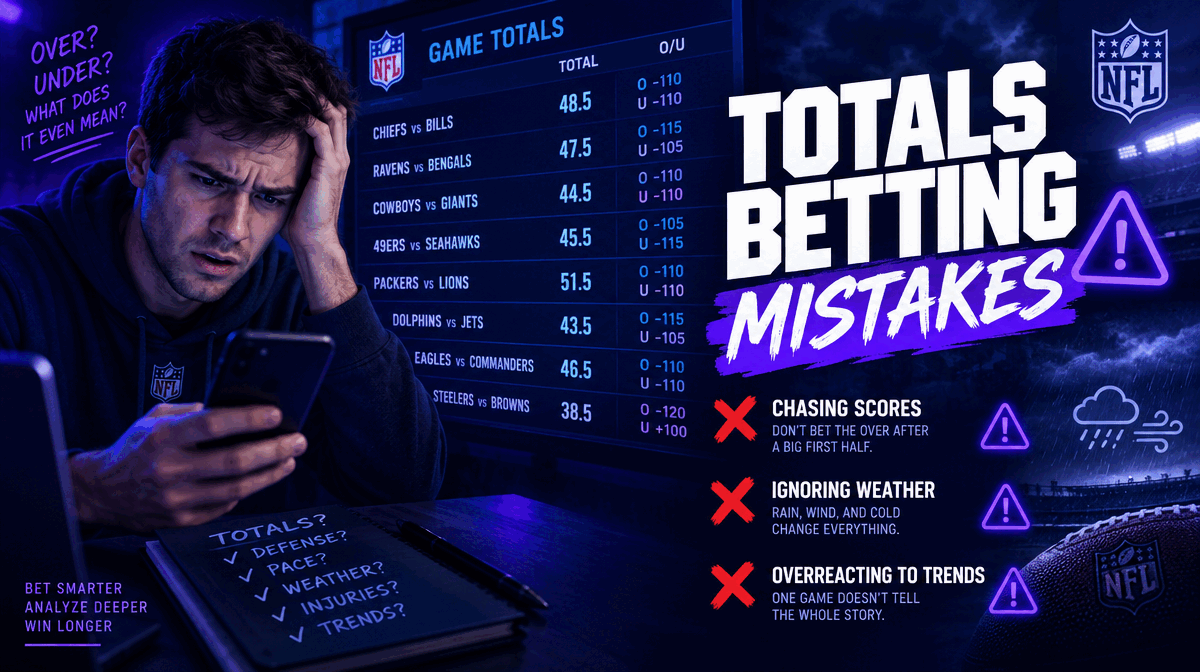
Most totals mistakes come from betting on feel instead of the number. Watch out for these.
Betting the Over just because it is more fun. Rooting for touchdowns feels better than rooting for punts. But fun is not an edge. Bet the side the facts support.
Ignoring the weather. A total set on Tuesday might not reflect a Sunday wind warning. Check the forecast close to kickoff.
Chasing a moved line. If a total already dropped from 47 to 43 because of news, most of the value is gone. Getting in late at a worse number is a common trap.
Forgetting about the hook. Over 44 and Over 44.5 look almost the same. They are not. At 44, a final of 44 is a push. At 44.5, it is a loss.
Not shopping for the best line. Different sportsbooks post slightly different totals and prices. Getting 43.5 instead of 44.5 on an Under can be the difference between a win and a loss.
Overreacting to last week. One wild shootout does not mean the next game will be one too. Look at a bigger sample.
Where Can You Bet NFL Over/Unders?
You can bet NFL totals at almost any sportsbook. The best ones for totals offer fair prices, plenty of alternate totals, and team totals and half totals. Alternate totals let you pick a different number at a different price. Team totals let you bet on just one team’s points. Here is how our approved books rank.
| Rank | Sportsbook | DWZ Rating | Why It Stands Out for Totals |
|---|---|---|---|
| 1 | Bovada | 4.8/5 | Deep NFL menu with game, half, and team totals |
| 2 | BetOnline | 4.5/5 | Wide range of alternate totals and live betting options |
| 3 | MyBookie | 4.3/5 | Simple layout that makes totals easy to find |
| 4 | BetUS | 4.2/5 | Solid NFL coverage for bettors who want a basic setup |
Ratings reflect Daily Wager Zone’s editorial scoring. Always compare the number and the price across books before you bet. Also check each site’s rules for overtime and pushes, and confirm the book is available where you live.
References
- CBS Sports — Over/Under betting: What is it, how it works and best strategies for betting totals
- SportsLine — Over/Under betting guide: Everything to know about the over/under and how to wager (updated September 2026)
- OddsShopper — NFL Totals Betting: How Over/Under Bets Really Work
- FOX Sports — What Is the Over Under in Sports Betting? Totals Explained (updated December 3, 2025)
- Investopedia — What Is an Over-Under Bet? Types, Examples, and Strategies