Closing line value shows whether you got a better price than the final NFL line. We simulated 200,000 bettors to show why one season proves little, then priced a half point against a 5-cent price difference for line shopping.

Closing line value, or CLV, is the gap between the price you got on a bet and the final price just before kickoff. If you keep getting better prices than the close, your betting process is probably sound, even in weeks you lose. If you keep getting worse prices, it probably is not, even in weeks you win.
Line shopping, which means checking the same bet at several sportsbooks before you place it, is the easiest way to get that better price. This guide covers the CLV math, our simulation of luck versus skill, and what a half point and a 5-cent price difference are worth when you shop. If spreads and prices are new to you, start with our complete guide to NFL point spreads and over/unders.
By Jake Mercer, Lead Sports Betting Analyst. Last updated: October 15, 2026.
The Quick Version
- CLV compares your price with the closing line. A better price than the close is positive CLV. A worse one is negative CLV.
- A season of results cannot prove you are good. In our simulation, after 54 bets (three a week for an NFL season), 60% of real winners were in profit. So were 34% of bettors who lose money.
- Grade yourself against the no-vig close, not the posted number. The worked example below shows the math.
- Half points are not equal. Our estimate: beating the close by a half point across 3 is worth about +9.8% expected profit per bet. Across 6, it is about +2.4%.
- Trust CLV in busy markets. NFL sides and totals work. Thin props can fool you.
- Line shopping is how you start ahead of the close. Checking more than one book is free. Our estimate: a half point across 3 adds about 13.6 cents of expected profit per dollar risked, a 5-cent better price about 2.
What Is Closing Line Value in NFL Betting?
The closing line is the last number a sportsbook shows before it shuts the market, usually at kickoff. CLV asks one question. Was your number better than that one?
Here is a spread example. Say you bet Team A -2.5 on Tuesday. By Sunday the line closes at -3.5. You laid one point fewer than the market ended up asking. That is positive CLV. If you had bet Team A -4.5 and it closed at -3.5, that is negative CLV. The price matters too, not just the points. A -3 line at -125 is not the same bet as -3 at -110.
Why trust the close? Betting analyst Joseph Buchdahl says lines move for two reasons: news and money. The later it gets, the more of both the line has absorbed. For heavily bet markets like the NFL, he says there is ample evidence that the closing line is a reasonable measure of the true chances, at least on average. Pinnacle’s own education site calls CLV one of the most important signs of a bettor’s skill and long-term profit potential.
Our take is to treat the close as the best public estimate, not the truth. It is wrong sometimes. It is just hard to beat over many bets. We explain why lines differ between books in our guide to how sportsbooks set NFL point spreads, and what it means when a line moves against the crowd in our reverse line movement guide.
Why Do Bettors Care More About CLV Than Their Record?
A record is noisy. Football bets end as a win or a loss, and a few bounces of the ball can flip a month. CLV changes in much smaller steps.
Buchdahl puts numbers on it. He says the standard deviation of an even-money bet result is about 1.0, while for CLV it is about 0.1. So a bettor who keeps beating the close could show a real signal in as few as 50 bets. A bettor with the same size edge who only looks at profit might need several thousand bets. That is his math for even-money bets, not a rule for every bettor.
We wanted to see what that looks like with NFL-sized numbers. So we ran our own test.
How Many NFL Bets Does It Take Before Your Record Means Anything?
We simulated three kinds of bettors. Each placed flat bets at -110, the standard NFL price. A real winner wins 54.5% of bets, which is about +4% profit per dollar bet. A no-edge bettor wins 52.4%, the break-even rate at -110. A losing bettor wins 50% of bets and loses about 4.5% per dollar. We ran 200,000 bettors per group at each number of bets.
A season of three bets a week is about 54 bets. All 272 regular-season games is 272 bets. The table shows how many bettors were in profit, and how many real winners had a record strong enough that chance alone would produce it less than 1 time in 20.
| Number of bets | Real winners in profit | Real winners with a record that proves it | No-edge bettors in profit | Losing bettors in profit |
|---|---|---|---|---|
| 54 (one season, 3 a week) | 60% | 8% | 48% | 34% |
| 100 | 66% | 12% | 49% | 31% |
| 272 (every game) | 76% | 16% | 50% | 22% |
| 500 | 84% | 24% | 51% | 15% |
| 1,000 | 91% | 39% | 51% | 7% |
| 2,000 | 97% | 60% | 50% | 2% |
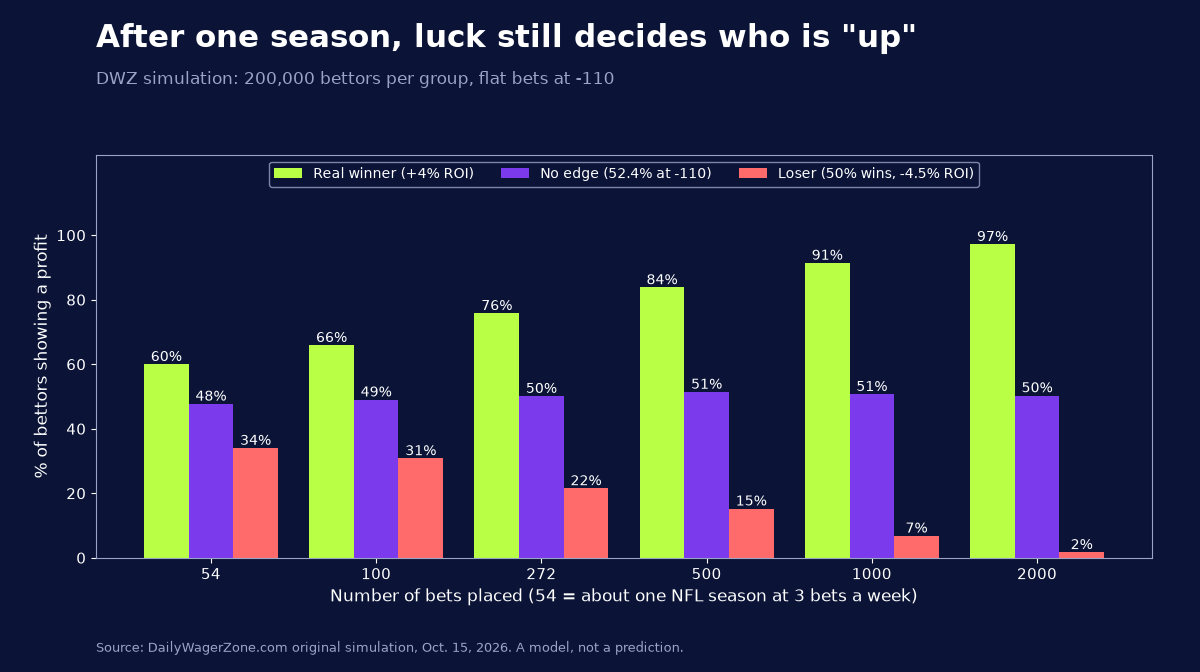
Three things stand out. After 54 bets, 6 in 10 real winners are ahead. But so are 1 in 3 bettors who lose money on every dollar. Only 8% of the real winners can prove it from their record. Even after 272 bets, only 16% can.
The no-edge bettor is ahead about half the time at every size. That is why a hot streak tells you so little.
We built a simple model. Bets are flat, independent and always at -110. Each bettor’s true win rate never changes. Real betting is messier, so use these numbers to understand the size of the luck problem, not to predict your own results.
Our take: if you bet three games a week, this season’s win-loss record cannot tell you whether you are good. CLV can start telling you sooner, as long as the close is a fair benchmark.
How Do You Calculate Closing Line Value?
Do not compare your price with the posted closing odds. The posted close still has the sportsbook’s cut inside it. Remove that cut first. Jake Hari at OddsShopper calls skipping this step the one most guides miss.
- Record your price when you bet.
- At the close, write down both sides of the market.
- Turn both closing prices into implied probabilities. They will add up to more than 100%. The extra is the sportsbook’s hold.
- Divide each probability by the total. That is the no-vig closing probability.
- Turn it back into a price and compare it with the price you got.
Here is a worked example with made-up prices. You bet Team B at +150. The market closes at Team A -160 and Team B +140.
| Step | Math | Result |
|---|---|---|
| Implied probability of Team A -160 | 160 / (160 + 100) | 61.5% |
| Implied probability of Team B +140 | 100 / (140 + 100) | 41.7% |
| Total (the hold) | 61.5% + 41.7% | 103.2% (hold of 3.2%) |
| No-vig probability for Team B | 41.7% / 103.2% | 40.4% |
| Fair closing price for Team B | Convert 40.4% back to odds | About +148 |
| Your price | +150 | 40.0% implied |
| Your edge against the close | 0.404 x 2.50 – 1 | About +0.9% |
You got +150 on a number that fairly closed near +148. That is a small positive CLV, about 0.9% of your stake. It is not much on one bet. It adds up over hundreds of bets.
Which close should you use? OddsShopper’s answer is the sharpest market you can see, not the book where you bet. Soft books move late and loosely, so grading yourself against your own book is half circular.
What Is a Half Point Worth on an NFL Spread?
In points, every half point looks the same. In probability, it does not. NFL games land on some margins far more often than others. We explain why in our guide to NFL key numbers.
Cleanup Hitter’s data on regular-season games from 2000 to 2026 shows a 3-point margin in 14.99% of games and a 7-point margin in 9.09%. Action Network’s key-number table, which starts in 2003, lists 7.25% for a 6-point margin. The date ranges differ, so treat the figures as close estimates.
We used those shares to estimate what a half point is worth. We assumed the closing number is fair and that games land above and below it equally. Also, we then asked what a -110 bet is worth if you got a half point better than that number. For example, you laid -2.5 and the fair close is -3. Your bet still wins if the favorite wins by 3. At -3, that result would be a push.
| Closing number | Share of games that land on it | Expected profit per -110 bet that beats the close by a half point across it |
|---|---|---|
| 3 | 14.99% | About +9.8% |
| 7 | 9.09% | About +4.1% |
| 6 | 7.25% | About +2.4% |
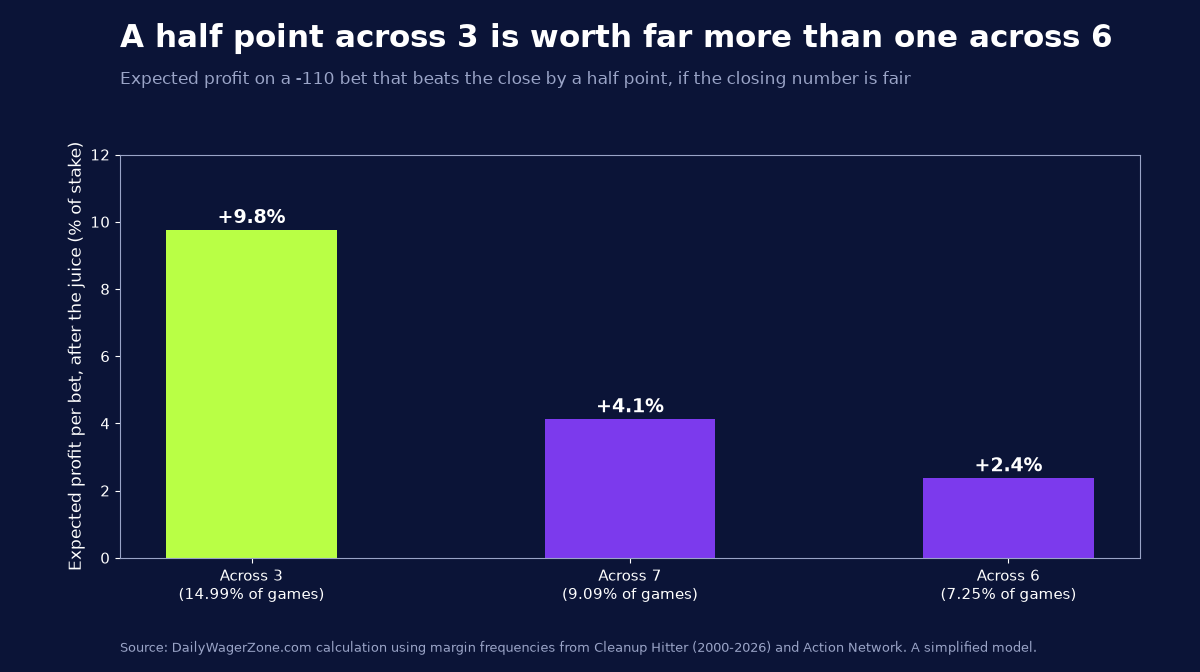
These figures are net of the juice. A -110 bet at a fair number loses roughly 4% to 4.5% over time. Beating the close by a half point across 3 turns that into about +9.8%. Across 6, it only turns it into about +2.4%.
This is our simplified math, not a price any sportsbook offers. Real markets also move the price (the juice) when a line crosses a key number. Check both the number and the price.
Our take: this is why an NFL spread that moves from -2.5 to -3 matters more than one that moves from -5.5 to -6. Keep it in mind when you read our guide to NFL betting strategies and think about line shopping.
What Is Line Shopping and How Does It Help You Beat the Close?
Line shopping means checking the same bet at more than one sportsbook and placing it where the number or the price is best. Each book sets its own odds, so one game can sit at -3 at one book and -3.5 at another.
Why does that matter for CLV? The close is the market’s final estimate. If you start with the best number you can find, you start closer to that estimate, or past it. Pikkit makes the same link: taking the best available number when you bet is one of the main ways bettors build positive CLV.
There are two things to shop. The number is the spread or total, like -3 or -3.5. The price is the juice next to it, like -105 or -115. OddsShopper gives a simple case: two books post the same total at 47.5, but one charges -110 on the over and the other -105. Same bet, and one is cheaper. Our spreads and totals guide has the break-even rates: -105 needs 51.2%, -110 needs 52.4%, -115 needs 53.5% and -120 needs 54.5%.
How Many Sportsbooks Should You Compare?
More than one. After that, the sources agree on the idea but not on a magic number. OddsShopper says three to five accounts at the major licensed books in your state capture most of the price spread, and that past that you chase small gains while the admin grows faster than the edge. It also says to compare at least three books before every bet. Pikkit says there is no fixed number, but you need at least a few funded accounts to have real prices to compare. Both guides are written for licensed U.S. sportsbooks.
Our take: start with two or three books you trust to pay out. Each extra account splits your bankroll and adds logins, deposits and withdrawals. Pikkit warns that chasing a one-cent edge at a book you cannot trust or reach can cost you more than it saves. Scale matters too. OddsShopper says a heavily bet NFL side usually sits within a nickel or a dime across books, while props and side markets run wider. So on NFL sides, the nickel and the half point are the gaps worth pricing.
What Is a Half Point Worth Compared With a 5-Cent Price Difference?
Start with the price. At -110 you risk $110 to win $100, so you must win 52.4% of your bets to break even. At -105 you risk $105 to win $100, so you must win 51.2%. Each 5 cents of juice moves the bar by about one point.
In money terms, a bettor who wins exactly half of their bets loses 4.55 cents per dollar risked at -110 and 2.38 cents at -105. So a 5-cent better price is worth about 2 cents per dollar, and a 10-cent better price (-115 to -105) about 4 cents. Take a 54-bet season, the size we used earlier, at $100 a bet and 27 wins. At -110 that season loses about $245. At -105 it loses about $129. Same picks, about $117 saved. Pikkit estimates that always taking the best price is worth roughly 0.5% to 2% of added return over a large sample. That is a vendor estimate we could not verify. Our 5-cent math lands near the top of that range, which fits a bettor who gets the better nickel on every bet. Most will not.
A half point can be worth more, but only at the right number. We used the margin shares from the half-point table above and asked what a half point adds when it turns a push into a win on a -110 bet. The math is the share of games that land on the number times the $0.91 you win per $1 risked. Across 3 it adds about 13.6 cents per dollar (14.99% x 0.909). Across 7 it adds about 8.3 cents (9.09% x 0.909). Across 6 it adds about 6.6 cents (7.25% x 0.909). The +9.8% in the earlier table is the whole bet’s expected profit. The half point’s own gain is larger because a -110 bet at a whole 3 loses about 3.9% on its own.
What if the better number costs more juice? We priced one trade at each key number. Book A offers the half point better at -115. Book B offers the whole number at -105.
| Key number | Book A: half point better, -115 | Book B: whole number, -105 | Better deal |
|---|---|---|---|
| 3 | -2.5 at -115: about +7.5% | -3 at -105: about -2.0% | Book A, by about 9.5 points |
| 7 | -6.5 at -115: about +2.0% | -7 at -105: about -2.2% | Book A, by about 4.1 points |
| 6 | -5.5 at -115: about +0.3% | -6 at -105: about -2.2% | Book A, by about 2.5 points |
Figures are expected profit per dollar risked in our simplified model. It assumes the whole number is the fair close and that games land above and below it equally. The prices are examples, not live odds.
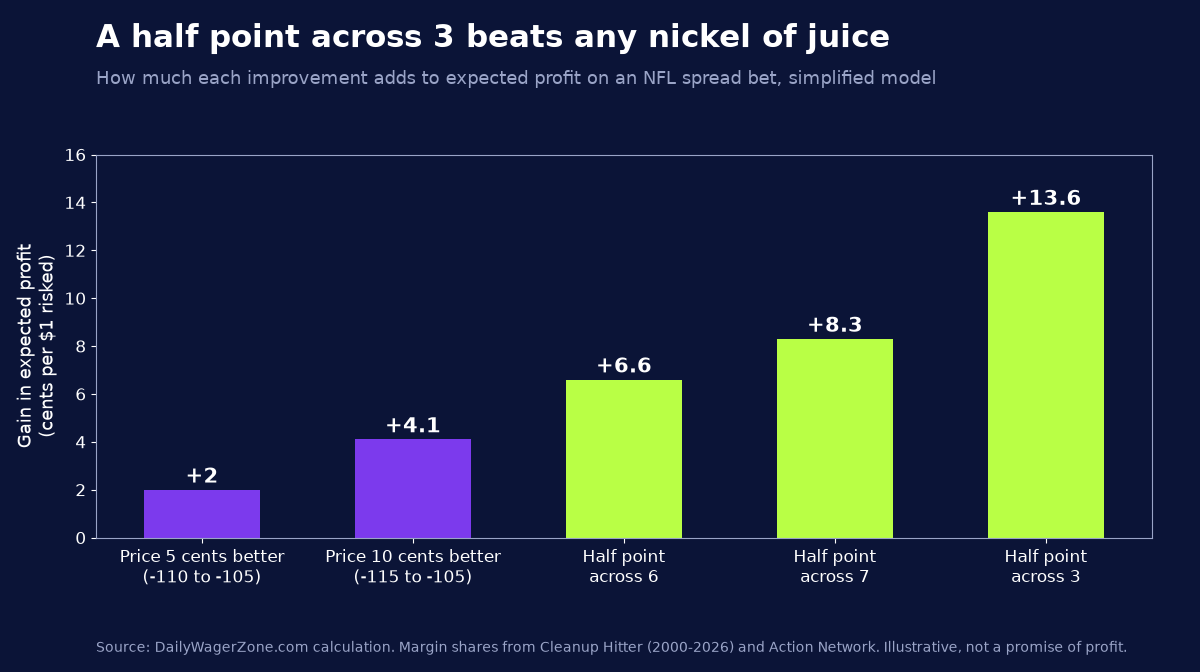
Our take: in this model, a dime of extra juice is a good trade for a half point across 3 or 7, and a thinner one across 6. Away from those numbers we did not price the half point, but it is worth less, so the price often decides. Real books also change the price when a line sits on 3, so check both.
When Can Closing Line Value Fool You?
- Thin markets. OddsShopper calls it artificial CLV. A big tout posts a bet on an obscure prop, followers pile in, and the line moves. The line moved because of the followers, not because the bet was good.
- Betting very early. Earlier bets give more chances to beat the close. They also give injuries, weather and news more time to change the game. OddsShopper says to size for that.
- Small samples. OddsShopper says to judge CLV over 100 or more bets, not last night.
- Treating CLV as a profit guarantee. Buchdahl reports that over nearly 20,000 bets in his own betting system, actual profit was 3.4% against 4.0% expected from CLV. That is close. It took a very large sample to get there.
- Getting limited. OddsShopper warns that books limit bettors who consistently beat the close.
How Can You Track CLV If You Bet at Offshore Sportsbooks?
Start small. You do not need software. You need a habit and a spreadsheet.
- Screenshot every bet slip. Save the team, line, price and time.
- Record the closing line just before kickoff from the best source you can see. Write down which source you used. Some odds sites publish closing lines. We have not tested any of them for this guide.
- De-vig the close. Use the five steps above.
- Log it. Keep one row per bet: your price, the no-vig close and the difference.
- Review after 100 bets. Do not change anything after ten.
- Shop before you bet. If you hold accounts at more than one book, such as BetOnline and Bovada, compare the number and the price first. It is the easiest way to start with better prices. We have not tested their closing lines against sharper books.
- Set a budget first. CLV does not protect your bankroll. Only bet money you can afford to lose.
What Is a Simple Line-Shopping Routine?
Fold shopping into the log you already keep for CLV. OddsShopper suggests tracking three prices on every bet: the one you took, the best one that was available, and where the line closed.
- Pick your books. Keep a funded balance at two or three, so you can act on the best number without moving money first.
- Shop right before you bet. Lines move on news and volume. Pikkit warns that a number you saw an hour ago may be gone.
- Compare the number first, then the price. A half point across 3 or 7 beats a nickel of juice. Away from key numbers, the price matters more.
- Log three prices per bet. Write down the price you took, the best price you saw and the no-vig close from the five steps above.
- Review after 100 bets. If you keep finding a better number after you bet, your log shows which book you are missing. OddsShopper says the same.
- Size bets from a fixed bankroll. Better prices do not protect your money. See our bankroll management guide for unit sizes.
Offshore sportsbooks are not licensed by U.S. state regulators. Read each book’s terms, payout rules and limits before you deposit, and never bet money you cannot afford to lose.
Where Should You Go Next?
| If you want to… | Read this |
|---|---|
| Learn spreads, totals and break-even prices | NFL point spreads and over/unders, explained |
| See why books post different numbers | Power ratings, openers and why books differ |
| Read line moves | When a line moves against the money |
| Learn 3 and 7 | Key numbers 3, 7, 6 and 10 |
| Build a plan | Line shopping and betting strategy |
| Size your bets | Bankroll rules |
Editor’s Note: The simulation and the half-point table are our own illustrations built from the assumptions we state above. The worked example and the sample prices in the line-shopping table use made-up numbers, and that table comes from the same simplified model. The handwritten lines on the featured image are for illustration and are not real odds. We did not place bets or test any sportsbook’s closing lines or any CLV or line-shopping tool. Real lines change by the minute, so check live prices before you bet.
Must be 21+ to bet. Sports betting is not legal in every state. Gambling problem? Call 1-800-GAMBLER (1-800-426-2537) for free, confidential help.
References
- Pinnacle. “What Is Closing Line Value (CLV) in Sports Betting?” Pinnacle Betting Resources. September 15, 2025. Checked October 15, 2026.
- Joseph Buchdahl. “Closing Line Value (CLV) demystified by expert Joseph Buchdahl.” Pinnacle Odds Dropper. December 5, 2024. Checked October 15, 2026.
- Jake Hari. “Closing Line Value (CLV) Explained: Beat the Close.” OddsShopper. June 5, 2026. Checked October 15, 2026.
- Cleanup Hitter. “Frequency of NFL regular-season scores, 2000-2026.” Checked October 15, 2026.
- Action Network. “Key Numbers in NFL Betting, Explained.” Checked October 15, 2026.
- Sam Smith. “Do Different Sportsbooks Have Different Odds On The Same Game?” OddsShopper. August 7, 2026. Checked October 15, 2026.
- Ryan Bornemann. “Line Shopping in Sports Betting: The Strategy Guide to Getting the Best Price.” Pikkit. July 14, 2026. Checked October 15, 2026.