
Horse racing betting means picking a horse you think will finish in a certain position — first, second, or third — and wagering money on it. If you’re right, you get paid based on the odds. This guide walks you through every step, from the simplest bets to reading a race card, so you can place your first wager with confidence.
Key Takeaways
- Win, place, and show are the three starter bets — pick a horse to finish first, top two, or top three.
- Horse racing odds tell you what you’ll get paid; higher odds mean a bigger payout but a lower chance of winning.
- A race card (also called a program) gives you every detail about each horse — learn to read it and you’re already ahead of most beginners.
- You can bet on horse races online through offshore sportsbooks that serve US players, like Bovada, MyBookie, BetOnline, and BetUS.
- Start small. A $2 bet is enough to learn the ropes without risking real money you can’t afford to lose.
What Does It Mean to Bet on Horse Racing?
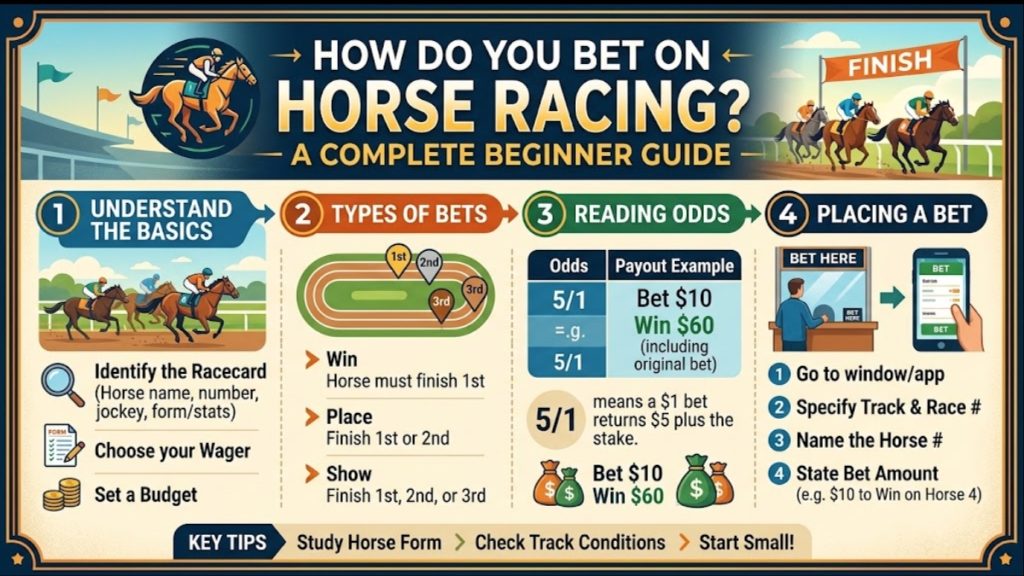
Betting on horse racing is straightforward: you pick a horse, choose how you think it will finish, put up some money, and collect a payout if you’re right.
Most horse racing bets work on a pari-mutuel system. That’s a fancy term for “pool betting.” Every dollar wagered on a race goes into one big pot. The track takes a cut (called the takeout — usually 15% to 25%), and the rest gets split among the winners. The more people bet on one horse, the lower that horse’s payout will be.
Some offshore sportsbooks offer fixed odds instead. Fixed odds mean the payout you see when you place your bet is the payout you get — the number won’t change after the race starts. Check whether your book uses pari-mutuel or fixed odds before betting, because it affects what you’ll actually win.
What Are the Three Horse Bets Every Beginner Should Learn?
These are the simplest wagers in horse racing. Start here.
1. Win
You bet on a horse to finish first. If it wins the race, you get paid. If it finishes anywhere else, you lose your bet.
2. Place
You bet on a horse to finish first or second. The payout is smaller than a win bet because you have two chances to cash in instead of one.
3. Show
You bet on a horse to finish first, second, or third. This is the safest straight bet, but the payout is the smallest.
4. Across the Board
An “across the board” bet puts equal money on the same horse to win, place, and show. It’s three separate bets rolled into one ticket.
Example: A $2 across-the-board bet costs $6 total ($2 win + $2 place + $2 show). If your horse wins the race, you collect all three payouts. If it comes in second, you collect the place and show payouts but lose the win bet. Third place? Just the show payout.
What Are the Different Horse Racing Bet Types?
Once you’re comfortable with win, place, and show, you can try exotic bets. These are harder to hit but pay more.
Boxing Your Bet
Don’t think you can nail the exact finishing order? You can box an exacta, trifecta, or superfecta. Boxing means your horses can finish in any order. The trade-off: it costs more because you’re covering every possible combination.
Example: A $2 exacta box with horses #3 and #7 costs $4 (two combinations: 3-7 or 7-3). A $2 trifecta box with three horses costs $12 (six combinations).
How Horse Racing Odds and Payouts Work
Horse racing odds are usually shown as fractional numbers like 5/1, 3/2, or 7/5. Here’s what fractional odds mean:
- 5/1 (five-to-one): For every $1 you bet, you win $5. A $2 bet pays $12 total — $10 profit plus your $2 stake back.
- 3/2 (three-to-two): For every $2 you bet, you win $3. A $2 bet pays $5 total.
- 2/5 (two-to-five): For every $5 you bet, you win $2. This horse is a heavy favorite.
The lower the odds, the more likely that horse is expected to win — and the less you’ll get paid. High odds mean the crowd thinks that horse is less likely to win, so the payout is bigger.
Morning Line vs. Live Odds
The morning line is an estimate of each horse’s odds set by the track handicapper before betting opens. It’s a starting guess, not a guarantee.
Once bettors start placing money, the odds shift. A horse getting a lot of action will see its odds drop. The final odds at post time (when the gate opens) are what determine pari-mutuel payouts.
Quick payout table for a $2 win bet.
How to Read a Horse Racing Form
A race card (or program) is a one-page cheat sheet for every race. It tells you everything about the horses, the track, and the conditions. Here’s what to look for:
- Race number and post time: Which race and when it starts.
- Distance and surface: How far the horses run and on what (dirt, turf, or synthetic). Some horses perform better on one surface than another.
- Class: Races are grouped by quality. A horse stepping up from a lower class to a higher one faces tougher competition. A horse dropping down may have an edge.
- Post position (PP): The starting gate slot. Inside posts (lower numbers) mean a shorter trip on turns, but outside posts sometimes avoid traffic jams.
- Recent finishes: A string of numbers like “2-1-4-3” shows where the horse finished in its last few races. Lower numbers are better.
- Speed figures: A single number that rates a horse’s past performance. Higher is faster. Compare speed figures across horses in the same race.
- Jockey and trainer: Some jockeys and trainers win more often than others. Their win percentages are usually listed.
- Morning line odds: The handicapper’s pre-race estimate of each horse’s chances.
How Do You Pick a Horse to Bet On?
You don’t need to be an expert handicapper. Use this quick checklist:
- Check recent form. Look at the last three to five races. Has this horse been finishing in the top three or trending upward?
- Compare speed figures. Which horses have posted the fastest recent numbers?
- Look at surface and distance. Is this horse proven at today’s distance on today’s surface?
- Check the jockey. A high win-rate jockey on a capable horse is a solid starting point.
- Compare odds to your read. If you think a 10/1 horse has a real shot, that’s value. If the 2/1 favorite looks shaky, you might skip the race.
When in doubt, pass. You don’t have to bet every race. Skipping unclear races is one of the smartest things a beginner can do.
How to Bet on Horse Racing Online From the US
Offshore sportsbooks that serve US players often carry horse racing markets alongside their sports betting menus. Here’s the general process:
- Create an account at a book that offers horse racing. You’ll need a valid email and basic personal info.
- Fund your account. Most offshore books accept credit/debit cards, Bitcoin, and other crypto. Check the minimum deposit — it’s usually $20 to $50.
- Find the horse racing section. It’s usually listed under “Racebook” or “Horses” in the main menu.
- Pick a race and a bet. Select the track, the race number, your bet type (win, place, show, exacta, etc.), the horse number, and your stake.
- Confirm and wait. Your bet goes in before the race starts. After the race, your account is credited automatically if you win.
- Withdraw your winnings. Most books pay out via crypto, check, or bank wire. Crypto is usually fastest — often within 24 to 48 hours.
Important: Rules, odds formats, available tracks, and bet types vary between books. Always check the sportsbook’s terms and your local laws before placing a bet. DWZ does not provide legal advice.
If you’re looking for a sportsbook to get started, compare the best horse betting sites in the US to review available horse racing markets, betting options, and terms.
Where to Bet Horse Racing Online
These are the four offshore sportsbooks DWZ covers that offer horse racing markets for US players:
Verify current availability, tracks, and terms directly on each sportsbook’s site before betting. Markets and features can change without notice.
How Much Should a Beginner Bet on Horse Racing?
Start small. Seriously.
A $2 win bet is the standard minimum at most tracks and many online books. There’s no reason to bet $50 or $100 while you’re still learning how odds work and how to read a form.
Beginner bankroll plan (example — not a prediction):
- Set a daily limit you can afford to lose. For many beginners, that’s $10 to $20.
- Bet flat stakes — the same amount on every wager. Don’t double up after a loss.
- Stick to win, place, or show bets until you’re confident reading forms and comparing odds.
- Never chase losses. If you hit your limit, stop. Tomorrow is another race card.
Horse racing is entertainment first. The house edge (takeout) means most bettors lose over time. Bet what you can lose, enjoy the races, and treat any winnings as a bonus.
What Are the Most Common Horse Racing Betting Mistakes?
- Betting every race. Quality over quantity. Wait for races where you see a clear edge.
- Confusing morning line with final odds. The morning line is a guess. Final odds at post time set your payout.
- Ignoring scratches. A scratched horse changes the entire race. Always check for late scratches before the gate opens.
- Jumping into exotic bets too soon. Exactas and trifectas look exciting, but they’re hard to hit. Master the basics first.
- Chasing losses. Doubling your bet to win back what you lost almost always makes things worse.
What Do Common Horse Racing Betting Terms Mean?
Understanding common horse racing betting terms makes it easier to read a race card, compare odds, and place a wager correctly. Win means betting a horse to finish first, while place means the horse must finish first or second, and show means it must finish in the top three. Odds indicate the potential payout and the market’s view of a horse’s chances. The morning line is the track’s estimated opening odds, while final odds are set by the betting market at post time in pari-mutuel racing.
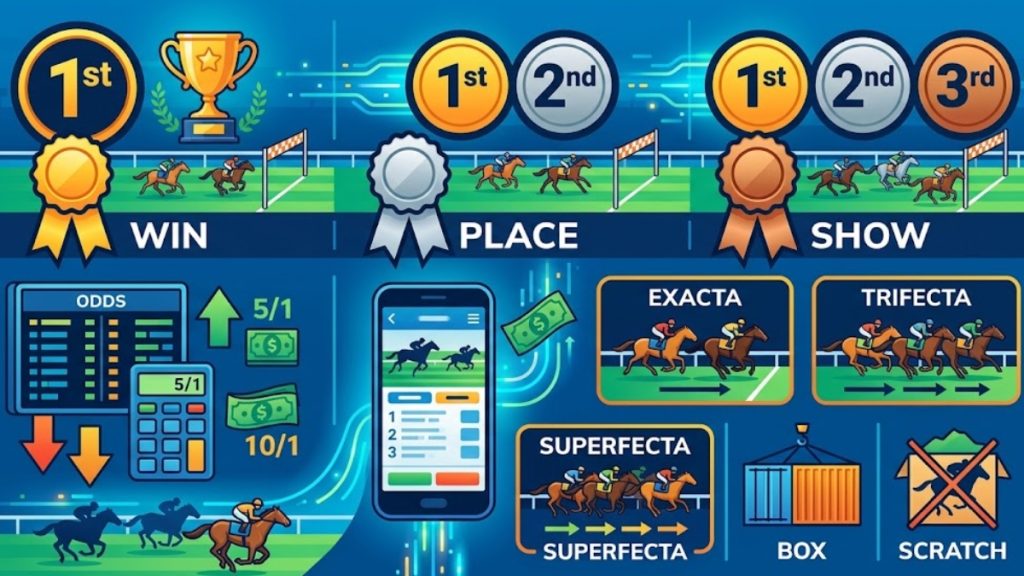
Other terms you may encounter include exacta, which requires picking the first two finishers in order, trifecta, which requires selecting the first three in exact order, and superfecta, which involves predicting the first four. A box allows your selected horses to finish in any order, while a scratch means a horse has been withdrawn from the race. Knowing these terms can help beginners understand their betting options before placing a wager.
References
- Churchill Downs. “A Complete Guide On How to Bet on Horses for Beginners.”
- Canterbury Park. “How To Bet On Horse Racing: Guide To Odds & Wagering Tips.”
- DraftKings Horse Racing. “How to Bet on Horse Racing & Read Racing Odds.”.
- National Thoroughbred Racing Association. “NTRA Wagering.”
Related Reading
- Browse All Gambling Guides
- Offshore Sportsbooks That Accept Players from Texas
- How the MLB Wild Card Works — Baseball’s Expanded Playoffs Explained
- What Do NFL Betting Odds Mean and How Do You Read Them?
More in Gambling Guides