How crypto deposits and withdrawals work at offshore sportsbooks and casinos: a coin and network picker, fee layers, wallet safety and a careful look at where taxes show up.
Home » Crypto Betting and Casino Payments Guide (2026)
Crypto betting means funding a sportsbook or casino account with coins like Bitcoin instead of a card, and the coin and network you choose can change what you pay, how fast you get paid and how much you can cash out at once. This guide shows how the money moves, how to pick a coin, what each fee layer costs, how deposits differ from withdrawals, how to protect your wallet and where taxes show up. Every figure comes from a brand help page, the IRS or Bitcoin.org. DailyWagerZone did not test a deposit or withdrawal for this page.
By Jake Mercer, Lead Sports Betting Analyst. Last updated: October 15, 2026.
The Quick Version
Pick the coin by payout speed and cap. Bovada says Bitcoin payouts take up to 24 hours once approved, while Litecoin, Ethereum, Bitcoin Cash and Tether take up to 1 hour. Bovada also caps Bitcoin at $9,500 a request, and BetOnline lists no limit on Bitcoin.
The sportsbook’s own crypto fee can be zero. Bovada charges nothing on crypto deposits or withdrawals. BetOnline says crypto deposits skip deposit fees. Your exchange and wallet still charge, and BetOnline can pass network fees on some withdrawals.
Match the network. BetOnline warns that some coins run on several networks and says to confirm the network shown on the deposit screen to avoid losing funds.
Crypto sends cannot be undone. Bitcoin.org says confirmed transactions can only be refunded by the person who received them.
Winnings are reportable even without a form. The IRS pages we read do not say how a sportsbook deposit is treated. Ask a tax professional. This is not tax advice.
Our take: choose the coin that fits your payout size, copy the address fresh each time and keep only what you plan to bet at any offshore book.
Trust & Authority
Item
Details
Sources
Bovada and BetOnline help pages; Bitcoin.org FAQ; IRS Topic No. 419, IRS digital assets page, IRS Form 1099-DA page, IRS Instructions for Forms W-2G and IRS Bulletin 2026-19; FBI Internet Crime Complaint Center (Dec. 17, 2025); Michigan Gaming Control Board (Oct. 8, 2026). All opened Oct. 15, 2026.
Original analysis
A four-question coin picker, a fee table with our percentage arithmetic, a deposit-versus-withdrawal comparison and a payout-cap chart. No deposit or withdrawal was tested.
Author
Jake Mercer, Lead Sports Betting Analyst, Daily Wager Zone
Disclosure
This page links to BetOnline and Bovada through affiliate links. DWZ may earn a commission at no cost to you. Affiliate status did not change any figure on this page. Offshore sportsbooks are not licensed by U.S. states.
What is crypto betting, and how does the money move?
You copy a deposit address from the cashier, send coins from your wallet, and the book credits your balance in dollars. A wallet is the app that holds your coins and sends them. An address is the long string of letters and numbers that works like a mailbox for coins. A network is the blockchain a coin travels on. BetOnline says its site uses U.S. dollars as its fixed base currency, and Bovada says funds change to dollars the moment they arrive from your wallet.
Here is the deposit flow BetOnline publishes:
Open the cashier and pick your coin.
Enter the amount, and add a bonus code at this step if you have one.
Copy the one-time wallet address. BetOnline says it stays good for 15 minutes and works once.
Open your wallet, paste the address, and check the network and fee before you send.
Tell the cashier you finished. BetOnline says funds usually appear within 15 minutes of the required confirmation.
Casino play uses the same cashier. BetOnline’s own Bitcoin page says it takes Bitcoin for sports, casino games and poker. The cashier is the same for every game. Bonus rules are not. BetOnline says a deposit bonus must be requested when you deposit, so read the current bonus terms first. Sources: BetOnline Help Center and BetOnline deposit rules (both June 2026), Bovada Help Center.
There is no single best coin. Bovada publishes a side-by-side comparison, and BetOnline publishes its payout limits by coin. Here they are in one table.
Coin
Bovada payout speed once approved
Bovada wallet and exchange fee rating
Bovada largest payout per request
BetOnline largest payout, per transaction and per week
Bovada minimum deposit
Bitcoin (BTC)
Up to 24 hours
$$$
$9,500
No limit
0.0001 BTC
Litecoin (LTC)
Up to 1 hour
$
$9,500
$50,000
0.01 LTC
Ethereum (ETH)
Up to 1 hour
$$
$2,500
No limit
0.002 ETH
Tether (USDT)
Up to 1 hour
$$$$
$2,500
No limit
5 USDT
Bitcoin Cash (BCH)
Up to 1 hour
$
$2,500
$10,000
0.001 BCH
The dollar signs are Bovada’s own rating of wallet and exchange fees. They are not dollar amounts. Bovada also says Bitcoin Cash, Bitcoin SV and Litecoin usually cost less to move than Bitcoin or Tether. Its speed row starts the clock after approval, and its footnote says withdrawals are usually confirmed within 15 minutes unless the network is congested. Sources: Bovada withdrawal limits, Bovada coin comparison and BetOnline withdrawal table, checked Oct. 15, 2026.
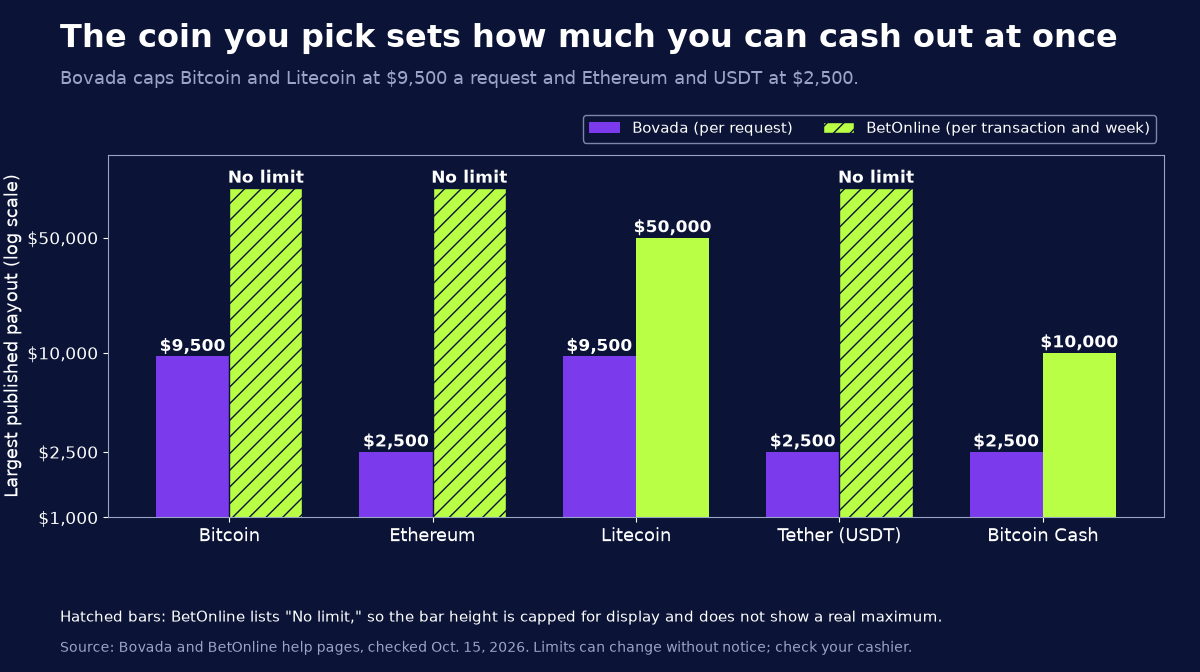
Hatched bars show BetOnline lists no limit; bar height is capped for display. Source: Bovada and BetOnline help pages, checked Oct. 15, 2026.
The chart shows why the coin matters beyond speed. Use Bitcoin at Bovada and one request tops out at $9,500. Use Litecoin and it still tops out at $9,500, but Bovada’s weekly cap is $180,000 for Litecoin and $90,000 for Bitcoin. The chart does not show weekly caps.
A four-question coin picker
This framework is ours. It turns the published numbers into a short decision path.
Ask yourself
If the answer is yes
Why
Do I need the money out fast?
Lean toward a coin the book lists at up to 1 hour after approval, such as Litecoin or Ethereum at Bovada.
Bovada lists up to 24 hours for Bitcoin and up to 1 hour for the others. Approval still comes first, so see our offshore payout speed comparison.
Might I cash out a big win in one request?
Check the cap for your coin before you deposit.
Bovada caps Bitcoin at $9,500 and Ethereum at $2,500 a request. BetOnline lists no limit for Bitcoin and Ethereum.
Does a price swing worry me?
Consider a coin built to track the dollar, such as Tether, for the minutes your money is in transit.
Both books hold your balance in dollars. Your price risk sits before you deposit and after you withdraw. Bitcoin.org says Bitcoin’s price can move sharply on small events.
Does my coin run on more than one network?
Match the network in your wallet to the one the cashier shows.
BetOnline says some coins run on several networks and to confirm the network under the amount field. Tether lists many networks for USDT on its own page.
Our take: a faster coin helps only after the book approves your request. Pick for the cap and the network first, then speed.
What does crypto really cost? The four fee layers
Four different parties can charge you. Only two of them are the sportsbook.
Layer
Who charges it
What the published pages say
1. Buying coins
Your exchange
Bovada says exchanges charge a commission that may be added to the price or hidden in the exchange rate. It says that is usually under $1.00, and higher when the network is congested.
2. Sending coins
The network, set in your wallet
Bitcoin.org says the fee is not tied to the amount sent and that a higher fee can speed confirmation. BetOnline says it cannot guarantee timely deposits sent with low fees.
3. Book deposit fee
The book
Bovada charges none on any crypto. BetOnline says crypto deposits skip deposit fees. BetOnline card deposits carry fees shown at checkout that depend on amount, card type and VIP level.
4. Book withdrawal fee
The book
Bovada charges none. BetOnline lists Bitcoin as free. It also says some customer-controlled addresses pay network fees debited from your balance, and its table lists $1.50 to $25 for other coins, by amount.
Layer 2 is where small bettors lose the most, because a flat fee takes a bigger bite out of a small deposit. Here is our arithmetic, using a hypothetical $2 network fee. The $2 is an assumption for the math, not a quote from any book or wallet.
Deposit
$2 fee as a share of the deposit
$20
10%
$50
4%
$200
1%
$1,000
0.2%
Check the fee your wallet shows before you send. If you deposit often, fewer and larger deposits dilute a flat fee. Do not size a deposit around a fee if it pushes you to bet more than you planned.
How fast are crypto deposits and withdrawals?
Deposits are mostly a network clock. BetOnline says deposits usually post within 15 minutes of the required confirmation, and it lists one to six confirmations for Bitcoin. Bovada says deposits post on zero confirmations, though a low fee can delay them. If a Bovada deposit has not posted after one confirmation, Bovada says it needs at least six because of congestion.
Withdrawals add the book’s own queue before the network clock starts. BetOnline publishes one window: within 24 hours. Bovada publishes about 24 hours to approve a request, then the coin windows in the table above. Bovada also says Bitcoin withdrawals are not processed until your deposit transactions have confirmed, and that it allows one crypto withdrawal every 15 minutes.
How are crypto deposits different from withdrawals?
The two directions look alike in your wallet but follow different rules. This table compares them using the same published pages.
Topic
Deposit
Withdrawal
Who sets the pace
You and the network
The book’s approval queue first, then the network
Address
A one-time address from the cashier. BetOnline says it lasts 15 minutes.
Your own wallet address, pasted into the cashier. BetOnline says to review recipient, amount and fees before you submit.
Limits at Bovada
Bitcoin: 0.0001 BTC minimum, $5,000 maximum per transaction.
Bitcoin: $75 minimum, $9,500 per request, $90,000 per week.
Limits at BetOnline
Minimums and maximums vary by method; the cashier shows yours.
Bitcoin: $20 minimum, no limit listed.
Verification
BetOnline reserves the right to ask for ID, address proof and card copies.
Bovada says it needs a card verification form for each card used to fund the account, even for Bitcoin payouts.
Wagering rule
Bovada says all deposits must be fully wagered before winnings can be withdrawn.
Bovada says missing that rule can get a withdrawal canceled.
Can it be reversed?
No. Bitcoin.org says only the recipient can refund a confirmed transaction.
No, for the same reason.
How do you protect your wallet and your balance?
Check the whole address. Bitcoin.org says to verify the entire receiving address, not just the first and last characters, and to consider a small test transaction before a large transfer.
Use the address the cashier gives you now. BetOnline says each address is single-use and expires after 15 minutes.
Match coin and network. BetOnline says to confirm the network, and Tether lists many networks for USDT on its own page.
Back up your wallet. Bitcoin.org says wallet files with your keys can be deleted, lost or stolen, and calls user error Bitcoin’s most common vulnerability.
Ignore anyone offering wallet details. Bovada says its representatives and VIP hosts never provide wallet addresses or payment destinations.
Keep a small balance at the book. Offshore books can freeze or void balances under their own terms. This one is our rule, not a published figure.
Our take: most crypto losses come from a typed address, a wrong network or a message from someone pretending to be support. All three are avoidable with ten extra seconds.
What should crypto bettors know about taxes? (This is not tax advice)
This section is education, not tax, legal or financial advice. Tax rules differ by person. Talk to a qualified tax professional about your own return.
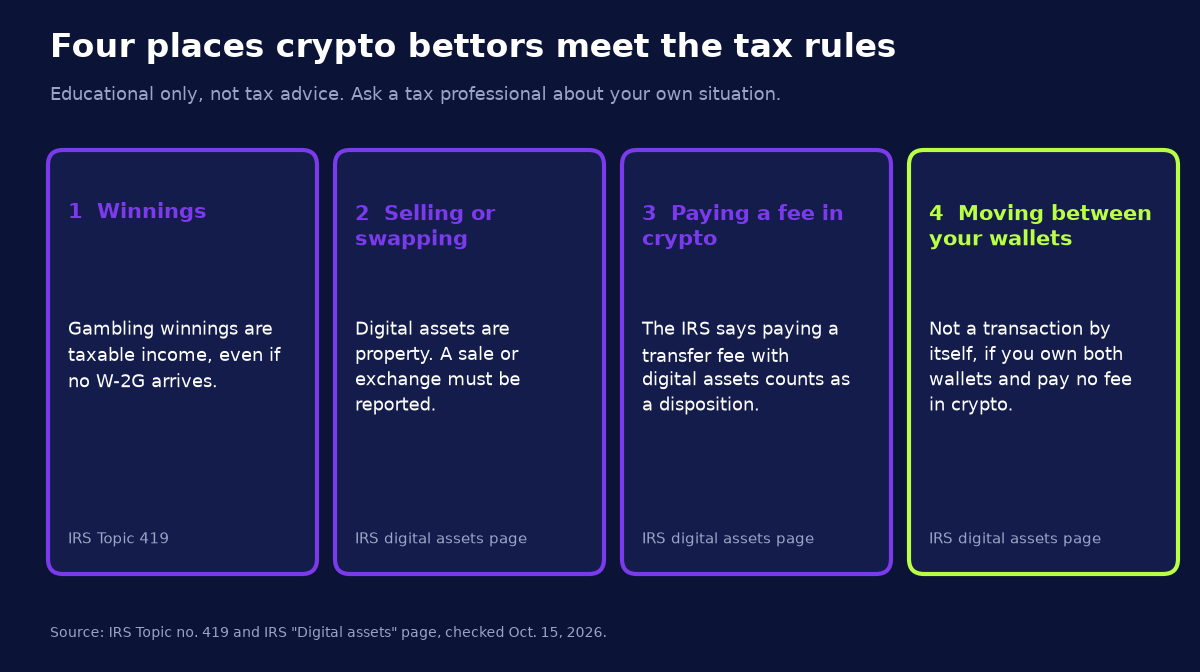
Educational only, not tax advice. Source: IRS Topic No. 419 and IRS Digital assets page, checked Oct. 15, 2026.
Where taxes can show up
What the IRS pages we read say
Winnings
IRS Topic No. 419 says gambling winnings are fully taxable and you must report them on your return, including winnings not reported on a Form W-2G. A form may or may not arrive. Your duty does not depend on one.
Losses
Topic 419 says you can deduct losses only if you itemize and keep a record, and not more than your winnings. The One Big Beautiful Bill Act (OBBBA), section 70114(a), limits the deduction to 90 percent of wagering losses. IRS proposed rules in Bulletin 2026-19 would apply that to tax years beginning after Dec. 31, 2025.
Selling or swapping coins
The IRS treats digital assets as property. It says to check Yes on the digital assets question if you disposed of coins for dollars, for another digital asset or for goods and services.
Moving coins between your own wallets
The IRS says this alone is not a transaction, unless you paid the transaction fee with digital assets.
Exchange forms
Brokers report gross proceeds on Form 1099-DA. For 2025 the rule generally applies to U.S. brokers, and the IRS says you must report taxable transactions whether or not you get the form.
The IRS pages we read do not say how to treat coins you send to a sportsbook. We found no direct answer, so treat that as an open question for your tax professional. Do not rely on any website, including ours, that states it flatly.
IRS Topic 419 says to keep an accurate diary or similar record, with receipts, statements or tickets showing wins and losses. The IRS also says you must calculate basis, meaning what you paid, before you file. A simple log helps: date, coin, amount, dollar value at the time, what you paid for it, the book and the result. For payer forms, the IRS Instructions for Forms W-2G say the minimum threshold for reporting certain payments, including on Form W-2G, is $2,000 for payments made in 2026.
Does crypto change the risk of betting offshore?
It adds one risk and removes none. The FBI’s Internet Crime Complaint Center said on December 17, 2025 that offshore sportsbooks “are not held to the same legal standards as U.S. licensed sportsbooks and may lack consumer protections.” The Michigan Gaming Control Board said on October 8, 2026 that it has “no recourse” for players if winnings are withheld or an account is closed on an unlicensed site. Add irreversible crypto sends, and you have no chargeback either. Our offshore risk guide covers the rest.
Bet only what you can afford to lose. You must be 21 or older. If gambling is causing problems, call 1-800-GAMBLER for free, confidential help.
What should you do before your first crypto deposit?
Confirm your state allows you to sign up. Bovada, for example, names 19 states and Washington, D.C. it blocks.
Finish any ID checks first, so a win is not stuck behind paperwork.
Pick the coin by cap and network, using the picker above.
Open the cashier and copy the fresh address and the network name.
Check the network and fee in your wallet. Send a small test first if the amount is large.
Keep a record of the date, coin, dollar value and book.
Set a deposit limit you can afford to lose, and stick to it.
Ready to compare cashiers? These are DWZ affiliate links, and DWZ may earn a commission at no cost to you: BetOnline and Bovada. Check each book’s current terms before you deposit.
Bovada Help Center, cryptocurrency pages: “What cryptocurrency is best for me?”, “What are the deposit limits?”, “What are the transaction fees?”, “When will my funds be available?” and “What is network congestion?” Checked Oct. 15, 2026.. https://www.bovada.lv/help/cryptocurrency-faq
FBI Internet Crime Complaint Center, Public Service Announcement PSA251217 (Dec. 17, 2025). Checked Oct. 15, 2026.. https://www.ic3.gov/PSA/2025/PSA251217
Jake Mercer is the Lead Sports Betting Analyst at Daily Wager Zone. He covers sports betting strategy, offshore sportsbook analysis and odds breakdowns across the NFL, NBA and MLB. His work focuses on line shopping, platform comparison and the practical side of betting offshore for U.S. players.
Written by
Jake Mercer
Jake Mercer is a sports betting analyst and odds writer with over six years of experience handicapping NFL, NBA, MLB, and college football markets. Based in Las Vegas, Jake has maintained active accounts across the major offshore sportsbooks — including Bovada, BetUS, MyBookie, and BetOnline — giving him firsthand platform experience that most betting writers simply don't have.
His work at DailyWagerZone focuses on offshore sportsbook reviews backed by real account screenshots, weekly picks analysis, and line movement breakdowns. Jake approaches sports betting as a discipline — tracking closing line value, market movement, and sharp action rather than chasing parlays or gut-feel picks.
Before joining DailyWagerZone, Jake covered odds analysis and betting market trends for several independent sports media outlets. He has been betting recreationally and professionally since 2018 and treats bankroll management and expected value as the foundation of every recommendation he publishes.
Jake can be found on Bluesky at @jakemercer-bets.bsky.social and Reddit at u/JakeMercer_DWZ.